Miigwech bizaagigizha -

- THANK YOU FOR BEING HERE


Mary Gissler — “Queen of the Wolves,” published in the West Virginia News, Dec. 21, 1907, described Mary Gissler, a Chippeway woman living alone in an isolated camp in Ontario, Canada, approximately halfway between International Falls, Minnesota, and Mine Centre, Ontario. St. Paul fur trader Daniel Rutledge, who knew of her, regarded her as fearless, while another man who encountered her camp expressed amazement at finding a woman living under such conditions in the northern wilderness. The location places her within the Rainy River–Seine River region, where the local population was Saulteaux (Chippeway). Gissler was therefore likely associated with the community now represented by Seine River First Nation, although the surviving newspaper account does not establish her band affiliation. Her story offers a rare contemporary glimpse of a native woman living independently on the Canadian frontier in 1907.
In 1900 the San Francisco Chronicle (CA) Jan. 23, on page 6 ran an article "RUNS A WOLF FARM" the Gissler's were "discovered" by a gold prospector, about twelve miles from Rainy Lake City.
Her story made it into several newspapers
The Daily Telegram (Clarksburg, W. Va.), Sept. 11, 1907
Grant County herald (Lancaster, Wis.), September 21, 1907
Saturday news (Watertown, S.D.), September 25, 1908
The Topeka state journal (Topeka, Kansas), December 7, 1899, (LAST EDITION)https://www.loc.gov/resource/sn82016014/1899-12-07/ed-1/?sp=7&q=frank+gissler+wolves&r=-0.071,0.626,0.427,0.206,0
The Daily Telegram (Clarksburg, W. Va.), Sept.11, 1907, p.6
Grant County Herald (Lancaster, Wis.), Sept. 21, 1907, p.7
The West Virginia news (Ronceverte, W. Va.) Dec 21, 1907
https://www.loc.gov/resource/sn85059663/1907-12-21/ed-1/?sp=14&q&r=-0.728,0.014,2.456,1.183,0
Saturday news (Watertown, S.D.), Sept. 25, 1908, p.9
The Saint Paul globe (St. Paul, Minn.), February 13, 1898

Princess Wah Nese Red Rock (1913–1988) — Ojibway-Totem / Nipissing. Daughter of Chief Paul Commanda of Canada's Ojibway-Totem tribe, Wah Nese Red Rock was a lyric soprano and actress who performed with the St. Louis Opera Company and San Francisco Light Opera Company. She sang at the 1945 inauguration of President Franklin D. Roosevelt and the 1949 inauguration of President Harry Truman. She was also appeared in the 1936 film Rose-Marie.

Trilingual plaque to Catherine Sutton or Nahnebahnwequay. Her father was Bunch Sunegoo, a member of the Eagle Clan of the Credit Mission Mississauga. She is a historic figure in the struggle for Indigenous rights, and her people’s grievances.
.

Pe-Ahm-E-Squeet (Floating Cloud) aka Bee Mayes / Bee M. Barry Pe-Ahm-E-Squeet was a member of the Chippewa tribe and a graduate of Haskell Institute. A talented singer, musician, lecturer, and performer, she studied music in Boston and appeared professionally in Chicago, St. Louis, New York, Washington, D.C., and Winnipeg. Contemporary accounts described her as a performer of Chippewa songs, legends, dances, and customs. The University of Oklahoma's Western History Collections identifies Pe-Ahm-E-Squeet with Bee Mayes/ Barry and has an archive on her. Burial: Norman, Oklahoma.

Wigemar Wasung, Eastman Johnson 1857 Grand Portage band of Lake Superior Chippewa
© St. Louis County Historical Society
"The stories of our ancestors are the roots of our strength."
Elder's wisdom


Ojibwe woman, Eastman Johnson, 1857, Grand Portage band.
©St. Louis County Historical Society

The King Turtles or "Me-che-kans" relay messages from the spirit world to the living world through the "Gee-sah-ke-we--ni-ne" of the medicine clan. https://newspapers.mnhs.org/jsp/PsImageViewer.jsp?doc_id=9f9cced7-0e56-4398-87d3-1f1ab339d023%2Fmnhi0031%2FXETFTD5A%2F02020101
"What we do now will echo in eternity; choose wisely."
Elder"s wisdom
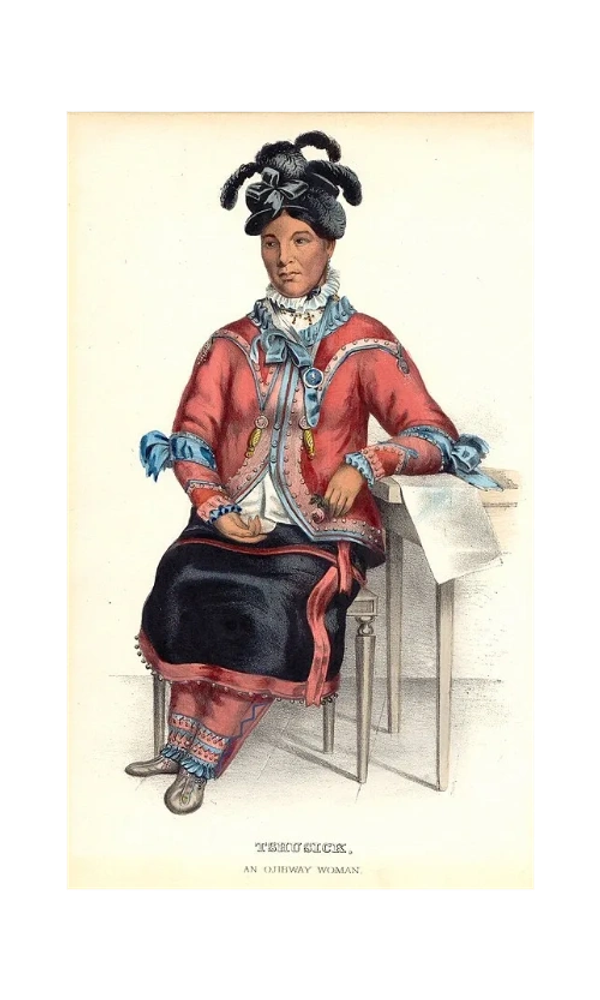
“Tshusick, an Ojibway Woman.”
In the winter of 1826–1827, Tshusick, a Ojibway woman, walked from Detroit to Washington, D.C., seeking instruction in the Christian religion. She made the journey on foot. She was fluent in French and requested that her religious conversation be conducted in that language. She was baptized in Washington and given the name Lucy Cornelia Barbouer. Her trek was recorded by Thomas L. McKenney and resulted in a portrait by Charles Bird King. He titled and published as “Tshusick, an Ojibway Woman.” She was still mentioned in the news in 1899.
- The Bossier banner (Bellevue, Bossier Parish, La.), January 5, 1899, p.4.

Sha-win-ne-gun, Eastman Johnson, 1857, Grand Portage band
© St. Louis County Historical Society

Louise LaChapelle, Leech Lake band, Carlisle Indian School, 1892-98

A Chief's Daughter from Lake St. Clair, oil on paper, Paul Kane ca. 1845. Walpole Island First Nation
©The Stark Art Museum

Unidentified Ojibwa woman ca.1885 Fort Snelling, carte-de-visite
©Minnesota Historical Society
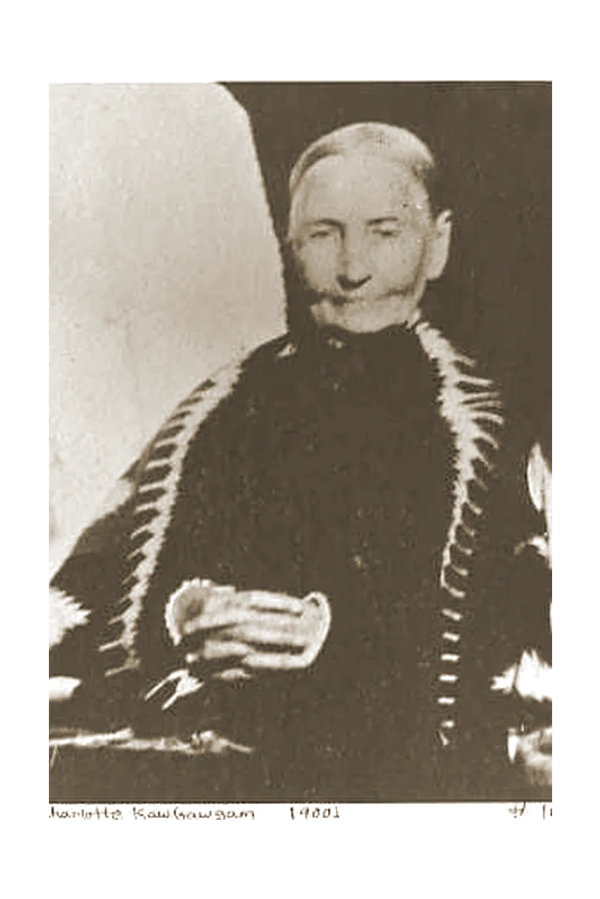
The Michigan Supreme Court concluded that Chippewa law ‘must be recognized by Michigan’s courts.’ Charlotte Kawbawgam was declared Chief Marji-Gesick’s lawful heir, inheriting his ownership interest in the Jackson Iron Company and setting a legal precedent for tribal sovereignty. Sault Ste Marie band

"Susan Belo, a Half-Breed Girl", Sault Ste. Marie, oil on paper, Paul Kane, 1846.
©The Stark Art Museum
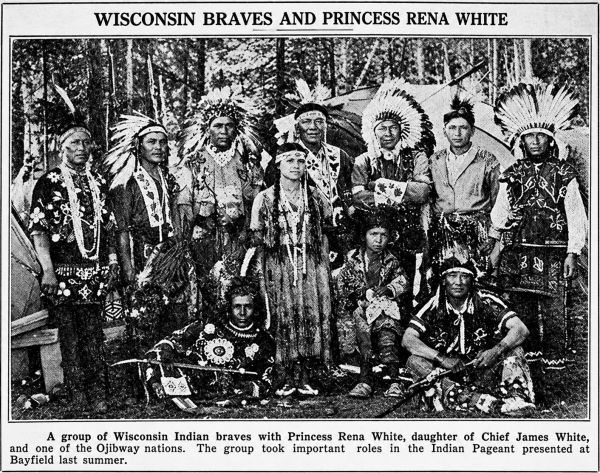
Rena White Danforth — Chippewa Princess
Rena White Danforth, 26, daughter of Chief James White, a Chippewa chief of the La Pointe Band, died at Odanah, Wisconsin, in 1925. She was remembered in the local press as a “Chippewa Indian princess.”
She had served as an assistant matron at the U.S. Indian School at Odanah. She was the first daughter of a Chippewa chief of the La Pointe Band to marry outside her tribe, to a member of the Green Bay Oneida tribe.
Her burial at Odanah was conducted with tribal rites. The newspaper reported that she was buried in a manner “befitting a chief's daughter,” wearing her tribal ceremonial apparel.
Before her marriage, the newspaper noted that she had gained considerable recognition as a soloist, performing at the Apostles Islands pageant and at Bayfield, Wisconsin.
Superior Telegram, February 3, 1925 photograph and caption, Wisconsin Magazine of History, 1925
Wisconsin Historical Society

Turtle Mountain Indian Relay Race 2016 at Chippewa Downs.
©Diana Volk
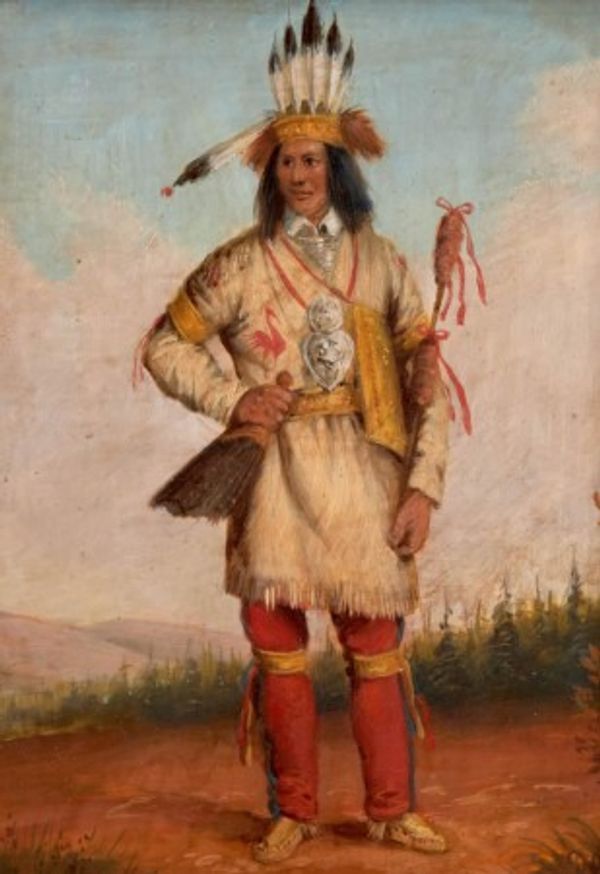
Research Notes: One Portrait—Three Identities?
In researching the work of Cornelius Krieghoff, nearly identical portraits were found bearing three different identifications:
- Chief Tanaghte, Delegate to Lord Elgin at Montreal, 1848–49. ©Art Gallery of Ontario
https://www.allpainter.com/cornelius-krieghoff/chief-tanaghte-delegate-to-lord-elgin-at-montreal-handmade-oil-painting-reproduction-222103.html - Chief Eclipse or Wabumagoging. Musée McCord. The portrait differs from the Tanaghte image in the addition of two feathers and a second medal. https://www.pinterest.com/pin/29836416266082451/
- Tessouat, the One-Eyed Man of the Island. Radio-Canada article illustrated with the Musée McCord image. https://ici.radio-canada.ca/nouvelle/1001554/de-remarquables-oublies-tessouat-dit-le-borgne-de-lile
Note: The historical Tessouat ("The One-Eyed Man of the Island") lived during the early seventeenth century and died nearly two centuries before Krieghoff painted his portraits. The Radio-Canada article use of the McCord image for Tessouat is not explained.
Additionally, the record identifies The Eclipse as Nebenagoching, one of the Chippewa chiefs from Batchewana who traveled to Montreal to meet Lord Elgin in 1849. https://www.collectionscanada.ca/obj/s4/f2/dsk3/ftp04/nq41579.pdf
This website documents the historical acknowledgment and public integration of the Ojibwe (Otchipwe) family as preserved in the documentary record. It preserves the full diversity of the family's historical ethnonyms while tracing the remarkable public footprint that developed—particularly under the name Chippewa—throughout North American history.
Our goal has been to present this history in a manner that is inclusive, balanced, and neutral, allowing the documentary record to speak for itself.
We hope you found something of interest during your visit.
Respectfully,
Brian and John

©Joe Valequez Ojibwa artwork @ Ansada Group
"The Chippewa"

"Turtle Spirt Shield"

"Healing Light"
"Healing Light"

"Healing Light"
"Autumm Light"
"Ojibwa Night"
"The Growling Rapids"