Cultural Artifacts, Life & after life Abode, Public Art, :

Chippewa ball club with spike.(Bigwaakwaado baagaamaagaan) Collected 1650-1850 in New France. At the, Musée du quai Branly - Jacques Chirac, Paris, France.
GRASAC educator's permission

Ogichidaa talismen made of chert, St. Croix band of Chippewa. For a warrior's medicine bag to provide power and protection, from western Wisconsin, St. Croix river valley.
authors collection

Historically grizzly bears ranged into Manitoba, Ontario and Minnesota. By 1900 they had been hunted from the region. However, black bears were numerous through Anishinaabe lands.
©Freemans/Hindman
Objiwa appearance: Dress, headdress, hair, tattoos,[269] piercings, body paint, and ornaments.[49]
Trade Ornament Usage Among the Native Peoples of Canada, A Source Book, Karlis Karklm, 1992, p. 21-41, 116-120 http://parkscanadahistory.com/series/saah/trade-ornaments.pdf
One Chief's peace pipe another's war club:

Chief Aysh-ke-bah-ke-ko-zhay (Flat-Mouth), Leech-Lake steatite pipe, collected 1866. The Ojibwa word for pipe is "opwaagan".

Chief Shingwaukonce (Little Pine) Garden-River band. War club with an animal head finial that has a broken piece of metal protruding from the mouth, possibly from a spike that has been broken off or for attaching some sort embellishment at the Royal Ontario Museum. The museum is home to the Oronhyatekha Historical Collection which also includes the: medicine bag, council war club, War dance earrings, copper spearhead, hunting knife and scabbard, and War dance beaded garters that belonged to Chief Shingwaukonce. https://archive.org/details/cataloguenotesof00indeuoft/page/n43/mode/2up https://collections.rom.on.ca/favorites/399/singwaukonse/objects
GRASAC educator's permission

Chippewa ball club collected at Fort Snelling, Minnesota ca.1832-36.
Brooklyn Museum educator's permission

Tomahawk pipe collected on the White Earth Reservation, Minnesota in 1889.
Harvard Peabody Museum, wikicommons
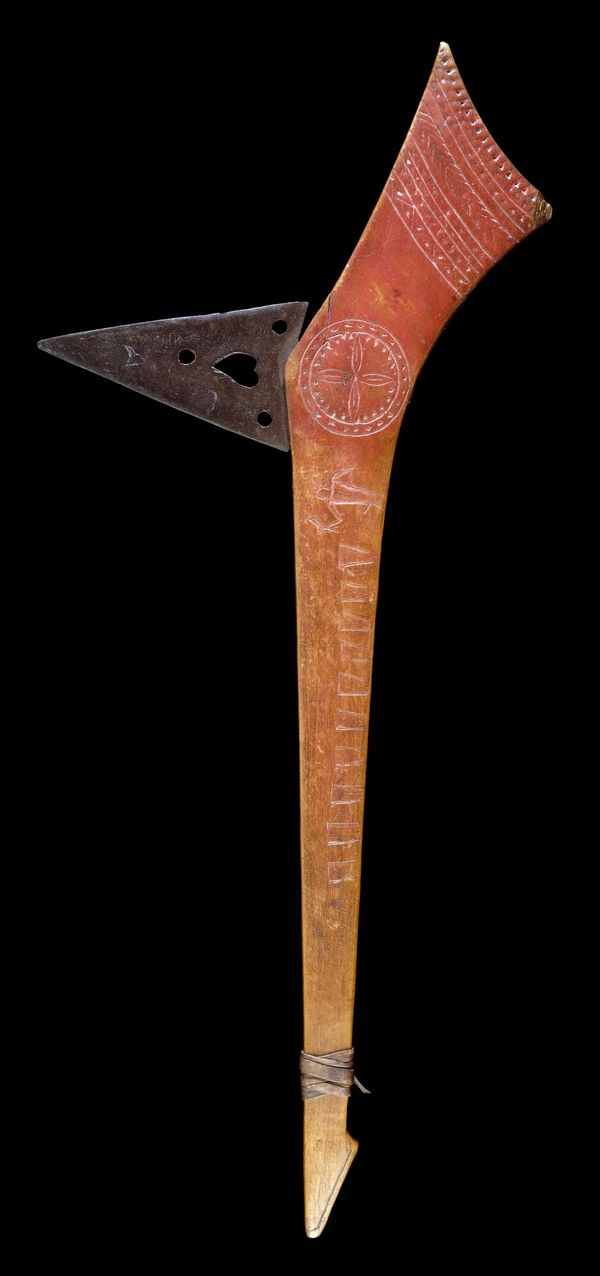
A Spontoon club commonly called Gunstock clubs for their gunstock appearance. The steel spontoon of the weapon was a trade item at the trading posts This example was acquired by the British Museum from the Jesuit Stonyhurst College. Stonyhurst is the direct decendent of the Jesuit's St. Omer College that had sent missionaries to Walpole Island and Wikwemikong in 1844, Sault Ste. Marie in 1846, and Thunder Bay in 1848. The lines in the handle could indicate coups made with the weapon.
British Museum wikicommons
_(14782566514).jpg)
Austrian model 1854 .54 cal. Lorenz rifle:
The 1854 Treaty with the Chippewa stated the United States would furnish two hundred guns, one hundred rifles, five hundred beaver-traps, three hundred dollars’ worth of ammunition, This is the model of rifle the U.S. Government gave to the Wisconsin Chippewa. The gun was a percussion-type muzzleloader similar to the American Springfield Model 1862 rifle-muskets. ©Smithsonian

Loom beaded Ojibwa knife case.
©Minneapolis Art Institute

Mille-Lacs band bow. The Gitchee Manitou sent Nanaboozhoo to teach the people how to make canoes, snowshoes, and bow and arrows.
Projectile Points of Ontario, 2025 https://www.projectilepoints.net/Search/Ontario_Search.html
©Mille-Lacs Indian Museum
.jpg/:/rs=w:600,cg:true,m)
The Portland Art Museum has an Ojibwe knife case with the Great Lynx iconography related to the pictographs in Michigan, Ontario, and Ojibwa mythology. ca.1860.
©The Portland Art Museum
1858 Lehmann's "Indian" rifle .54-.58 cal.
This rifle is what the Government purchased to use for annuity or treaty payments with the Chippewas. The Mississippi, Pillagers, and Lake Winnibigoshish bands all received these weapons in 1858. They came in two calibres .54 or .58 smooth bore. These guns were used long after more modern rifles became available. There were 50 "shotguns" in the treaty goods for the Treaty of Old Crossing in 1862 for the Red-Lake and Pembina bands. They were used against the Sioux at Fort Abercrombie Sept 1862. It is possible those weapons were Lehmann's. wikicommons
Chippewa Ojibwa birch bark wigwams & teepees:

Summer homes of the Chippewa on the shores of Red Lake, ca. 1925.The favored construction material that was available. Unlike hides it did not absorb water.
Minnesota Historical Society
Photographer: Gordon R. Sommers
Location No. E97.31 p44 Negative No. 20201

Lac du Flambeau Medicine man "Bearskin wigwam, seated by his home.
Wisconsin Historical Society, wikicommons

Birch bark Wigwams
"Upper Canada Sketches", Thomas Conant 1898. ©University of Calgary
Anaakan - mat:
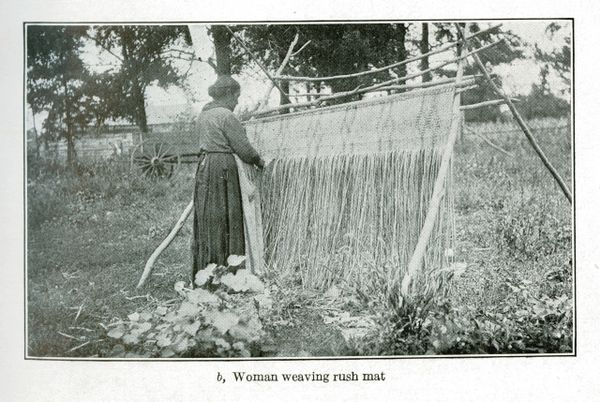
Mrs. Gurneau at Red Lake weaving a rush mat on a frame she constructed.
Woman created Anaakan from different sources: white cedar bark, bullrush, and cattails. The mats served several practical functions. In the home, placed on a layer of leaves, they provided a sleeping surface that would have been dry and off the soil. Another use was as a hanging partition in the wigwam. Mats were also used in the Manoomin harvest as a liner in the canoes, to capture to the rice, or placed on the ground for a canoe to to be dumped out upon.
The image is from Chippewa Customs, Frances Densmore, 1929, Ayer 301 .A5 v. 86, pl. 1).
From Chippewa Mat Weaving Techniques, Peterson, Smithsonian, pages 280-1,
"The mat was ubiquitous: it accompanied the Chippewa literally from cradle to the grave. A baby was delivered on a grass covered mat (Hilger, 1951, p.13) and rolled in it's cradle inside the family matting when the camp was moving (Densmore, 1929, p.50). Later a mat provided a dry smooth surface for working on damp ground (Hilger, 1951, p. 136) or in berrying or ricing (Lyford, 1953, p.90). Finally a mat might line and cover a Chippewa's grave. (Hilger 1951, p.80 & 82).
https://repository.si.edu/bitstream/handle/10088/22128/bae_bulletin_186_1963_67_211-286.pdf

Three women weaving a mat with different patterns in Minnesota. Frances Densmore recorded the Chippewa word for mat as "Anaakan". Baskets were made using the same technique.
Image by Richardson, ca. 1900, Minnesota Historical Society,
Location No. E97.34 p13 Negative No. 3936.

An Anaakan possibly for the entrance to a wigwam. The plain portion could have gone in the entrance with the decorative portion to the interior. It could have also served as a door hanging for privacy.
Tapestry-twined weft faced rush mat. Southwestern Chippewa or Ottawa, first half of nineteenth century. Length 83 cm, width 44 cm. Musée d’Yverdon, cat.no. 00.01.5. ©Fibbi-Aeppli
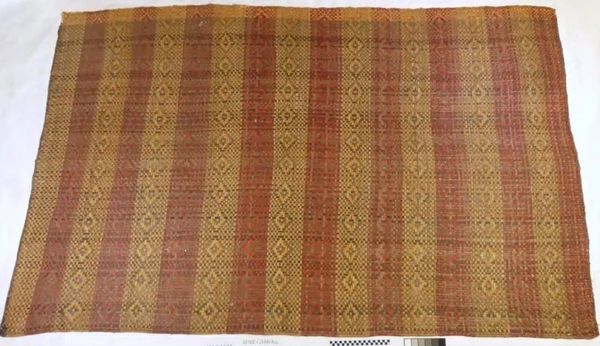
The Isle Royale National Park loaned five Chippewa cedar and sweetgrass mats to Grand Portage National Monument. Helen Robinson Linklater or Tchi-Ki-Wis, of Lac La Croix, crafted the mats while living on Isle Royale. For a red dye the bloodroot (Sanguinaria canadensis) was used. The mat pictured measures 6'x8'. There are 17 mats at Grand Portage NM. ©Grand Portage National Monument
In 1860, historian Johann G. Kohl wrote:
"I confess, such a new clean wigwam with it's gay matting looks very comfortable, especially when a fire is cracking in the centre and such a house would amply satisfy a Diogenes."
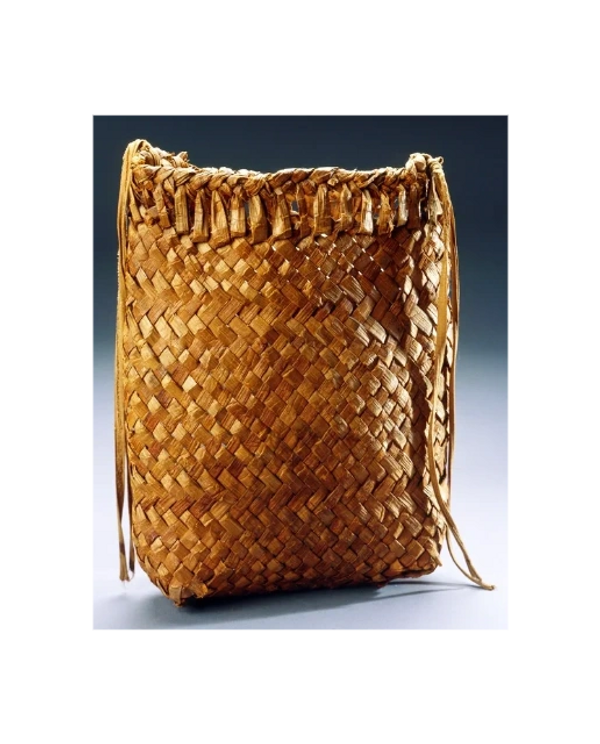
Chippewa cedar bark bag,ca.1900, 12.25" X 8.625" X 2.375", image by Frances Densmore, 1929.
"Densmore recorded mats being made at Mille Lacs Lake in 1929. Cooper (1936, p. 16), at Rainy Lake; Reagan (1924, pp. 119-120; 1928, pp. 245-246), at Bois Fort (Nett Lake) Reservation; and Mason (1904, p. 374), at Grand Marais on Lake Superior—all in Minnesota. Volney Jones (1948, p. 341) recorded them being made at Garden River Reserve, Ontario; Jeimess (1935, p. 14) at Parry Island on, Lake Huron; Chamberlain (1888, p. 155) for the Mississauga (Chippewa north of Lake Ontario); and Skinner (1912, p. 127) for the Northern Saulteaux (Chippewa east of Lake Winnipeg )." Chippewa Mat- Weaving Techniques" Karen D. Petersen, Smithsonian, 1963, https://babel.hathitrust.org/cgi/pt?id=osu.32435061737029&seq=14
©Minnesota Historical Society, Negative No. 6874.11
Chippewa Ojibwa burials:

Fond-du-Lac child's scaffold burial. The box was described as not being large enough for an adult to be laid out full length
Illustration from "A Further Contribution to the Study of Mortuary Customs of the North American Indians" by Dr. H. C. Yarrow. First Annual Report of the Bureau of Ethnology to the Secretary of the Smithsonian, 1879-80 (Washington, Government Printing Office, 1881). The image first appeared In the Bureau of American Ethnology Bulletin 71, plate 4, "A Chippewa Grave at Fond du Lac", 1826. ©Smithsonian

Memory bundles. A woman who had lost her mate would make a bundle of his belongings to morn his death as warriors did not always return. The bundle in the image appears to be wrapped in a mat.
Chief Rocky Boy's bundle is still maintained by his family. Charles Chippewa was the brother of Chief Rocky Boy on Rocky Boy's Indian Reservation. He was the keeper of Rocky Boy's memory bundle and passed it down.
Fig. 32 "Chippeway Widow", "A Further Contribution to the Study of the Mortuary Customs of the North American Indians", Dr. H.C. Yarrow First Annual Report of the Bureau of American Ethnology, 1881. ©Smithsonian

Traditional spirit houses. Each individual has a physical body, a spirit, and a shadow.
1873 "Chippewa Indian graves", photo No. 88 taken at Red Lake by Alexander Gardner with the British North American Boundary Commission. (public domain, "Canadian Border", The National Archives UK. see Further reading) Both houses have a jiibayaatig or "spirit stick"- "corpse tree," at the end of the grave.
Jiibegamig, spirit houses:

Spirit house of Chief Odahmeekoo at Muncey on the Thames River published by Methodist minister Chief Jones or Chief Kah-ke-wa-quo-na-by-was in his "History of the Ojebway Indians," 1861. (public domain)

The Spirit House has stone wired to the end with possibly the Morning Star inscribed on it. The Morning Star, symbolizes a link with the spiritual world, new beginnings, and enlightenment. It also represents a link between the living and the spirits of the past.The Morning Star is often associated with guidance and hope. It could also be the "Returning home star" (Polaris) for the Ogimaag Dodem (chief or headsman) It could also be the Wolf Star (Canis Major) for the Wolf Dodum)
INDIAN GRAVES.
The head of the grave is towards the west.
FIFTY YEARS IN THE NORTHWEST, by W. H. C. FOLSOM, 1888, p.284 .https://www.gutenberg.org/cache/epub/36375/pg36375-images.html#Page_284
©wghy

A traditional Spirit house of rough cut logs with openings for the deceased's spirit to leave and return. As finished lumber became available it was used instead to build more "house like" structures for the Spirit. Earlier versions were made of birch bark or arranged logs.
© rightojibwe.blogspot.com
Bay Mills band cemetery.
“Ke-wa-kunah — The Homeward Way.”
The Indian Leader (Lawrence, Kansas), March 10, 1905, published an account of an Ojibwe tradition under the heading “Ke-wa-kunah — The Homeward Way.” The account describes the people as having come from the west, traveling eastward until reaching “the great sea,” and later turning back toward the west, driving the Sioux before them. It also describes the white Megis (shell).
The article informs that Ke-wa-kunah, “The Homeward Way,” as the route of the soul after death. The westward journey of the deceased is therefore placed alongside the account of the people's earlier west-to-east movement and subsequent return westward.
The source of the account is not identified by The Indian Leader. Frances Densmore is sometimes identified as the source of this tradition, but the chronology makes that attribution uncertain: the article was published in March 1905, before her documented fieldwork among the Ojibwe at Grand Portage in August 1905 and her later work at White Earth.
https://www.loc.gov/resource/ca06001655/1905-03-10/ed-1/?sp=1&q
©Atlas Obscura
Chief Black Cloud or Charles Makadoaqua ca. 1740-1840 spirit house atBay Mills, Chippewa County, Michigan
He was a second chief of the Sault Ste. Marie band of Chippewas. No record has been found mentioning Chief Black Cloud for the War of 1812. He had a son that became well known, Chief Kawbawgam.
Bay Mills, Chippewa County, Michigan

Chippewa burial sticks. The upper left stick is an example for a man with pictograms for his Dodem.
1779 – In his rhymed chronicle of a speech delivered at l'Arbre Croche, Major Arent Schuyler De Peyster referenced the burial customs of his Native allies, writing that painted stakes marked the graves of war chiefs. De Peyster further noted that rows of "nicks" or carved hieroglyphic figures placed upon the posts recorded military accomplishments, explaining:
"Nicks or notches denote the number of times they have been to war, and they often carve hieroglyphical characters thereon."
Although written in verse, the accompanying footnote reflects De Peyster's observation of a commemorative tradition in which grave posts preserved a record of a warrior's achievements. Similar grave markers bearing pictographic designs and military symbolism have been documented among the Ojibwe and other Great Lakes peoples. His exact words "While o'er each war chief's sacred grave, The British union flag shall wave; And, on its staff, a row of nicks,"
Bureau of American Ethnology (public domain)

"Grave Fire" or "Maajaa ishkode", by the American School. A widow or mother by a grave board. For four days and nights food is kept near the grave and a fire built for night long vigils. On the final night there is a family meal and the spirit is instructed it must make a journey. (public domain)
Ojibwe (Chippewa) People: funeral rites, Spiritualité Autochtone, 2025 https://peuplesautochtones.com/ojibwe-people-funeral-rites/
AN OJIBWA QUOTE;
"YOUR ARE READY TO LEAVE ME NOW, BE SURE TO NOT LOOK BACK FOR YOUR GLANCE DRAWS US ALONG. LOOK STRAIGHT AHEAD AS YOU WERE TOLD BY THE CHIEF MIDE. WE LIVE HERE AS LONG AS WE ARE SUPPOSED TO. NEVER WISH US TO HASTEN AND JOIN YOU, FOR YOU WILL FIND YOUR BROTHERS THERE, AND YOUR MOTHER, FATHER, AND GRANDPARENTS THERE ALSO. DO NOT TROUBLE US WE WILL DO ALL YOU REQUESTED BEFORE YOU DIED.'
1873 Wigwam supports and a grave on an island in the Lake of the Woods, image by Alexander Gardner. The Spirit house has a protective "roof" possibly to keep rain off the grave. There is a tall lobstick at one end of the Spirit house. That may have been to help the Spirit return to the Spirit house.
(public domain, Canadian Border, The National Archives UK. see Further reading)

The Constellation Orion was called Mesabi by the Ojibwe on the Mesabi Iron Range in Minnesota.[141] Oral tradition has maintained the names for constellations showing a seasonal understanding of the night sky: Gaabiboonike (The Wintermaker, part of the constellation Orion), Mishipeshu, the Great Lynx (Spring, part of the constellations Leo & Hydra), Nanabozho (Summer, the constellation Scorpio), Mooz / Moose (Fall, the constellation Pegasus). Other constellations: the Loon, Maang, (Ursa Minor or the Little Dipper).The Big Dipper is the tail of Gichi-makwa (the Great Bear) and is also part of The Fisher Star (Ojiig-Anang). Hole in the Sky (Bug-o-nay-ki-shig) is The Pleiades constellation, the Path of Souls or (Jiibay-miikana), is The Milky Way, The North Star is (Giiwedin-Anang). Jane Schoolcraft's name Bame-wa-wa-ge-zhika-quay, or "Woman of the sound that the stars make rushing through the Sky," shows her people were star gazing and she told their stories for her husband's publications

"Spearing by torchlight", Paul Kane, ca. 1856, the subjects are Menominee, "spear fishing" on the Upper Fox River in Wisconsin. The Lac du Flambeau band gets it's name from the same method of fish harvesting just 100 miles to the west.
©Royal Ontario Museum
Binawin-naging or cradle boards:

Cradle board from the Grand Portage Lake Superior Chippewa. Made by Mash-ko-wa-ni-ma doke (Strong Wind) prior to 1932.
©Minnesota Historical Society

Cradle board by Josephine Norcross of the White Earth band of Chippewa prior to 1932.
©Minnesota Historical Society
Ojibwa beadwork or nokomisag:

Ojibwa matching mirrored image panels for a woman's garment in a biomorphic design, ca. 1850. ©Cleveland Museum of Art

Medicine Bandolier bag, Lac du Flambeau Band of Lake Superior Chippewa Made from tanned deer legs with hoofs that have notched edges. The beadwork has alternating buck and doe heads 1910. ©Logan Museum of Anthropology, Beloit College.

Wisconsin Ojibwa pipe bag with a symetric biomorphic panel. ©Balckburn Gallery

Ojibwa Medicine Bag with combined organic elements and a large panel in a geometric alternating pattern.
©Wabeno Logging Museum.

Ojibwa Gashkibidaaganag or bandolier 1890-1910. It has an asymmetrical biomorphic design of stylized thistle heads. Thistles, with their sharp spines, are seen as a symbol of protection against negative forces. The Ojibwe believe that thistles can act as a bridge between the human and spirit worlds and protect from dangers. © McClung Museum

This bag is believed to have belonged to Ojibwa chief 'Wah bah naquod' (Wab-an-quot), of the White Earth band, Minnesota. It was donated in 1880 by the estate of Reverend Lord Charles Hervey to the ©Saffron Waldon Museum.

Ojibwa Gashkibidaaganag or bandolier, 1870s. Metropolitan wikicommons

Gashkibidaaganag or bandolier with a symetrical geometric panel. Unmatching geometric shoulder straps. ca.1870 ©Smithsonian

Wisconsin Ojibwa Gashkibidaaganag or bandolier asymetric biomorphic design 1890s. ©1stDibs

Ojibwa bandolier witha an asymmetric biomorphic panel. ca. 1890's. ©Bonhams Skinner

Ojibwa drum, ca. 1840. ©Detroit Institute of Art

Ojibwa woman's collar with a biomorphic design.
©Portland Museum of Art
Art depicting the Chippewa in government buildings:

Indian Attack on the Village of Saint Louis in 1780. Oscar E. Berninghaus depicts Chief Matchekewis with his men. 1925. The mural is in a lunette of the Missouri State Capitol.
wikicommons

The North Hearing room of Wisconsin's State Capitol has four transpotation themed murals. One has the Chippewa with their canoes at a fur trading post by Charles Yardley Turner, 1915. [16][17]
©State of Wisconsin

1939 "Indian Hunters and Rice Gatherers" Margaret Martin, mural study for U.S Post Office, St. James, Minnesota. The work was a "New Deal" commission of the Treasury Section of Fine Arts. The more stylized final version hangs in St. James.[18]
©Smithsonian.

"Chippewa Legend" plaster bas-relief by Hugo Robus, for the New Deal "Treasury Section of Fine Arts (TSFA) photo by: Seth Gaines. Done for the The historic post office in Munising, Michigan.
© Used with permission of the United States Postal Service
Sculptures of the Ojibwa Chippewa in public parks:

Bronze "Indian Scout" by Hamilton MacCarthy, 1918, Major's Hill Park, Ottawa, Canada. Was renamed "Anishinabe Scout" in the 1990s.
wikicommons

Bronze "Chief Shaynowishkung" (Chief Bemidji) by Gareth Curtiss, 2015 in Bemidji Minnesota.
©City of Bemidji

Bronze Old Crossing Treaty memorial by Anders Skog.
Untitled bronze erected in 1932, Hout, Minnesota. wikicommons