_(14782566514).jpg)
© Parks Canada Agency / Agence Parcs Canada
The Provincal Park is situated in the southeastern corner of Ontario's Peterborough Crown Game Preserve. Image of the inital entrance sign with the base still being completed. The Curve Lake First Nation Reserve is 47km away. Peterborough is 57km, where the Canadian Canoe Museum. is located.
Peterborough Petroglyphs, Ontario
A Great Horned snake

The Peterbourgh Petroglyphs lie on historically Anishinaabe land There are many images for which there are no known indigenious comparables in North America. The main figure in the center image has rays coming from the head. CanadaDZ / CC BY 2.0
It's speculated the glyphs were made ca.900 - 1400 C.E.

The person in the image provides scale for the size of the glyphs. A shelter was erected to protect the site from the elements and vandalism that has since gotten criticism for aesthetics and cultural appropriateness. The site is a pilgrimage for the Ojibwa people today. © Parks Canada Agency / Agence Parcs Canada
They were "found" in 1954.

The exposed material at the site is white marble that is incised with hundreds of humans, turtles, snakes, birds, deer, wolves, and mythological creatures. In addition there are numerous abstractions of unknown meaning. The total number of glyphs is over 1,200. CanadaDZ / CCBY 2.0
The mythological
Some of the imagery is elaborate and took a great deal of time to execute. Even the simple ones took time with a depth of 2-3 inches. wikicommons
Grandmother Turtle

This turtle image and others link to the Anishinaabe. There are boats with oars, masts, and bow and stern posts with figureheads that do not and that connection.
The Curve Lake First Nation is the spiritual custodian of the site , administer the visitor center, and enforce the no photoraphy rules of the petroglyphs. In 1998 the elders requested no photography of the glyphs, so that the "spirits of the rock were not captured".
© Parks Canada Agency / Agence Parcs Canada, B. Morin
Abstractions with figures
The figure on the left has a tail. The figure on the right appears related to the thunderbird used by the 501st Airborne. © Parks Canada Agency / Agence Parcs Canada, B. Morin
Pictographs

Ojibwa pictograph, panel X, Agawa Rock,
Ontario. Anishinaabe Pictographs[267]
- Sanilac Petrogllyphs Historic State Park "Ezhibiigadek asin" Ojibwe for "written on stone", Michigan.
- Pimachiowin Aki is an UNESCO World Heritage site on Lake Winnipeg, with over 30 individual sites, it is Canada's largest grouping of pictographs.
- Hegman Lake Pictographs in Minnesota's Boundary Waters Canoe Area.
- Lake Superior Provincial Park contains the Agawa Rock Pictographs. "Aagawaa" means "sheltered place" in the Ojibwa.
- Wabakimi Provincial Park has multiple pictographs near Cliff Lake.
- Mazinaw Pictographs Nationa Historic Site of Canada. "Mazinaw" is Ojibwa for "picture" or "writing"
- Chippewa Pictograph Sites of the Border States; Michigan, Minnesota, Wisconsin[268] wikicommons

Nanabozho
Nanabozho (the trickster) pictograph, Upper Mazinaw Lake, Ontario. Nanabozhoo is said to have shown the Ojibwa how to make the bow and arrow, canoes, and snowshoes. wikicommons
Ojibwa Pictographs in Wisconsin
- Wichita eagle (Wichita, Kan.), July 1, 1888., p.3
Mallery then broadened his discussion to the Ojibwa system of picture records. He explained that the images used in the Mide and other birch-bark records served mnemonic, ideographic, and descriptive purposes. In this respect, the pictographs on the Odanah rock served a similar function: the images conveyed or recalled information rather than simply representing decorative figures. Mallery's discussion of the birch-bark records provides the broader context for understanding the pictographs at Odanah: in both cases, the images could function as mnemonic and descriptive devices, conveying or recalling information rather than constituting conventional written language
These pictographs were more than simple graphics etched into stone. Their meaning depended upon a viewer who understood the visual language. To someone visually literate in that tradition, an image could communicate or recall information concerning events, combat and victories, hunting, seasons and celestial phenomena, spiritual matters, or other subjects. The physical mark remained on the rock, but its continuing function depended upon people who understood what they were looking at.

Underwater Panther at the Agawa Rock,
Ojibwa pictograph of Underwater Panther at the Agawa Rock pictographs, Lake Superior Provincial Park, Ontario. In 1822 Schoolcraft was told of a raid made by Michigan Ojibwe on a native settlement at Aguawa ca.1600. It was his notes that led to the "discovery" of the Agawa pictographs in 1958. The Ojibwe painted their victory on on the rocks.
Turtle Petroform at Bannock Point, Manitoba

The turtle, or Grandmother Earth, represents wisdom, healing, health and protection.
The rattlesnake or Grandfather Earth has petroforms nearby. wikicommons
Petroform at Whiteshell Park, Manitoba
Whiteshell Provincial Park's petroforms serve as reminders of the instructions given to the Anishinaabe by the creator Gitche Manitou. The Anishinaabe Midewiwin, or Grand Medicine Society, considers the area containing the petroforms to be "Manito Ahbee", where the Gitche Manitou sits. It is the site where the Gitche Manitou lowered the original Anishinaabe from the sky to the ground according to oral history.
wikicommons
Chippewa: Steatite(soapstone) Pipes
Just north of Rainy Lake, in Canada, the Chippewa had found a jet black stone, steatite/soapstone, that they used to make pipes.[252][253][254] It is slightly harder than the Red Pipestone from southern Minnesota and is less well known in comparison.[255] The Chippewa also quarried steatite near Devils Lake, Sauk County, Wisconsin and other sites in Ontario.[256] [257] [258] [259] [260] Another source has a quarry at Pillager, Minnesota and a quarry north of Duluth that produced a jet black material that took a high polish.[261]
Longfellow's poem places the Red Pipestone quarry in Ojibwa lore stating Gitche Manitou called the tribes together there.[262]
Chief Aysh-ke-bah-ke-ko-zhay (Flat-Mouth), Leech-Lake steatite pipe, collected 1866, Smithsonian[263]
Bois-Forte steatite pipe with lead and catlinite inlaid, ca. 1900, Harvard University Peabody Museum[264]
Cass Lake pipe with lead and catlinite inlaid.[265]
Lake Winnibigoshish/Leech-Lake steatite pipe, Smithsonian[266]

Chippewa Steatitie pipe inlaid with lead and catlinite. © Heartland Artifact Auctions
Medicine Men:

Grand Portage Chief Medicine Man Axel Pasey with his family 1936. The Chippeway Hearld, Vol. 1, No.2 Feb.1902 published by Theo and Gus Beaulieu, at White Earth Reservation lists three of types of spiritual practitioners: Meda (medicine man), Gee-sah-ke-we-nine (jugglar), and the A-nun-ann-du-we-e-way-we-nin (blower). The Webeno (dreamer) was not listed.
In 1935 Diamond Jenness identified three classes also:
- Wabeno — curator/healer and spell-maker
- Djiskiu (Jiisakiid/Ojiskiu) — conjuror/summoner
- Kusabindugeyu — seer
The Ojibwa Indians of Parry Island: Their Social and Religious Life, Jenness,
National Museum of Canada, Bulletin No. 78, Anthropological Series No. 17, 1935.
1632 In the Jesuit Relations, the Nipissing are referred to as the “Nation des Sorciers” — “Nation of Sorcerers.”
1888 — A Waterbury Evening Democrat article on Indian Juggery repeated this 1632 historical reference while discussing the Jossakeed and an account of a Jossakeed at Leech Lake in about 1858, showing that the seventeenth-century Nipissing account had entered the nineteenth-century American historical and ethnological record. https://www.loc.gov/resource/sn94053256/1888-08-28/ed-1/?sp=3&q=jossakeed&r=0.354,0.416,0.484,0.228,0
1898 Battle of Sugar Point; The Chippewa Sorcerer's skills made news for the "Last Indian" battle of the west.
* CHIPPEWAYS USE MAGIC.
UNCLE SAM'S ENEMIES AT LEECH LAKE FOLLOW SORCERY. The Morning News (Savannah, Ga.), November 11, 1898
https://gahistoricnewspapers.galileo.usg.edu/lccn/sn86063034/1898-11-11/ed-1/seq-7/
* MAGIC BY THE INDIANS, The Sea Coast Echo (Bay Saint Louis, Miss.), January 16, 1904 https://www.loc.gov/resource/sn86074033/1904-01-16/ed-1/?sp=2&q=chippeway+lodge&r=-0.022,0.032,0.744,0.359,0
* CHIPPEWA SORCERS; THEIR QUEER DEALINGS WITH RED HOT STONES, THE THUNDERBIRD AND DEMONS, New-York tribune (New York [N.Y.]), May 21, 1899, p.26
wikicommons

. Shaw-wan-osso-way, or "One with his Face towards the West," he was formerly a great war Chief but a great medicine-man, Paul Kane 1845 at Manetouwaning on Manitoulin Island. Paul Kane 1845
Walter James Hoffman (1846–1899). Bureau of American Ethnology ethnologist 1888 paper, Pictography and Shamanistic Rites of the Ojibwa, states: “There are extant among the Ojibwa Indians three classes of mystery men, termed respectively ... the Midē, the Jĕs’sakkīd, and the Wâbĕnō".
- Mide — the Midewiwin / Grand Medicine Society
- Jossakeed (jugglery/prophecy) Hoffman describes it as a class of spiritual practitioner concerned with divination, healing, and communication with the spirit world.
- Wabeno — The Wabeno practitioners were a class of spiritualists variously called “Fire-handler”, “Men of the Dawn”, or “Eastern men”. They were sometimes associated with the Fire Dance, whose practices are traditionally guarded that involved curing, ritual, song, and communing with supernatural powers. Hoffman (1891) reported that Wâbĕnō, were prompted by dreams or visions, and were reputed to handle red-hot stones & burning brands with impunity and to place their hands in boiling water or boiling maple sirup. These acts led to the descriptions “dealer in fire” or “fire-handler.”
Hoffmann wrote there are four levels to the Mide. He also record that the Mide used facial decoration indicating graduated status on pages 174,179:
- First degree: one stripe of vermilion across the face.
- Second degree: another vermilion stripe across the eyelids, temples and root of the nose.
- Third degree: upper half of face green, lower half red.
- Fourth degree: forehead and left side green, with vermilion spots, accompanied by red-painted golden-eagle feathers and the war bonnet. American Anthropologist, Vol. 1, No. 3, July 1888, pp.146–300
https://www.biodiversitylibrary.org/item/87737?
Frances Densmore recorded eight degrees of the Mide'wiwin in Chippewa Music, Bureau of American Ethnology Bulletin 45 (1910) She recorded songs associated with initiation songs for the first, second, third, and sixth degrees.
1896 O-sha-gus-co-da-wau-qua, Chippewa Medicine Woman: The Kimball Graphic (Kimball, South Dakota), October 3, 1896, published a report dated Sault Ste. Marie, Michigan, September 28, describing an Ottawa war party from the Georgian Bay country that traveled to Potabranissing village on Drummond Island, to attack the Chippewa people. The Ottawas were searching for O-sha-gus-co-da-wau-qua, a Chippewa medicine woman whom they blamed for casting a spell upon them, after many Ottawa warriors had died under mysterious circumstances. The newspaper states that it was the Ottawas’ expressed intention to kill the woman if they found her.
1897 “Red Girl,” Chippewa Medicine Woman: The Morning News (Savannah, Georgia), June 27, 1897, p.20 reported on a wedding on the St. Croix River between a Chippewa girl and a Sioux warrior being put on by Chief Nebagamain. The gathering was also associated with an intertribal truce, bringing together members of the two nations. Among the notable people attending was “Red Girl, the Chippewa medicine woman.”
1899 " Mitä'kwe" Chippewa medicine woman at Mackinaw: The St. Tammany Farmer (Covington, La.), November 11, 1899, reported an account attributed to ethnologist W. J. Hoffman concerning Lewis Cass at Mackinaw. During a large “medicine feast,” a Chippewa woman whom Hoffman described as a “very powerful mitä'kwe” carried an old dried snake skin fashioned as a bag. She threw it to the ground, where it appeared to come alive, and then chased Cass away from the conference. Hoffman recorded the incident in The Menomini Indians (1896, p. 105), noting that the story had also been related by an Ottawa chief. A later account in The Progressive Thinker, October 3, 1903, described the woman as a “powerful witch” and stated that Cass himself told the story.
1920 Annette Leevier, Ojibwah Healer, born in Quebec
In her: Psychic Experiences of an Indian Princess, Daughter of Chief Tommyhawk, autobiography, published in Los Angeles in 1920, Annette Leevier describes herself as an Ojibwah woman and the daughter of Chief Tommyhawk. She identifies her grandmother, Princess Laconquinne, as a member of the Ojibwah tribe, and states that her Ojibwah father possessed a knowledge of herbs.
Leevier describes her own work as a medium and healer, including healing, prophecy, communication with spirits, and journeys into the spirit world. She also identifies “Moonbeam” as my Indian medicine-man who helps me in my healing.”
Jossakeed would be the term Hoffman used to describe a class of spiritual practitioner concerned with divination, healing, and communication with the spirit world—activities that Annette Leevier stated she did or could do in her 1920 autobiography.
https://www.loc.gov/resource/gdcmassbookdig.psychicexperienc00leev/?sp=1&st=image
©The Stark Art Museum

Ojibwa Medicine Man with drum emblazoned for the Turtle (Mikinaak/Mshiikenh) clan ca.1900. In 1899 the New York Tribune ran an article on "Chippewa Socercers".
Women in the Midewiwin — Hoffman reported that women could take the degrees of the Midewiwin. He found that their professional work included treating women and children and therapeutic tattooing, particularly for headache, toothache, and neuralgia. He states that some were experts at the artform. He also recorded female Mide participating in initiation ceremonies. Henry Schoolcraft noted a woman as a “female Jossakeed.”
An Ojibwe tattoo toolkit collected by Frances Densmore is held by the State Historical Society of North Dakota.
"Indian Music Mirrors Redman's Life" article discusses Frances Densmore documenting the music related to the Midewiwin Lodge.
Evening star (Washington, D.C.), January 8, 1911, p.52
Grand Medicne Initiation
The "Medicine Man", Robert Bell MD. Canada Medial & Surgical Journal, 1886
https://wellcomecollection.org/works/mkt2uegc/items?canvas=2
Minnesota Historical Society, wikicommons

1919, H.R.H. Edward, the Prince of Wales spent three days fishing with Ojibwa guides on the Nipigon River in Ontario. His cousin Prince Arthur, Duke of Connaught & Strathearn had recommended the trip having done it himself the year prior with the Ojibwa. In total, Edward's entourage had 20 guides, one was Chief of the Nipigon Ojibway Band. Another guide caught Edward's attention, as he was certain they had met before. They had, at a field inspection the Prince held in France prior to the Battle of Cambrai (1917).[188] Edward also met with the League of Canadian Indians at Sault Ste Marie and inaugurated Canada's "Warriors' Day" at the Canadian National Exhibition during his 1919 trip.
wikicommons
Figures from history:

Marie Louise Baldwin Bottineau or N-Dan-Sis (daughter of a chief) ca.1910-15 American University law school graduate.
wikicommons

Chief Nah-gun-e-gah-bow, Rabbit- Lake band. Offered to fight the Sioux in 1862.
wikicommons

1870-80s, Stephen & Georg Bonga were African American Ojibwe fur traders and translators.[16] Both passed away at Leach Lake.
wikicommons
Lewis & Clark and the Chippewa and historians question how?

ca.1933 picture of 1803 Lewis & Clark Presentation Flag owned by the Oji-Cree in Montana. Held by 2 Oji-Cree, Loud Thunder or Jim Gopher and the Frenchman or Frank Linderman. Lewis & Clark had several different versions of the flag with them. This one has the Great Seal with 13 stars in the canton. The shield with 3 stars symbolizes the branches of government. Linderman was greatly involved in Rocky Boy's band getting a reservation in 1916.
©Distinctly Montana

Peace Medal, 1st size, for head chief's. It was collected in 1900 at Mille-Lacs. Jefferson medals were the first to have a President's profile on them. This medal belonged to Chief Katawabeda of the Sandy Lake band and "Emperor" of all Mississippi band Chippewa. Mille-Lacs band oral history has that he received it from Lewis & Clark in 1804. It was donated to Jefferson Nat. Expansion Mem. in St. Louis, Missiouri, in 1964. The Fond-du-Lac band also received a medal from Lewis & Clark and is in their oral history. They are identified as the "foriegn nation" that received a 3rd size medal from Lewis & Clark p.17 reference: Indian Peace Medals in American History, Francis Paul Prucha(index p.179, "Fond du Lac") Ronald Reagan Presidential Library Digital Library Collections, 2025, https://www.reaganlibrary.gov/public/digitallibrary/smof/publicliaison/blackwell/box-032/40_047_7007434_032_019_2017.pdf
©National Park Service

Franklin Pierce 1853 peace medal said to have been owned by "Chief Kinquish". It was collected in Marinette County Wisconsin adjacent to Forest County home to the Sokaogon Chippewa reservation is. It would have been given at La Pointe on Madeline Island, Wisconsin for either the Chippewa Treaty of 1853 or the treaty that followed the next year at Madeline Island. ©Smithsonian
Fraternal Organizations: Local branches adopted Ojibwa - Chippewa names.
* Improved Order of Red Men (I.O.R.M.) — Patriotic
* Freemasons (A.F. & A.M.) — Fellowship
* Ladies' Auxiliaries — Community Support
* I.O.O.F. — Charity
* Sons of Hermann — Mutual Aid
* Brotherhood of Railroad Trainmen — Mutual Aid
- Ojibway Tribe No. 1 — La Crosse, Wisconsin
- (I.O.R.M.) Chippewa Tribe No. 4 — Detroit, Michigan 1870
- (I.O.R.M.) Ojibwa Tribe No. 5 — Superior, Wisconsin 1906, ( is in the 1906 U.S. Congressional Record)
- (I.O.R.M.) Chippewa lodge No. 10 — Minneapolis, Minnesota
- (I.O.R.M.) Chippewa Tribe No. 14 Edgefield, S.C
- (I.O.R.M.)Chippewa Tribe No. 14 Milton, Delaware
- (I.O.R.M.) Chippewa Tribe No. 19 — Frederick, Maryland May 3, 1850 ( is in the 1860 U.S. Congressional Record)
- (I.O.R.M.) Chippewa Tribe No. 26 — Fort Wayne, Indiana 1876–7
- (I.O.R.M.)Chippewa Tribe No. 28 Milford, Delaware
- Chippewa Lodge No. 35 — Sons of Herman, Wisconsin.
- (I.O.R.M.) Chippewa Tribe No. 40 Marshalltown,Iowa 1905
- (I.O.R.M.) Chippewa Tribe No. 47 — West Bay City, Michigan 1900
- (I.O.R.M.) Chippewa Tribe No. 49 — Telluride, Colorado
- (I.O.R.M.) Chippewa Tribe No. 50 — Atlanta, Georgia 1910–11
- (I.O.R.M.) Chippewa Tribe No. 51 — Philadelphia
- (I.O.R.M.) Chippewa Tribe No. 60 — Frederick, West Virginia
- (A.F. & A.M.) Manitou Lodge No. 105 — New York City — 1896
- (A.F. & A.M.) Manitou Lodge No. 106 — New York City — 1845/1846
- (A.F. & A.M.) Manitou Lodge No. 108 — New York City — 1896
- A.F. & A.M. Chippewa No. 136 Wisconsin
- (I.O.R.M.) Chippewah Tribe No. 140 — Woodstown, New Jersey 1903
- (I.O.R.M.)Chippewa Tribe No. 169 — Sullivan, Illinois 1904
- (I.O.R.M.) Chippewa Lodge No ? — Rock Island, Illinois 1884.
- (I.O.R.M.) Chippewa Lodge No ? — Barnesvill, Ohio
- Chippewa Falls lodge No. 176 (A.F. & A.M.)
- A.F. & A.M. Chippewa lodge No. 275 Bigfork, Minnesota
- (I.O.R.M.) Ojibway Tribe No. 307 — Albany, New York 1905
- Chippewa Lodge No. 410 — Abbotsford, Wisconsin, appearing in the 1902 Congressional Record. Brotherhood of Railroad Trainmen
- I.O.O.F. Manitou Lodge No. 8 — Marshalltown, Iowa
- I.O.O.F. Chippewa Lodge No. 472 — Ontario, Canada
- (I.O.R.M.) Ojibway Tribe No. 496 — Milesburg, Pennsylvania
- Chippewa Lodge No. 662, Stevens Point Ladies Auxiliary
- Chippewa Lodge No. 764 — Brotherhood of Railroad Trainmen, Montevideo, Minnesota. The 1932 Congressional Record
- Chippewa Valley Lodge No. 888 — Brotherhood of Railroad Trainmen
- Order of the Eastern Star Chippewa Chapter No. 112 Chippewa Falls, Wisconsin
- Royal Arch Masonry Chippewa Chapter No. 46, Chippewa Falls, Wisconsin
- Knights Templar Chippewa Commandery No. 8 Eau Claire, Wisconsin 1868
- Chippewa Lodge — Knights and Ladies of Honor — St. Louis, Missouri 1902
- Masonic youth Chippewa Valley Chapter of DeMolay — Eau Claire, Wisconsin
- A.F. & A.M. Chinguacousy Lodge No. 738 — Brampton, Ontario. 1987
- Chippewa Lodge No. 1326 B.P.O.E Chippewa Falls, Wisconsin 1921
- Chippewa Lodge No. 35 — Sons of Hermann Wisconsin
- Chippewa Lodge No. 496 — Order of Moose, Mt. Pleasant, Michigan
- Chippewa Tribe, Hilltop Nation, YMCA Indian Guides — Columbus, Ohio 1959
- (I.O.R.M.) Manitou Tribe No. 18 — Delaware
- I.O.R.M.Manitou Tribe No. 87 — Fall River, Massachusetts 1904
- I.O.R.M. Manitou Tribe No. 31 — Eminence, Kentucky
- (I.O.R.M.) Manitou Tribe No. 18 — Delaware
- (I.O.R.M.) Manitou Tribe No. 53 — Fortville, Indiana
- (I.O.R.M.) Manitou Tribe No. 125 — San Francisco 1902
- (I.O.R.M.) Manitou Tribe No. 125 —Easton, Pennsylvania,
- (I.O.R.M.) Manitou Tribe No. 128 — San Francisco 1910
- (I.O.R.M.) Manitou Tribe No. 426 — South Bend , Indiana
- (I.O.R.M.) Manitou Tribe No. ? — York, Pennsylvania, former Conesingo Tribe 1906
- (I.O.R.M.) Manitou Tribe No. ? — Oakland, California 1902
- (I.O.R.M.) Ojibway Tribe No. 307, Albany, New York, 1905
- (I.O.R.M.) Ojibway Tribe No. 496 Milesburg, PA
- (I.O.R.M.) Degree of Pocahontas, Ojibway Council, Albany , New York, 1905
- I.O.O.F. Manitou Lodge No. 8 — Tipton, Iowa, 1848
- I.O.O.F. Manitou Lodge No. 71 — Manitou, Colorado 1901
- I.O.O.F. Manitou Tribe No.? — San Francisco, California
- A.F. & A.M. Manitou Lodge No. 106 — New York City 1846; 1845.
- A.F. & A.M.Manitou Lodge No. 68 — Manitou Springs, Colorado 1887
- Loyal Order of Moose, Manitou Lodge No. 1107 — Rochester, Indiana 1912
- Fraternal Order of Eagles Manitou Aerie No. 852— Rochester, Indiana
- Woodmen of the World, Camp Manitou, Colorado
- Good Templars Manitou Lodge 279 Milbank, South Dakota
- (Knights of Pythias) Manitou Lodge — Salt Lake City, Utah — 1892
Manitou — broader Algonquian Indigenous term; included in the footprint because it was adopted as an organizational name, but not identified as exclusively Ojibwe.
* I.O.R.M = The Improved Order of Red Men.- mission is to promote freedom, friendship, and charity through community service, patriotism, and the preservation of American history and traditions
* I.O.O.F. = Independent Order of Odd Fellows- mission is to promote friendship, love, and truth, while providing mutual aid, community service, and support to those in need.
Turtle-Mountain Chief Little Shell III:

Chief Little Shell III of the Turtle-Mountain band of Chippewa. He received a Lincoln Indian Peace Medal at the 1863 signing of the Treaty of Old Crossing.
wikicommons
In 1900 the Massachusetts State Seal was redesigned by Edmund H. Garrett. He used Chief Little Shell III of the Turtle Mountain Band of Chippewa as his model. There is now an effort in Massachusetts to remove the Chief from the State seal claiming using his image is racist. Massachsetts is the only state to acknowledge a First Nation's leader on it's State Seal and State flag. In heraldry, a figure centered on a design, typically within the shield (or escutcheon), is called a "charge". In Heraldry an arm holding a sword above a figure generally symbolizes authority, military prowess, or the protection of justice. The sword itself is a common symbol of honor, bravery, and military might.
Saulteaux Chief Peguis:


Chief Perguis 12' monumen by Marguerite Judd Taylor. Erected 1923 in Kildonan Park, Winnipeg, Canada. Chief Peguis led his band from Sault Ste. Marie to Rupert's Land ca.1790. In 1817 Chief Perguis signed the Perguis Selkirk Treaty that recognized indigenious rights. It included lands that would become Minnesota and North Dakota. The Peguis First Nation is the largest in Manitoba today.
©Trevor Brine/CBC
©City of Winnipeg

Government tug "Pegius II" at the Marine Museum of Manitoba. She was named for Chief Peguis.and assisted dredging operations on the Lake Winnipeg waterways.
©Robert B. Farrow

THE OLYMPIANS:
- Clarence "Taffy" Abel
- Henry Boucha
- Joclyn Laroque
- Abby Roque
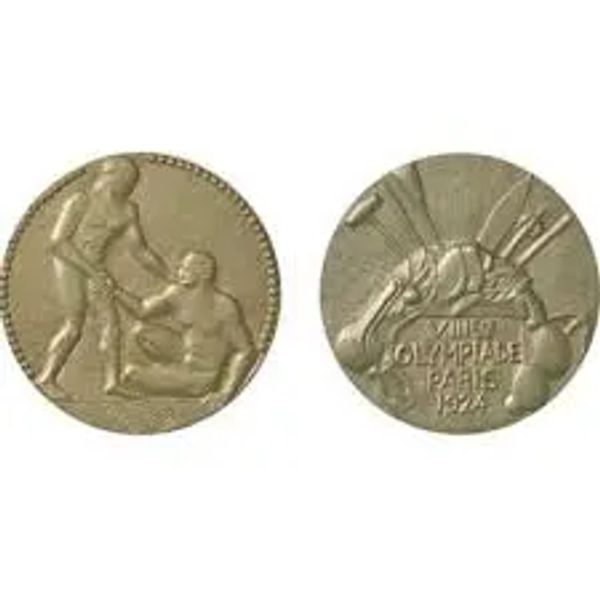
1924 Olympic Silver medal.
Clarence "Taffy" Abel
Sault Tribe of Chippewa Indians.
© Olympics.com
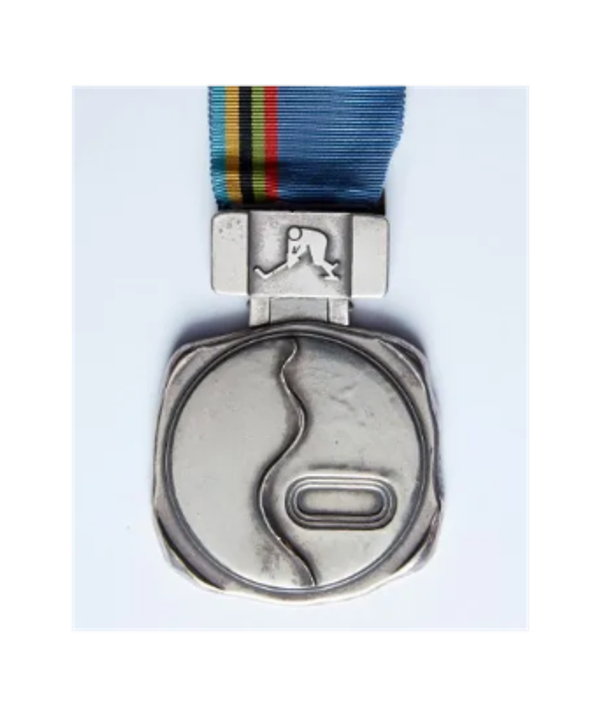
1972 Olympic silver medal for hockey.
Awarded to Henry Boucha of Team USA. He was a member of the Animakee Wa Zhing #37 First Nation, formerly called the Fort William Chippewa. It was sold by Heritage Auctions in 2017.
© Heritage Auctions
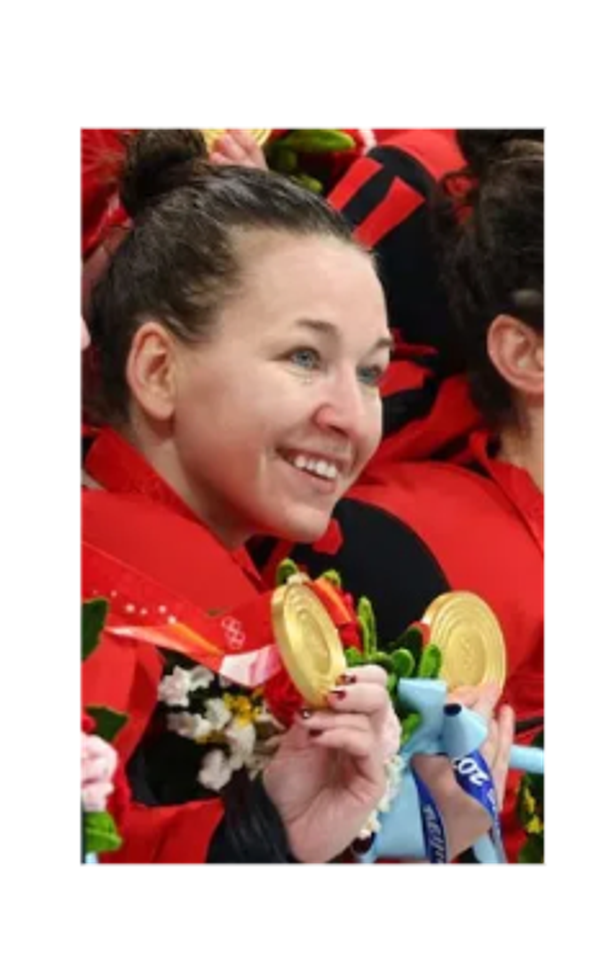
Joclyn Laroque, Red River Metis,
- Sochi 2014 – Gold Medal
- PyeongChang 2018 – Silver Medal
- Beijing 2022 – Gold Medal
- Milano Cortina 2026 – Silver Medal
Beyond the Olympics, Larocque has won four gold and five silver medals at world championships, and in 2018 she received the prestigious Tom Longboat Award.
She is in The Manitoba Aboriginal Sports & Recreation Council (MASRC) Hall of Fame.
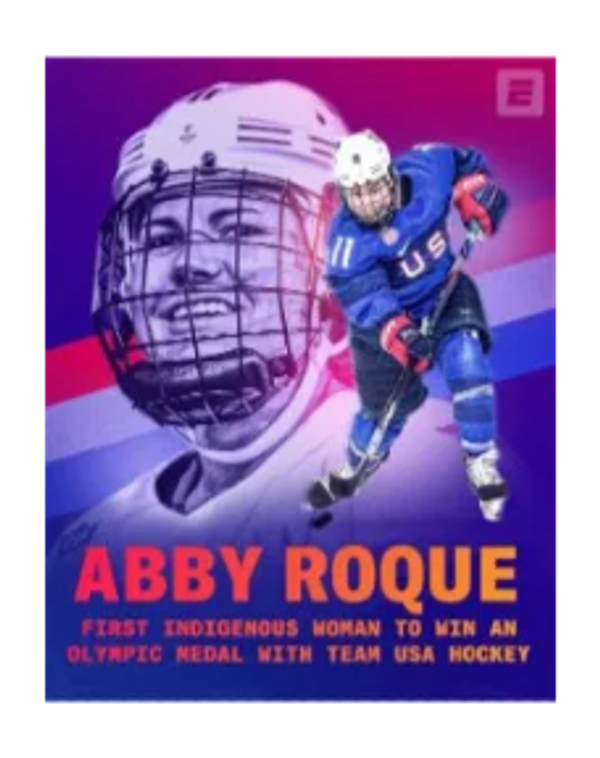
Abby Roque, Wahnapitae First Nation
- Beijing 2022 – Silver Medal
- Milano Cortina 2026 – Silver Medal
Abby is in the North American Indigenous Athletics Hall of Fame
©Sports Center ESPN
Gallery #3: High School, College & Professional Sports

Edward L. Rogers (1876–1971)
White Earth Nation.

In 1900 Rogers attended Carlisle Indian School as an end & team captain. In 1903 U of Minnesota end & captain, Carlisle head football coach in 1904, with a 9–2 record.
In 1910 he was elected Cass County Attorney & 1962 named attorney of the year by a National Organization of District Attorneys.
1968 he made the College Football Hall of Fame & 1973 the American Indian Athletic Hall of Fame.
1977 h

Girls wrestling match, Chippewa Junior and Senior High School, Doylestown, Ohio. The name Chippewa appears prominently across a wrestler's waist and in large letters on the gymnasium wall above the words " PROUD OF IT," illustrating the public recognition of the Chippewa ethnonym through school athletics. The image documents the name as an active expression of school identity and community pride.

Ojibwa Golf & Bowl golf ball, Chippewa Falls, Wisconsin. Personalized golf balls bearing the Ojibwa Golf & Bowl logo illustrate another example of the commercial and recreational use of the Ojibwa ethnonym in everyday American life.

PEGIUS REDMEN
International Softball Confrence
© Pegius First Nation team logo

CHIPPEWA CHIEFS
International Softball Confrence
© Chippewas of the Thames First Nation team logo
Ojibwa acknowledgement by U.S. & Canadian Post:
Canada's Post Office's: "Ojibwa thunderbird" & "Naskapi pattern" Se-tenant pair was issued on April 4, 1975. The thunderbird was created by Norval Morrisseau of the Ojibwa Sandpoint First Nation.
©Canada Post

George Morrison, Grand Portage band of Lake Superior Chippewa. ( 1919 - 2000) He was an abstract painter & sculptor that the U.S. Post office acknowledged with a souvenir sheet of stamps of five of his works in 2022.
Permission United States Postal Service®
.
.
Pierre Bottineau
Pierre Bottineau was the son of a Saulteaux mother, Margaret Ah-dik-Songab (Clear Sky), and, Charles Joseph Bottineau, a French-Canadian fur harvesting father. His mother was the sister of Chief Red Bear of the Pembina band. He was raised near St. Boniface, now Winnipeg, Manitoba. He was famous and respected as a scout, guide, and translator. He is reported to have been able to speak: French, Ojibbway, Dakota, Assiniboine, Plains Cree, Mandan, Winnebago and English. He was reported to have been born in 1817 on the Red River of the North at Bear Point, near the mouth of the Turtle River. One of his sons served in Co. F 5th Minnesota during the Civil War. During 1863-4 Pierre served as a guide and a scout for General Sibley against the Sioux. Minnesota Govenor Ramsey, Oregon Governor Steven, and the Northern Pacific RR all engaged his service. He acted as the translator for the Pembina band at their 1863 Treaty. There is no record that he was ever engaged by the Crown. His first travels were to carry messages for the American Fur Co. from Selkirk to Prairie du Chien in 1830. A mere 690 mile trek as a teenager. After that he delivered messages for the HBC. He was married twice and fathered over 20 children. In 1863 he translated for the 1863 Red Lake Pembina treaty. In 1876 he led 70 French and Saulteaux Metis familys to found the town of Red Lake Falls, Minnesota. Other towns he founded were Osseo, Maple Grove, Breckenridge, Minnesota and Wahpeton, North Dakota He later was labeled the "Kit Carson of the Northwest". Some called him the "Walking Peace Pipe". It's sticking out of his pocket in the image. In 1879 the U.S. granted him a pension for his service. His son, Jean Baptiste, practiced law and was the Turtle Mountain Chippewa legal council for 20 years in claims against the government. In his obiturary his daughter wrote: He was a strong and consistent advocate of a liberal education for the Indian of today,—industrial, technical, professional, and moral. He strongly approved and supported the policy of the U. S. Indian Office in maintaining such schools for the education of the Indian as that at Carlisle, Pennsylvania.Contributed by Mrs. Marie L. Baldwin (née Bottineau) in memory of her father". She became the first female lawyer in the UnitedStates. Jean Baptiste provided legal assistance to at least one student from Turtle Mountain to gain admittance to Carlisle.
https://www.metismuseum.ca/media/db/11974
https://www.findagrave.com/memorial/95652352/jean_baptiste-bottineau
https://carlisleindian.dickinson.edu/sites/default/files/docs-documents/NARA_RG75_91_b2214_01282.pdf

Pierre Bottineau, wikipedia
A-wum-ne-wa-be & King Louis Phillippe I

1845 Silver King Louis Phillippe 51mm medal. The King ordered medals be made for the 12 Walpole Island Ojibbeway with George Catlin. Two gold for the Chiefs and silver for the others. This medal was found in the collection of the Gilcrease Museum in doing the writing for this website. They did not know it's history and simply labeled it as "unidentified donative medal". It is engraved "A-wun-ne-wa-be" for "Bird of Thunder". Smithsonian.
©Gilgrease Museum

A-wun-ne-we-be. Bird of Thunder, George Catlin, Painted at the request of the King of France, Louis Phillippe I,1845, Paris France along with, as well as Ud-je-jock, Au-nim-muck-kwa-um and Say-say-gon. All of those paintings are now at the Smithsonian. They were all from Walpole Island, lower Canada.
wikicommons

The King had each medal personalized, with the recepient's name. This is A-wun-ne-wa-be's.
©Gilgrease Museum
George Catlin and some of his Ojibbeway:
Pelican, Catlin 1845

Ud-je-jock, a boy
painted for the King of France,
Smithsonian copy wikicommons The paintings Catlin did for the King are now in the ©Musée du Quai Branly— Jacques Chirac.
King Louis Phillippe I 1845 Medal

Ke-che-us-sin
(the strong rock)
Lot #4 Stack's Bowers Galleries
Oct. 2006 Auction
reallized: $1,097,000.00
Silver medal presented by King Louis Philippe I to a member of the Walpole Island Ojibbway delegation during George Catlin's 1845 visit to France.
Peace Medals: Negotiating Power in Early America, Robert B. Pickering, ed. Tulsa, OK: Gilcrease Museum, 2011[University of Oklahoma Press] exhibition catalog
© Gilcrease Museum
Tempest Bird, Catlin 1845

Au-nim-muck-kwa-um,
painted for the King of France,
Smithsonian copy, wikicommons
The paintings Catlin did for the King are now in the ©Musée du Quai Branly—Jacques Chirac.
Boy Chief, Catlin 1835

Painted at Fort Snelling, Wisconsin Territory.
Smithsonian wikicommons
Hail-storm, war chief Catlin 1845
Say-say-gon was painted in Paris.
Smithsonian wikicommons
Kei-a-gis-gis, Catlin 1832

Painted at Fort Union, Missiouri Territory, Smithsonian. wikicommons