Leaders from across the Ojibwa Nation
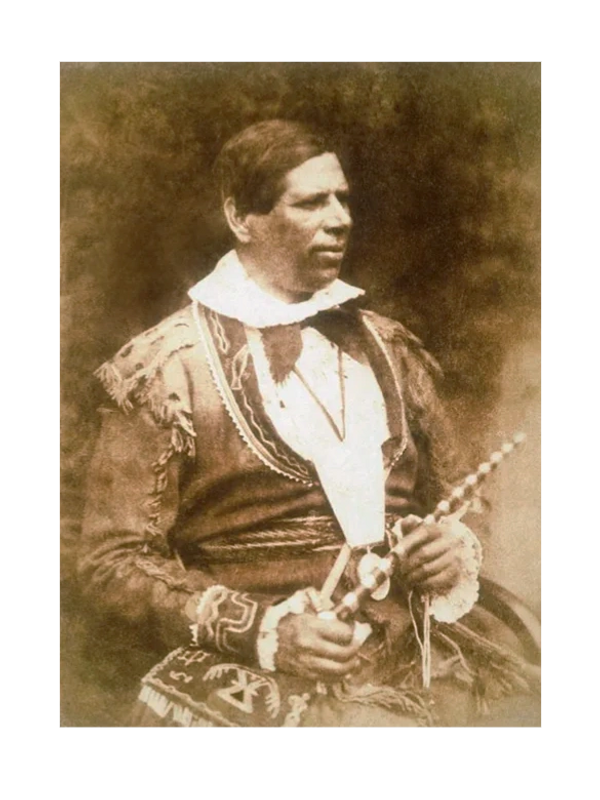
Chief Kah-ke-wa-quo-na-by-was
Calotype of Mississauga band Chief Kahkewaquonabywas, Peter Jones, taken August 4, 1845, Edinburgh, Scotland, by Hill & Adamson. Images taken that day are the oldest known of a Native American. He has a Chiefs medal and his bag has an Ojibwa thunderbird.[4] In 1838 he met Queen Victoria to request the Mississauga Ojibwa be given title deeds to their land. He was a Methodist minister and published a book on the Chippewa in 1861. His son was given his name without "the second or junior" to distinguish him in the records. Chief Kah-ke-wa-quo-na-by-was II or Peter Jones junior became the first Native American to receive a medical degree in British North America. Getty Museum wikicommons

Chief No-Tin or "Wind
1832 Chief No-Tin or "Wind" of the Snake River St. Croix band, Henry Inman. Los Angeles County Museum wikicommons

1832 Chief Sha-có-pay or Six
1832 Chief Sha-có-pay or "Six", George Catlin. Saulteaux Chief, at Fort Union, the American Fur Company trading post at the confluence of the Yellowstone and Missouri Rivers in the far west. On Wikipedia this image has been identified as one of the best on Wikipedia. Smithsonian wikicommons

"Chief from Fort William," (Portrait of Chief Maydoc-game-kinungee of the Ojibbeways)
1848 Chief Maydoc-game-kinungee or "I hear the noise of the deer", he was from Fort William, painted by Paul Kane at Fort Michipicoten. The King George III medal likely indicates 1812 service.
©Royal Ontario Museum

1846 Waw-gas-kontz or "The Little Rat"
1846, Waw-gas-kontz a Saulteaux second Chief, Paul Kane, oil on paper, at Rainy Lake. Most likely the British side of the lake. ©The Stark Art Museum

1845 Nipissing Chief Sha-bo-gesic or "against the heavens"
1845, Paul Kane painted Sha-bo-gesic, oil on paper.
©The Stark Art Museum

Sault Ste Marie Chief Kaw-Baw-Gam. In 1845 he showed a U.S. surveyor iron ore in the roots of a tree in Michigan that began the iron ore industry in the great lakes region.
©The Stark Art Museum

Chief Naagaanab or The Foremost Sitter, Fond du Lac second Chief, ca. 1862
He and his cousin Shin-Gwack were the Fond du Lac Chiefs that met Lincoln just prior to the Mdewakanton Uprising. He was a second chief, Shin-Gwack was the FDL hereditary Chief. Together they sent Lincoln a letter offering to fight the Sioux and remove them from Minnesota. That offer made them national news in 1862 and identified them as Wisconsin Chippewa. Photograph by J. E. Whitney, St. Paul, Minn. Shin-Gwack, or The Balsam, had multiple spellings of his name, Shingoop or Zhingob are others. ( letter is on page 1)
Minnesota Historical Society

Chief Okee-Makee-Quid 1826
In 1825, Chippeway Chief Okee-Makee-Quid attended the Treaty of Prairie du Chien. At the treaty, he made an exchange of apparel with a Sioux warrior. It is possible that this is what he is wearing in this image, painted by James Otto Lewis. Both the artist and the chief attended the 1826 Fond du Lac Treaty in western Michigan Territory. He wears an animal-hide gorget bearing the head of a canid, the species is indeterminate.
Bands that were divided by treaties and or a border:
PEMBINA CHIPPEWA:
The Pembina Band occupied the Red River of the North Valley long before the international boundary divided their homeland. In 1670, England claimed the region through the Royal Charter granting Rupert's Land to the Hudson's Bay Company (HBC), giving the Company exclusive commercial rights throughout the Hudson Bay drainage basin, extending as far south as the confluence of the Bois de Sioux and Otter Tail Rivers near present-day Wahpeton, North Dakota, and Breckenridge, Minnesota.
During the 1730s, French explorer Pierre Gaultier de Varennes, sieur de La Vérendrye, claimed the region for France and established Fort La Reine and later forts extending westward from Lake Winnipeg. French control ended with the Treaty of Paris (1763), which concluded the French and Indian War in North America and transferred the region to Great Britain.
Following the boundary settlement between the United States and Great Britain, the international border eventually divided the Red River Valley, separating the traditional homeland of the Pembina and Red Lake Chippewa. As settlement expanded and Minnesota became a state, the Pembina Band was ultimately displaced westward into what is now North Dakota, where many became associated with the Turtle Mountain Reservation. North of the border, descendants became associated with the present-day Roseau River First Nation.
In 1849, Father Georges-Antoine Belcourt wrote Major Woods of the Red River Expedition that the Pembina Chippewa District extended approximately 400 miles from southeastern South Dakota north into Canada, and more than 500 miles east to west from Cass Lake, Minnesota, to the Missouri River. Portions of this same region were also claimed by the Yankton, Yanktonai, and Lakota.
SAULT STE. MARIE BAND:
The Sault people are the first Anishinaabe to enter the written historical record, appearing in the Jesuit Relations about 1640. The Ojibwe word Baawitigowininiwag ("the people of the rapids") was translated into French as Saulteurs or Saulteaux, meaning "the people at the rapids."
France formally claimed Sault Ste. Marie in June 1671 when Simon-François Daumont de Saint-Lusson proclaimed the territory surrounding Lake Superior for King Louis XIV. Fourteen nations were represented at the ceremony, including the Chippewa, Ottawa, Potawatomi, Sauk, Menominee, Winnebago, and Cree.
Following the French defeat in North America, Britain assumed control of the region in 1761, and the Treaty of Paris (1763) formally transferred New France to British rule. During the War of 1812, British and Saulteaux forces successfully defended Sault Ste. Marie against an American attack, maintaining British control of the settlement.
The establishment of the international boundary divided the traditional homeland of the Sault people. Those living north of the border became associated with the present-day Batchewana First Nation, while those south of the border became the Sault Ste. Marie Tribe of Chippewa Indians. Although separated politically, both communities trace their ancestry to the historic people of Baawitigong.
In 2010, the Sault Ste. Marie Tribe of Chippewa Indians and Batchewana First Nation jointly secured the repatriation from the Smithsonian Institution of the remains of six ancestors that had been removed from burial grounds on Whitefish Island about 1875.
SWAN CREEK AND BLACK RIVER BAND:
Some of the Swan Creek and Black River Bands of Chippewa were removed from Michigan under the treaties of 1836 and 1837. Initially, they were relocated to Kansas, where they shared a reservation with the Christian Munsee. The federal government later took that reservation, leaving the bands landless. Many subsequently joined a band of Potawatomi that became known as the Citizen Potawatomi. During the 1870s, they were again removed to Indian Territory, where they settled in northeastern Oklahoma alongside the Cherokee Nation.
Not all members of the Swan Creek and Black River Bands left Michigan. Those who remained became part of the present-day Saginaw Chippewa Indian Tribe of Michigan.
THE BOIS FORTE BAND:
The Bois Forte Band represents a unique three-way combination within the Anishinaabe world. To the French voyageurs, the largest component was known as the Les Songatikitons ("Strong-Wooded Ones"). A second component was the Lake Vermilion Band of Lake Superior Chippewa. The third was the southern portion of the Little Forks Band of Rainy River Saulteaux, whose traditional homeland was divided by the international boundary. Together, these historically distinct communities became part of the present-day Bois Forte Band.

1874 Cutting the international border "the Slash" across Turtle Mountain. The National Archives UK
Pipestone Indian Training School, one of many:

Girls proudly displaying a large example of Ojibwa beadwork at Pipestone. The photograph complicates the history of assimilation at federal Indian boarding schools. While schools pursued assimilation in important areas of Native life, surviving photographs also show students making, wearing, displaying, and being photographed with forms of Native material culture. At Pipestone, Ojibwe students were among the school's largest student populations.
©Minnesota Historical Society

Pipestone Indian School students ca.1914 (author's collection)
The Chippewa/Ojibwa attended many schools established by Anglo-European institutions from the earliest period of contact. The first schools were founded by Catholic and Protestant missionaries, whose educational efforts continued after responsibility for Indigenous education gradually shifted to the British Crown in Canada and the United States Government. Fur trading companies also participated in education. In 1830 the American Fur Company hired Frederick Ayer to establish a school at its trading post on La Pointe. The following year Ayer moved his classroom to the Company's principal inland post at Sandy Lake, and later to Fort Ripley.
In British North America, Methodist missionaries established a school at Alderville that was promoted in 1848 as a model for Indigenous education throughout the Province of Canada. In the United States, several forms of schools developed, including day schools, mission schools, agency boarding schools, and off-reservation boarding schools.
Among the latter was the Pipestone Indian School in southwestern Minnesota. Although located on the Yankton Reservation, no resident tribal population remained there to supply students. As a result, Pipestone recruited children from reservations throughout the region and functioned much like an off-reservation boarding school. Because many Dakota communities had been removed from Minnesota, the school increasingly recruited students from the Chippewa reservations of northern Minnesota until the Bureau of Indian Affairs eventually prohibited the practice. Consequently, despite being located on Yankton land, the majority of Pipestone's students came by rail from Chippewa communities. During its early years, a chief from White Earth served as a member of the school's staff.
In 1891 Congress made attendance at Bureau of Indian Affairs schools compulsory for many Native American children. Although compulsory school attendance laws already existed in many states, they were not yet universal throughout the United States.
Historically, individual states operated orphanages and institutions for orphaned, destitute, and neglected children. The Bureau of Indian Affairs generally did not provide comparable facilities for Native children. Some tribes addressed this need themselves. The Cherokee Nation established an orphan asylum in 1879, while other communities used boarding schools in part to provide care and education for children who otherwise lacked family support. This occurred among some Ojibwa communities in Minnesota and among the Eklutna in Alaska.
The Daily Alaska Empire, Aug. 14, 1945, p.3 https://chroniclingamerica.loc.gov/lccn/sn83045499/1945-08-14/ed-1/seq-3/
The Daily Chieftain, Oct. 20, 1902, p.1 https://chroniclingamerica.loc.gov/lccn/sn93050700/1902-10-20/ed-1/seq-1/

Pipestone Indian School students ca.1914
Pipestone County Historical Society

Pipestone Indian School students ca.1914
Pipestone County Historical Society

Students at PITS dated 1914 (author's collection)
OTHER "INDIAN" SCHOOLS:
1833 Treaty of Chicago $5,000 was allocated for the Chippewa, Ottawa, and Potawatamie tribe's children to attend the Choctaw Academy, the first boarding school in the U.S.[74] $5,000.00 equates to $187,895.24 in 2024.
1879 The Carisle Indian School opened. Numerous Chippewa students applied to and attended. Their files are available at:
Carlisle Indian School Digetal Centre 2025.
1900 The Carisle School band played the 1900 Paris Exhibition or World's Fair. Louise LaChapelle of the Leech-Lake tribe made the trip. Her school file indicates she was progressive for her time. https://carlisleindian.dickinson.edu/sites/default/files/docs-ephemera/NARA_1327_b047_f2343.pdf
The first Chippewa boarding School in Michigan opened in 1893: Mount Pleasant Indian Industrial Boarding School and closed 1933. It had students from both Wisconsin and Minnesota.
Wisconsin had Chippewa boarding schools:Hayward Indian Boarding School, 1901-1934. The student population was mostly Lac Courte Oreilles band. There was also the Government Boarding School at Lac du Flambeau (on reservation) 1895-1935.
1871 The first boarding school in Minnesota opened at White-Earth. The school newspaper was the "The Chippeway Herald ".
1902 Another school for the Chippewa was the Morris Industrial School for Indians which opened as a Catholic School 1887-96. BIA reopened 1898-1909.
1903 "The Indian Boarding Schools, Non-reservation school, The Need of the Hour" editor, The Tomahawk, Apr. 30, 1903, p.1.
1903 "An Indian's View", letter to the editor of the White Earth Tomahawk, about Indian schools and Indian education, from Kk-che-ze-be-we-ninee.
The Tomahawk, Oct. 8, 1903, p.1.
1904 Col. R.H. Pratt, founder and superintendent of the Carlisle Indian School in the White EarthTomahawk:
"Better, far better, for the Indians had there never been a Bureau" of Indian Affairs."
The Tomahawk, White Earth, May 19, 1904, p.1., MNHS Digital Newspaper Hub.
1904 The Bois Forte and Nett Lake parents refused to send their children to the boarding school at Tower, Minnesota. A student there hadrefused to follow an order from a staff member. Who then stuck the student on the head with a lead billy club instantly killing the student. The staff member was arrested but the intervention of the school superintendant got the charges dropped. "School Boycotted",
The Tomahawk, Feb.12, 1904, p.1, MNHS digital newspaper hub.
1907 Native Indian Art address by Angel De Cora, Carisle Indian Art instructor to the National Education Convention, Los Angeles. https://newspapers.mnhs.org/jsp/PsImageViewer.jsp?doc_id=9f9cced7-0e56-4398-87d3-1f1ab339d023%2Fmnhi0031%2FXETFTD5A%2F07090101
In the north the Canadian Indian residential school system was "funded" by the Department of Indian Affairs and administered by Christian Churches. Attendence became cumpulsory in 1896.
Mount Elgin Industrial Institute aka Muncey Institute – Indian Residential School. The Chippewas of the Thames, the Chippewas of Sarnia, the Moravian of the Thames, and the Mississaugas of the New Credit set aside one quarter of their annuities to support the school, 1850-1946.
Pipestone Indian Training School 1901 Pan-Am bronze awards

Pan -American Exhibition 14"x18"award Certificate. The Pipestone students would have received 12 of these which authorized their having a Bronze Medal made for each Award they won.
wikicommons

Obverse of the 1901 Pan-American Exhibition Medal
This was the pattern of all awards regardless of the award level: Gold, Silver, Bronze, or Honorable mention.
wikicommons

Reverse of the 1901 Pan-AMerican Medals
Winners could choose a different pattern, but this one has figures representing North and South America. They could also have smaller versions of their medal made to give as gifts. There is no record the school had medals made for the students. wikicommons

Engineering Department, PITS
©Chester E. Sogn,1923-47
PITS, one school's chronology:
The topic of "eduacation" is broad when it comes to Native Americans. Typically the schools are lumped together as though they were all the same. Here the focus is on one that was atypical, Pipestone Indian Training School. It was a school built at the request of the Yankton Sioux.
and built upon land the BIA appropriated from the Yankton Pipestone Reservation. That appropiation was not taken well by the tribe and they took it to court and won. Even though the school was on their land and they had the closest reservation to the school, the student population was drawn more from Minnesota's Chippewa reservations, in particular from White Earth. The religious component, typical of many schools, was not an element of Pipestone. Student health was addressed, with the buildling of a hospital on the campus. In 1889 plans and specifications for a Indian School at Pipestone were drawn up.[274] Attendence at non-reservation BIA boarding schools was by application. The length of attendence was specified by the parent on the application they submitted. For Pipestone, many years there were more applications than beds. The Yankton Pipestone quarry site was a culturally significant location for numerous tribes due to the revered red catlinite quarried there.
In 1890 it was reported tribes had requested a school at the Yankton tribe's Pipestone Reservation.[275] An appropriation of $30,000 was requested and $25,000 was approved. The Bureau of Indian Affairs took 100 acres of the reservation land to build the Pipestone Indian Industrial School adjacent to the Pipestone Quarry. The Yankton people long contested that loss and won before the Supreme Court years later. It was one of the BIA's 25 non-reservation boarding schools and amongst the last to be closed. When the school opened the majority of native Americans in Minnesota were Ojibwa and they dominated the school's enrollment throughout it's history. The school had grades 1-8 with a split curriculum, mornings and afternoon groups switching: academics and occupation skills. The school fielded both girls and boys sports teams[276] [277] [278] Post WWI, the Pipestone student body became more diverse, but White-Earth remained the primary source of students until the school closed. Attendance was voluntary and by application. The School superintendent made visits to reservations both in and outside Minnesota to recruit students. The circumstances for the attendance of orphans at the school are not published. In 1952, last year the school was supposed to be open, over 300 students wanted to attend, however due to budget reductions only 130 from Minnesota were accepted. Post WWII newspapers portray the school's secondary tasking as an orphanage.[279] [280] Leaders of the Chippewa were against closing Pipestone School until something could be done to place the kids in permanent situations.[281]
Despite it's location on the Yankton Pipestone reservation it was considered an off-reservation school because their was no resident population.
1891 The Yankton tribe filed a complaint that the school would be placed on the Yankton Pipestone reservation not adjacent to it.[282][283]
1893 The Pipestone Superintendent passed through Marshall, MN with three groups of kids. Two were from White-Earth and Mille-Lacs. The third were Sioux he brought via St Paul.[284]
1894 the Avoca Catholic boarding school for Indian girls closed. The students were transferred to Pipestone and Flandreau after permission was received from the parents.[285]
1895 The Superintendents of the Indian schools at Pipestone and Pierre S.D. both went to White-Earth looking to enroll students. Pipestone got 8 or 9.[286]
1897 Six bright students were escorted back to the Rosebud Agency when classes ended in the Spring [287] In the Fall it was reported 67 Ojibwa children from the Detroit Lakes area were enroute to Pipestone.[288][289]
1899 C.J. Crandall, the first Superintendent of Pipestone, wrote that the legends surrounding the red Pipestone were mostly the creations of the "white man".[290][291]
1900 Congress considered buying the Pipestone Reservation[292]
1901 Pipestone's students won 12 bronze medals in Agricultural Products at the Pan-American Exposition in Buffalo, New York.[293][294]
1902 School enrollment reported at 135 mostly Chippewa.[295][289]
1904 Bids were solicited to provide 35,000 pounds of beef for the school. The desired cuts were specified as well as what would be rejected.[296]
1905 The White-Earth Tomahawk reported the Pipestone School matron, Miss Roy, returned for the new school year accompanied by many White Earth students.[297] White Earth Chief William Madison was the Boys Advisor at Pipestone.[298]
1906 The first 3 students to graduate at Pipestone were Clem Fairbanks, Willie Coffey, and Willie McIntosh from White-Earth. In 1906 enrollment was 215.[299]
1908 the BIA prohibited non-reservation school superintendents from going to reservations and recruiting students.[300] The head of the BIA felt too much money was being spent on the training programs at the non-reservation schools and that they should have the same curriculums as public schools.
1912 the students began publishing a school newspaper that some claim make it the first indigenous newspaper in the country.[301] However, The Oglala Light began publishing at the Oglala Indian Training School in Pine Ridge, South Dakota in 1900.
ca. 1914 Two girls displaying a large example of Ojibwa beadwork at Pipestone.[302]
1915 Congress Approbations for the Minnesota Chippewa: Pipestone School $51,725, $4,000 support of the Chippewa school of the Mississippi bands. A request was made to reserve the mineral rights of all tribal land taken by the whites. Another provision was made for a welfare payment be authorized for any tribal member that was destitute, ill, or incapacitated.[303]
1916 The BIA allocated Indian schools $167/student while PITS was spending $224/student[304] In 1914 the boys made the Tri-state Indian school championship.[305]
1918 School enrollment reported at 165: Chippewa 75, Sioux 55, Winnebago 19, Omaha 19.[289] During commencement PITS displayed a service banner with 35 stars for former students in uniform for WWI.[306]
1927 school enrollment was 340 the school's maximum, many applications were turned down[307]
1927 The school boy scouts preformed Longfellow's Song of Hiawatha for the first time. It became a annual school activity that was later adopted as a community activity. A Charles Morrison was a student from 1910- 1924 who later returned as a teacher. He was helped later, non-native, performers learn the correct pronunciation of the Ojibway words used in the play. (Pipestone Administrative History NM, Chapter VIII, NPS 2025, https://www.nps.gov/parkhistory/online_books/pipe/adhi8.htm )
1930 school enrollment was 315. 375.In 1930 the football team went 7-3 scoring 220 pts vs. their opponents 72. It was notable as almost all their opponents were High schools and Pipestone only went to the 9th grade. The team represented 11 tribes: Chippewa 5, Sioux 5, Gros Ventre 2, Akira 2, Sac-Fox 2, Winnebago 1, Omaha, 1, Oneida 1, and Cheyenne 1. The toughest game was against the Flandreau Indian School team.[308]
In 1932 Pipestone had it's largest enrollment. That year a Hospital was built on the school campus.[309] The building was demolished in 1999.
1940 Applications for enrollment far exceeded school capacity with many turned down to get to the preferred number of 320.
1936 Adam Fortunate Eagle Nordwall and his four brothers arrived from Red Lake and state that enroolment was 136. He also states that 54 of those student entered military service for WWII and that the school prepared them for it. .https://www.pipestonestar.com/articles/band-of-warriors/
1941 The boys basketball team made the news. It was reported that they had won a tournament two years running and were returning. They were noted for defeating the opposition routinely by 15-25 points. Because of this they had to travel over 100 miles to play teams they would or could compete with them.[310]
1947 enrollment demographics and costs per student reported. [311]
1948 the BIA proposed closing all Indian schools. The people of Pipestone said all the other schools could close except Pipestone. Because of the historical significance of the adjoining Pipestone Reservation, it should be exempted. In 1948 the Minnesota Welfare Board insisted that the Pipestone Indian School remain. The governor of Minnesota wrote numerous letters that "many of these children have no homes, no family's, or places to go". [312] That year the school and hospital closures were put off for a year.[313]
1948 Was the last year the School put on the Song of Hiawatha play due to the pending closure. The local community assumed production in 1949.
1949 The school had nearly 400 applications but only 125 were accepted due to reduced funding. Most of those were year round residents. They did not have homes to return to during summer because they were orphans.[314] That year Minnesota U.S. Senator H.H. Humphrey made efforts on behalf of keeping Pipestone open. Le Sueur News-Herald, Mar. 9, 1949, Minnesota Digital Newspaper Hub, 2024, MNHS, St. Paul MN [244]. Communities throughout Minnesota and South Dakota opposed the closing of the Indian School and the Hospital.[315]
In 1952 $135,000 was authorized to fund Pipestone's a last year of operations. That figure equals $1,582,819.32 in 2024 dollars or $12,662/student for 125 students.
1953 the School was scheduled for closure however, $250,000 was appropriated for the 1953-54 school year. The Indian Bureau diverted $72,000 of that money for the Minnesota foster care program for the placement of Pipestone students. The Bureau was ordered to return the monies as well as any Pipestone students it had placed.[316] The Chippewa opposed the closing of the Pipestone school[317][318]
* 1953 Termination Act: House Concurrent Resolution 108 (H. Con. Res. 108), passed August 1, 1953, declared it to be the sense of Congress that it should be policy of the United States government to abolish federal supervision over American Indian Tribes as soon as possible and to subject the Indians to the same laws, privileges, and responsibilities as other U.S.citzens. This includes an end to reservations and tribal sovereignty, integrating Native Americans into mainstream American society.
☆ The solution to the closing of Pipestone was placing the kids in the Foster Home Program.
☆ A student's opinion of Pipestone and "The Writings of Ward Churchill Fulsome and Inflammatory", The Ojibwe News, June 10, 2005, p. 4,5, Minnesota Digital Newspaper Hub, 2024, MNHS, St. Paul MN [245]
☆ PITS, Keeping Victimhood in Perspective, Chuck Trimble, Feb. 25, 2012 Indian Country Today, [246]
☆ Adam Fortunate Eagle Nordwall of the Red Lake Nation with four brothers attended Pipestone. With 8 kids to raise his mother saw Pipestone as a way to solve her situation. Adam credits Pipestone with giving him the training he and his bothers needed to be prepared for military service during WWII.
https://www.pipestonestar.com/articles/band-of-warriors/
☆ In 1929 the US Army turned over to the BIA 3000 Krag rifles with bayonets, scabbards, and ammunition belts for military training at boarding schools.
Evening Star, March 08, 1928, p.6, LOC, https://chroniclingamerica.loc.gov/lccn/sn83045462/1928-03-08/ed-1/seq-6/#date1=1756&index=0&rows=20&words=Army+boarding+Indian+schools&search
☆ The History of Native American Boarding Schools Is Even More Complicated than a New Report Reveals, Olivia Waxman, Time Magazine, May 17,, 2022, https://time.com/6177069/american-indian-boarding-schools-history/
In 1855 Henry Wadsworth Longfellow places the Chippewa at Pipestone in his Song of Hiawatha. He wrote "Here Gitche Manitou called all the tribes together".
2008 Was the last year the Song of Hiawatha was preformed at Pipestone ending what the students started over 70 years earlier.
Chief William Madison made the newspapers after his tenure at PITS. In 1940 he held a press conference with the media concerning the failure of the State to erect monuments acknowledging significant Chippewa history,[319] A decade later, in 1950, he ran for the office of State Senator for Minneapolis.[320]
PIPESTONE STUDENT FILES 1910 -1954 ARE AVAILABLE AT: National Archives at Kansas City, 2025, https://www.archives.gov/kansas-city/finding-aids/pipestone-students.html (RECORD GROUP 75) IS SUPPOSE TO CONTAIN THE YEARS 1894-1910. Direct questions to:
kansascity.archives@nara.gov

Pipestone Indian School bus 4. Chester E.Sogn, Minnesota Historical Society wikicommons
_(14782566514).jpg)
Ojibwa at Carlisle Indian School
The Ojibwa Language and Criticism of Carlisle at the Carlisle Indian School, 1897–1898
The Red Man, the Carlisle Indian School newspaper at Carlisle, Pennsylvania, January 1, 1898, reprinted an Ojibwa-language article originally published in Anishinabe Enamiad at Harbor Springs, Michigan, in September 1897. The article, “Obstacles Met With in Getting Indian Youth Away From the Old Life,” was dated Mount Pleasant, July 27, 1897, and presents the Ojibwa text together with an English translation. The article is highly critical of the Carlisle Indian School, including allegations concerning its treatment of Native religious beliefs. The text includes the historical Ojibwa word “Anishinabedig,” translated in the accompanying English text as “Indian.”
The entire page can be read at the Library of Congress:
Library of Congress — The Red Man, January 1, 1898, page 2
https://www.loc.gov/resource/2025200871/1898-01-01/ed-1/?sp=2&q=ojibway&r=-0.25,0.824,0.8,0.386,0
Hiawatha, When Longfellow was done, Hiawatha had become Ojibway personified.
Henry Wadsworth Longfellow became permanently associated with the Ojibway through his 1855 epic poem, The Song of Hiawatha. The poem became one of the most widely recognized works of American literature and carried Ojibway names, stories, characters, and cultural imagery into American popular culture and education. Longfellow drew upon material collected by Henry Rowe Schoolcraft, while reshaping that material into his own literary creation and using the name Hiawatha for his central character.
But the documentary record contains a much deeper Ojibway connection to Hiawatha than the familiar statement that Longfellow merely “used Ojibway legends.” At Garden River, Ontario, members of the Ojibway community maintained that their own traditions had been transmitted to Schoolcraft and ultimately to Longfellow. Contemporary newspaper accounts specifically identified the family of Chief Shingwauk as the source of this testimony. One 1900 account reported that members of Shingwauk's family told L. O. Armstrong that the chief had related the legends forming the story of Hiawatha to Schoolcraft, “from whom Longfellow obtained them.”
1857 — George Copway performs The Song of Hiawatha
He was reported performing/reading Longfellow's The Song of Hiawatha “in full costume” before large audiences in the Atlantic States. Volcano Weekly Ledger (Volcano, Amador County, Calif.), February 7, 1857, p.2.
1897 — “Hiawatha the Great: The Story of Longfellow’s Hiawatha”
W. E. Curtis, The Chicago Record, reprinted in the New-York Tribune, July 4, 1897.
Curtis distinguishes the historical Onondaga Hiawatha from Longfellow's literary creation, observing that Longfellow “transforms this grave Onondaga statesman into an Ojibwa demi-god, the son of the West Wind.”
Shingwauk of Garden River → Schoolcraft → Longfellow → Hiawatha
In September 1900, the New-York Tribune reported on an extraordinary performance of The Song of Hiawatha by Ojibway people from the Garden River community. The newspaper described Desbarats as being situated in “the land of Ojibways” and reported that members of the family of Shingwauk, the Ojibway chief, had told L. O. Armstrong that Shingwauk had related the legends forming the story of Hiawatha to Henry Schoolcraft, from whom Longfellow obtained them. The same illustrated article showed the Ojibway performers and the stage on which the drama was presented.
The connection was not simply retrospective. Garden River Ojibway invited members of the Longfellow family to attend the performance. A birchbark invitation preserved in the Longfellow archives survives today. The National Park Service identifies the object as an invitation from George Kabaoosa of Garden River to the Hiawatha performance at Desbarats in 1900.
The invitation was followed by an extraordinary personal encounter. The Longfellow family traveled to Desbarats, where the Ojibway performed Hiawatha for them. During the visit, members of the Longfellow family were formally adopted into the Ojibway community and received Ojibwe names. A contemporary account of the ceremony describes Kabaoosa addressing each person in Ojibway, striking the recipient three times on the shoulder, announcing the new name, and having the assembled Ojibway repeat it. The account states that the names were “valued names in the tribe,” chosen with care and given as proofs of high regard.
The adoption survives not merely in newspaper accounts but in physical objects. Birchbark adoption certificates were created for members of the Longfellow family. Alice Mary Longfellow received the name Odahnewasenoque, also recorded as Odenewasenoquay, translated in the historical record as “The first flash of lightning.” Anne Allegra Longfellow Thorp, Joseph G. Thorp, and Henry Wadsworth Longfellow Dana also received Ojibwe names. The certificates survive in the Longfellow archives.
The certificates themselves are part of the story. They are made of birchbark and carry attached leather medallions bearing a long-legged bird. The National Park Service has documented the objects but has not established the significance of the bird symbol.
The relationship continued after the 1900 visit. Alice Longfellow wrote a 43-page poem describing the family's journey to Desbarats and the Hiawatha pageant. The Longfellow archives also contain correspondence from George Kabaoosa, photographs, notes concerning the pageant, and other material documenting the Garden River connection.
The Garden River production itself developed into an extraordinary cultural phenomenon. Hiawatha, or Nanabozho: An Ojibway Indian Play was performed by Ojibway people, incorporated the Ojibway language, and developed from the Desbarats performances. By 1904 the production and its Native cast traveled to Chicago, Boston, and New York; the following year it traveled to Europe, including a lengthy engagement at Earl's Court in London. The Garden River community continued the Hiawatha tradition for decades.
A connection to the earlier Garden River tradition was also reported: a drum used in the Hiawatha performance had belonged to Chief Shingwauk. It had seen service at the Battle of Queenston Heights during the War of 1812. The Freeland Tribune, Oct. 1,1902., p.2. The report of the drum was repeated in the The Port Gibson Reveille (Port Gibson, Miss.), October 2, 1902, p. 6, LOC. It made the February 17 issue of Sporting Life (Philadelphia), weekly in 1903, p.15.
Hiawatha Enters American Education
The poem did not remain confined to literature. The Song of Hiawatha entered American education and became familiar to generations of schoolchildren. At the Pipestone Indian School in Minnesota, students produced The Song of Hiawatha as a school production in 1927. The production became an annual project involving the surrounding community and eventually developed into a regional event.
The Ojibway had, in effect, invaded the American English classroom — thanks to Longfellow. From the elementary grades through the upper grades, generations of American students encountered Hiawatha, Nokomis, Kwasind, Mudjekeewis, Pau-Puk-Keewis, Shingebis, Gitche Manito and other characters and names from Longfellow's Ojibway world. Even students in Thermopolis, Wyoming, were performing Hiawatha on the community stage.
What began as Longfellow's literary interpretation of an Ojibway cultural world had become a national educational and cultural vehicle through which Ojibway names and imagery entered American life.
The Documentary Footprint of Longfellow's Ojibway Characters
The reach of The Song of Hiawatha extended far beyond the classroom. Names from the poem appeared on communities, geographic features, transportation, businesses, recreational facilities, vessels, military vessels, schools, horses, and countless other elements of public life. The poem therefore became an important cultural vehicle through which Ojibway names entered the broader vocabulary of North America.
The Milwaukee Road made Hiawatha one of the most recognizable names in American transportation. Beginning in 1935, its streamlined passenger services included the Twin Cities Hiawatha, followed by trains such as the North Woods Hiawatha, Midwest Hiawatha, Chippewa-Hiawatha and Olympian Hiawatha. The railroad also operated the Chippewa service to Michigan's Upper Peninsula, later combining the names as Chippewa-Hiawatha.
The influence reached the visual arts as well. Frederic Remington, Maxfield Parrish, N. C. Wyeth and other prominent American illustrators produced artwork for editions of The Song of Hiawatha, helping carry its characters and imagery into American visual culture.
New-York Tribune, September 16, 1900, p39 https://www.loc.gov/resource/sn83030214/1900-09-16/ed-1/?
The Minneapolis Journal reported on August 31, 1901
https://www.loc.gov/resource/sn83045366/1901-08-31/ed-1/?
The Appeal, Saint Paul, Minn. , August 20, 1904
https://www.loc.gov/resource/sn83016810/1904-08-20/ed-1/?
Nokomis
Among the most enduring names carried into American culture by Longfellow is Nokomis, the grandmother of Hiawatha. Longfellow's use of the name helped make it familiar to generations of readers, and it subsequently appeared on communities, geographic features, neighborhoods, businesses, recreational facilities, vessels and other elements of public life.
The name also entered American naval history. Detroit automobile pioneer Horace Elgin Dodge owned two successive yachts named Nokomis. One entered U.S. Navy service as USS Kwasind (SP-1233), taking the name of Hiawatha's powerful companion in Longfellow's poem. Dodge's second yacht entered Navy service as USS Nokomis (SP-609). A later USS Nokomis (YT-142) served at Pearl Harbor on December 7, 1941, where she assisted vessels during the attack.
The Documentary Footprint of Longfellow's Ojibway Cast
Longfellow wrote The Song of Hiawatha in 1855. But the subsequent history of the work was shaped in an extraordinary way by the Ojibway themselves. The Garden River Ojibway transformed the poem into a living Native performance tradition, beginning with their 1900 production at Desbarats. L. O. Armstrong subsequently documented and published that production as “Hiawatha” or Nanabozho: An Ojibway Indian Play. The poem had already entered American literature and education; the Garden River production gave it a new life as an Ojibway performance tradition that could be staged, toured and reproduced.
By the early twentieth century, The Song of Hiawatha had become one of the most widely encountered works of literature in American schools. Generations of students encountered names such as Hiawatha, Nokomis, Kwasind, Mudjekeewis, Pau-Puk-Keewis, Shingebis and Gitche Manito. Through Longfellow's presentation of an Ojibway cultural world—and through the performances that followed—these names entered the broader public vocabulary of North America.
The resulting documentary footprint extended far beyond literature. Names from the poem appeared on communities, geographic features, transportation, businesses, recreational facilities, vessels, military vessels, schools and countless other aspects of public life.
During World War I, the U.S. Navy had four ships bearing Ojibwe names associated with Longfellow's The Song of Hiawatha. The yacht Nokomis I, acquired by the Navy in 1917, and renamed USS Kwasind, meaning the vessel carried two different names from the Hiawatha tradition during its history.
Maritime
- USS Hiawatha (SP-183), patrol vessel (1917–1920)
- USS Hiawatha (ID-2892), tug (1918)
- USS Hiawatha (YT-265 / YTB-265 / YTM-265), tug (1942–1987)
- Hiawatha, US Fishing vessel , lost
- Hiawatha, steamer 250 tons Nova Scotia
- Hiawatha, steamer 500 tons Nova Scotia
- Hiawatha, German, lost 123, Rngoon-Zwijndrecat
- Hiawatha, US MFV, 8 ton lost 1920-1936, Ketchikan
- Hiawatha, US MV length 66' beam 16', lost Ketchikan
- Hiawatha, Quebec, SS ,230 ton, lost Douglaston
- Hiawatha. SV, Ireland, 12 ton, lost
- Hiawatha, struck & sunk February 1884
- Hiawatha renamed Cabotia, 240' sank 1919
- Hiawatha, US SV, 98 ton, lost
- Hettie Gilmore Hiawatha Side Wheel Steamboat 1856
- Hiawatha Stern Wheel Steamboat 1890
- Nokomis Sailing barque 1884
- Nokomis Fishing vessel lost 1905 (US)
- Nokomis Fishing vessel lost 1914 (US)
- Nokomis I (1914) renamed USS Kwasind (SP-1233)
- Nokomis II (1916) renamed USS Nokomis (SP-609 / PY-6)
- Nokomis Jr. 32' launch built for the Nokomis II (speed 40 mph)
- Nokomis 40' motor yacht Perth Australia, 1923, 60-h.p.
- USS Nokomis (YT-142)
- MV Nokomis (1959)
- Nokomis 4 super yacht https://www.superyachttimes.com/yachts/nokomis-4/overview
- SS Chibiabos, 1918, wooden freighter 281' delivered three days after the armistice
- Dahinda, racing yacht, early 20th century
- Ishkoodah, British-registered sailing vessel, Montreal, 1895
- Keewaydin, Newfoundland pleasure yacht, 1947
- Keewaydin, New Zealand-built sailing vessel
- Keego, 1909 yacht Canadian
- SS Kwasind, British, 2233 Ton, sunk by a mine from the German submarine UC-4
- Bark Kwasind, Liverpool, 1879
- Bark Kwasind, Liverpool, abandoned at sea 1877
- Yacht Kwasind the former Schooner Elbridge T. Gerry,1888–96 New York Sandy Hook pilot boat;. 80 ft. long; 62 tons. Sold 1896 and renamed Kwasind on January 31, 1897,
- Yacht Kwasind, built 1892, 78.6 ft. long; 65 gross tons; yawl-rigged / auxiliary yawl.
- MV Hiawatha and MV Kwasind Royal Canadian Yacht Club
- SS Manitou, a freight boat on Lake Winnipegosis, launched 1900
- Mishe-Mokwa, passenger ferry, 1963
- Mudjekeewis, 26-foot catboat (1890)
- Mudjekeewis, Largs Scotland, 1964 yacht auxiliary motor, former T.W. Boag Honybee, length 27.0 ft), beam 8.0 ft
- Onaway (LT358), British fisheries research vessel, 1928 requisitioned by the Admiralty during World War II as a boom-defence tender.
- Opeechee, schooner, built 1864 lost in Lake Erie Sept. 5, 1864.
- USS Opeechee (SP-969), U.S. Navy motorboat, 1917–1918
- Opechee, Canadian vessel, 1977, formerly Morgan D II
- Owaissa, USS Owaissa (SP-659), U.S. Navy patrol vessel, 1917–1919
- Owaissa, British yacht, built 1934
- Owaissa, Canadian power yacht, built 1989
- Ponemah, American screw launch, 1903
- Ponemah, Erie ketch, 1979
- Shingebis , Motor yacht 1960, 61-ft previous names were Ancor and Rose Bay
- Wabun, yacht, 1892
- Wawa, Canadian steam screw vessel, built 1901, 8.79 gross tons, renamed Kacymo
- Wawa, Canadian vessel, built Nova Scotia, 1910, 33 feet
- Wawa, Canadian 1901. steam vessel, 8.79 gross tons, later renamed Kacymo.
- Wawa, British cargo ship, 1925, 1,650 gross tons. . Scuttled at Hong Kong in December 1941 raised & repaired by the Japanese and renamed Awa Maru in 1942. Sunk by USS Queenfish April 1945.
- Wawanesa 66 × 22 ft, Vancouver, BC built 1917
- Wawanesa II 63.9 × 14.4 × 6.5 ft , Originally Klatawa (I), renamed Wawanesa in 1972
- Note: two pairs of commissioned U.S. Navy vessels simultaneously bore the name USS Hiawatha & USS Nokomis.
- Rudder Vol. 33, p.79 https://books.google.com/books?id=mS0jAQAAMAAJ&pg=PA79#v=onepage&q&f=false
Communities
- Ahmeek, Michigan
- Bena, Minnesota, Virginia
- Dahinda Illinois, Saskatchewan
- Hiawatha, Iowa
- Hiawatha, Kansas (1857)
- Hiawatha Point, locality Snowy Monaro region of New South Wales
- Hiawatha, Utah (1911)
- Hiawatha small locality in Victoria, Australia (1913
- Ishkoodah / Ishkooda, Alabama
- Keewaydio possibly Kewadin, Michigan
- Manito, Illinois, Washington
- Meenahga / Menahga, Minnesota
- Mishe-Mokwa, Wisconsin
- Mondamin, Iowa
- Muskoda, Alabama, Minnesota
- Nahma Michigan
- Nokomis, Alabama
- Nokomis, Florida
- Nokomis, Illinois
- Nokomis, Saskatchewan
- Nokomis, Virginia
- Nokomis, Wisconsin
- Nokomis, Eastern Cape, South Africa
- Omemee, North Dakota, Ontario
- Onaway, Michigan, Idaho, Onawa, Iowa
- Opechee, Maine, New Hampshire, Virginia Opechee
- Osseo, Michigan, Minnesota, Ontario, Wisconsin
- Owaissa, Ontario
- Ponemah, Illinois, Manitoba, Minnesota, New Hampshire
- Pukwana, South Dakota
- Shawondasee, Dubuque County, Iowa
- Wabasso, Alberta; Florida, Minnesota, Wisconsin
- Wabeno, Wisconsin
- Wawbeek Alabama, Wisconsin, Iowa
- Wawa, Pennsylvania, Ontario
- Wawonaissa / Wawanesa, Manitoba
Islands, Lakes & Waterways
- Keewaydio, Keewayden Key, Florida
- South Wales
- Keego Harbor, Michigan
- Keego Lake, Wisconsin
- Kenabeek Ontario, Quebec
- Kenozha Lake Massachusetts, New York
- Lake Apukwa, Wisconsin
- Lake Nokomis, Minneapolis, Minnesota
- Lake Nokomis, Manitoba
- South Lake Nokomis, Manitoba
- Lake Nokomis, Saskatchewan
- Nushka Lake, Minnesota
- Nokomis Lake, Nipissing District, Ontario
- Nokomis Lake, Sudbury District, Ontario
- Nokomis Creek, Nipissing District, Ontario
- Nokomis Creek, Timiskaming District, Ontario
- Onaway Lake Maine
- Ponemah Lake Michigan
- Wendigo Lake Ontario
Neighborhoods, Streets, & Parks
- Nokomis neighborhood, Minneapolis, Minnesota
- Nokomis Memorial Park – City of Nokomis, Illinois
- Lake Hiawatha Park – Minneapolis, Minnesota
- Pau-Puk-Keewis Street: 1 in the United States
- Hiawatha — 650 streets ,618 in the United States, 32 in Canada.
- Nokomis — 144 streets
- Keewaydin Drive, Salem, New Hampshire
- Kwasind Street: 1 in Canada
- Mudjekeewis Terrace, McHenry, Illinois
- Mudjekeewis Trail, McHenry, Illinois
- Mudjekeewis Trail, Medford Lakes, New Jersey
- Mudjekeewis Wildlife Refuge, Michigamme Township, Michigan
- Onaway State Park
Commercial & Civic
- Hiawatha passenger lines & Locomotives 1–6 Milwaukee Road RR
- Hiawatha Coal Mines No.1 & No.2, Hiawatha, Utah
- Hiawatha Theater Chicago, Ill 5452 STate St. 1913-15
- Hiawatha Theater 590 Downing Street, Denver, CO 1927-2024
- Hiawatha Theatre, Washington, D.C. 11th & U Streets NW 1910-
- Hiawatha Theatre, Gwinn, Michigan. 1937-57
- Hiawatha Drive-In, Chassell, Michigan
- I.O.O.F. Hiawatha Lodge No. 6 Providence R.I.
- I.O.O.F. Hiawatha I.O.O.F. Lodge No. 20, Barre, VT in 1901
- I.O.O.F. Hiawatha Lodge 20, Winnipeg
- I.O.O.F. Hiawatha Lodge No. 57, Kentville, Nova Scotia
- I.O.O.F. Hiawatha I.O.O.F. Lodge No. 83, Hiawatha, Kansas
- I.O.O.F. Hiawatha Lodge No. 193, Smithland, Indiana — originally instituted at Marietta and later re-established at Smithland after the Civil War.
- I.O.O.F. Hiawatha Lodge No. 291, Anna, Illinois — 1883 county .
- I.O.O.F. Hiawatha Rebekah Lodge No. 2 Minneapolis, Minnesota
- I.O.O.F. Hiawatha Rebekah Lodge No. 16 Fall River, Massachusetts
- I.O.O.F. Hiawatha Rebekah Lodge 21 (Dixon Wyoming)
- (I.O.O.F) Nokomis Rebekah Lodge No. 73 — Ellsworth, Maine.
- I.O.O.F. Hiawatha Rebekah Lodge No. 75 Rice Lake, Wisconsin
- (I.O.O.F) Hiawatha Rebekah Lodge No. 123 — Indian Valley, Idaho
- I.O.O.F. Hiawatha Rebekah Lodge 126
- I.O.O.F. Hiawatha Rebekah Lodge 182 (McConnelsville, Ohio), 1930
- (I.O.O.F) Nokomis Rebekah Lodge No. 226 — Nokomis, Illinois. 1910
- I.O.R.M. Hiawatha Tribe No. 34 — Medford, Massachusetts
February 3, 1887. - I.O.R.M Hiawatha Tribe No. 3 — Ogden, Utah 1912
- I.O.R.M Hiawatha Tribe No. 7 — Louisville, Kentucky.
- I.O.R.M Hiawatha Tribe No. 15 — Nebraska 1893
- I.O.R.M Hiawatha Tribe No. 42 — Wilmington, Delaware
- I.O.R.M Hiawatha Council No. 6, D. of P. — Wilmington, Delaware
- I.O.R.M Hiawatha Tribe No. 52 —
- I.O.R.M Hiawatha Tribe No. 75 — Indianapolis, Indiana 1894 - 1918,
- I.O.R.M Hiawatha Council No. 2 Degree of Pocahontas— Augusta, Georgia.
- I.O.R.M Hiawatha Council No. 3 Degree of Pocahonta?— Augusta, Georgia.
- I.O.R.M Hiawatha Council No. 21, Degree of Pocahontas California
- I.O.R.M Hiawatha Council No. 22 Degree of Pocahontas— Kewanee, Illinois.
- I.O.R.M Hiawatha Council No. 58 Degree of Pocahontas — North Gorham, Maine. 1919
- Hiawatha Lodge No. 35, A.F. & A.M. at Hiawatha, Kansas
- Hiawatha Lodge No. 434, F. & A.M. — Mount Vernon, New York
- I.O.R.M Hiawatha Tribe No. 174 — O'Fallon, Illinois
- I.O.R.M Nokomis Tribe No. 246 — Indianapolis, Indiana 1900-18
- I.O.R.M Nokomis Tribe No. 413 — Ilion, New York 1901
- I.O.R.M Nokomis Tribe No. 489 — Rochester, New York 1935
- Royal Arch Masonry Hiawatha Chapter No. 252, — Sarnia, Ontario 1931
- Knights Templar Hiawatha Commandery No. 13, Hiawatha, Kansas
- Hiawatha Council No. 65 — Royal and Select Masters — Michigan.
- Masonic Hiawatha Grotto No. 8 — Anoka, Minnesota 1893
- Masonic youth Hiawatha Chapter of DeMolay — Minnesota
- Hiawatha Lodge No. 824 — Loyal Order of Moose — Mount Vernon, Ohio.
- Hiawatha Lodge — Loyal Order of Moose — Mount Vernon, New York. 1917
- Order of the Eastern Star Nokomis Chapter 70 Sault Ste. Marie, Ontario
- OES Hiawatha Chapter No. 4 — Omaha, Nebraska
- OES Hiawatha Chapter No. 47 — Kamsack, Saskatchewan
- OES Hiawatha Chapter No. 57 — Omaha, Nebraska
- OES Hiawatha Chapter No. 394 — Olin, Iowa, 1905
- OES Nokomis Chapter No. 42 — Newport, Maine
- OES Nokomis Chapter No. 128 — Webster, Massachusetts 1917
- OES Nokomis Chapter No. 138, , Nokomis, Illinois, 1889.
- Hiawatha Lodge No. 90 — Ancient Order of United Workmen — St. Paul, Minnesota. A 1893
- Hiawatha Lodge No. 520 — Royal Arcanum — Plymouth, Wisconsin. 1881,
- Hiawatha Council No. 184 — Knights and Ladies of Security — Hiawatha, Kansas 1894
- Hiawatha Council No. 25 — Modern Samaritans — Minneapolis, Minnesota. 1914
- Hiawatha Castle No. 315 — Knights of the Golden Eagle — Pennsylvania. A 1890s
- Knights of Pythias — Hiawatha Lodge No. 25 Eugene, Oregon 1906
- Nokomis Shoes (since 1931)
- Nokomis Produits de l'érable (Maple Products), Quebec
- Nokomis Golf Course, Saskatchewan
- Nokomis Theatre, 1915, Minneapolis, Minnesota
- Mudjekeewis Tribe 428 of the Improved Order of Redmen
- Kwasind Tribe No. 268 — Improved Order of Red Men — New Albany/Jeffersonville, Indiana. 1907–08
- Wendigo Mine Ontario
* I.O.R.M = The Improved Order of Red Men.- mission is to promote freedom, friendship, and charity through community service, patriotism, and the preservation of American history and traditions
* I.O.O.F. = Independent Order of Odd Fellows- mission is to promote friendship, love, and truth, while providing mutual aid, community service, and support to those in need
The Piano Was the Delivery System
Longfellow's Hiawatha Ojibway footprint did not exist only in books, classrooms, theaters and concert halls. By 1910, Hiawatha had entered the American home through the family piano. The Washington Herald, July 3, 1910, reported that more than a million copies of “Hiawatha” had been sold within its first three years, adding that in homes containing pianos, the instrumental or vocal number was rarely absent and that it was part of the repertoire of popular-music players. Samuel Coleridge-Taylor's, Hiawatha's Wedding Feast sheet music sold 126,750 vocal scores + 17,000 tonic-sol-fa copies before World War I.
The school introduced the Ojibwe hero Hiawatha and crew. The theater displayed his tale. The piano brought Hiawatha culture into the home.
The Worldwide Literary Footprint of The Song of Hiawatha
Longfellow's The Song of Hiawatha became one of the most widely translated works of American literature. Through editions published across Europe, Asia, and the Middle East, generations of readers encountered Ojibwe names such as Hiawatha, Nokomis, Gitche Manito, Mudjekeewis, and Pau-Puk-Keewis in their own languages. While Longfellow's poem was a literary adaptation rather than an ethnographic account, its extraordinary international circulation extended the cultural and documentary footprint of the Ojibwe far beyond North America. The breadth of these translations demonstrates that Ojibwe names became part of the world's literary heritage.
Documented translations include Albanian, Arabic, Armenian, Belarusian, Bulgarian, Chinese, Croatian, Czech, Danish, Dutch, English, Esperanto, Estonian, Finnish, French, Georgian, German, Greek, Hebrew, Hungarian, Icelandic, Italian, Japanese, Kazakh, Korean, Latvian, Lithuanian, Norwegian, Persian, Polish, Portuguese, Romanian, Russian, Serbian, Slovak, Slovene, Spanish, Swedish, Turkish, Ukrainian, and Uzbek.
The geographic footprint created by The Song of Hiawatha extends well beyond the better-known names Hiawatha and Nokomis. In his 1991 study, Place Names From Longfellow's "Song of Hiawatha," Virgil J. Vogel identified numerous North American places bearing names drawn from the poem. His study includes both documented connections and cases where the connection is probable or suggested by similarity. The following list extracts the Ojibwe names identified by Vogel, minus their broader adoption into everyday life. The numbers indicate the number of places he located with each name.`
Nokomis [grandmother]12
Mudjekeewis [West Wind]1
Osseo [Son of the Evening Star] 4
Wabun / Wabuo [East Wind]2
Shawondasse [South Wind]1
Keewaydio [Northwest Wind]1 definite + 1 possible
Mondamin [corn/maize]1
Nushka [ear of corn]1
Onaway / Onawa / Onoway [uncertain]7
Manito / Manitou [spirit]numerous
Wendigo / Windigo [cannibal/giant spirit]numerous
Ahmeek [beaver]1
Bena [pheasant]2
Dahinda [bullfrog]2
Keego [slender fish]2
Kenabeek [serpent]2
Kenozha [pike]2
Mishe-Mokwa [Great Bear]1
Nahma [sturgeon]1
Omemee [pigeon]2
Opechee [robin]4
Owaissa [bluebird]1
Wabasso [white rabbit]5+
Wawa [wild goose]2
Menahga [blueberry]1 possible
Apukwas [bulrushes/reeds]1
Ishkoodah [comet]1 probable
Muskoday / Muskoda [meadow]2 probable
Wawbeek / Waubeek / Wabeek [rock]4
Pukwana [smoke/smoke signal]1
Ponemah [hereafter/land of the departed]
Chibiabos [spirit/ghost rabbit] 1 + 2 posible
Hiawatha Enters the Motion Picture Age
The Hiawatha footprint entered motion pictures almost as soon as the new medium emerged.
* 1901-2 Garden River/Desbarats film footage Charles and Katharine Bowden
* 1903 Hiawatha, the Messiah of the Ojibway, Shot at Desbarats, Ontario with an Ojibway cast.
* 1908 Joseph K. Dixon's Wanamaker expedition produced a motion-picture version of Longfellow's The Song of Hiawatha, using Native performers. Rodman Wanamaker was sufficiently impressed with the production that Dixon subsequently presented 311 illustrated "Hiawatha" lectures in Philadelphia and New York, reaching more than 400,000 people.
1909 Hiawatha, a one-reel silent film
* 1910 The Death of Minnehaha — sequel to Hiawatha
* 1913 Hiawatha a longer silent production, included a native cast
* 1952 Hiawatha entered color feature filmmaking. Directed by Kurt Neumann and produced by Walter Mirisch, the 78–80 minute feature was filmed in Cinecolor and released nationally by Monogram/Allied Artists. The story again drew directly from Longfellow's The Song of Hiawatha.
Little Hiawatha — Disney's Ojibwa Cultural Footprint
The story moved again—from literature into mass entertainment. Disney's Little Hiawatha carried Longfellow's literary Hiawatha into another generation of American children. Disney's 1937 animated character was not simply another use of a familiar name; it continued a literary tradition whose principal source was Ojibwa cultural material.
From there, Hiawatha entered children's books, comics, merchandise, and international editions. The books shown here document that movement across languages and national markets, including French, Portuguese, Finnish, Spanish, Dutch, and others.
The publishers were not necessarily preserving Ojibwa culture out of altruism. They were publishing products they believed people would buy. That commercial decision is itself evidence of recognition: Hiawatha was sufficiently familiar and attractive to become a marketable children's character.
Longfellow's literary Hiawatha had traveled a remarkable distance—from Ojibwa cultural traditions into American literature, from literature into mass entertainment, and from American children's culture into books published for children across the seas.
And now the little feet were pounding that Ojibwa cultural footprint into another generation.
The following list was compiled by searching digitized historical newspapers, racing records, breed registries, pedigree databases, agricultural publications, and other surviving online sources. It is not intended to represent every horse ever given an Ojibwa name; rather, it documents the horses that can presently be identified in the accessible historical record.
Horses and canine given Ojibwa names from Longfellows "Song of Hiawatha"
- Hiawatha, Thoroughbred, foaled 1855. Sire: Albion (GB); dam: Wagner Mare (USA)Thoroughbred. Bred by J. C. Guild. One of Guild's three most famous horses. Hiawatha won a two-mile-and-repeat race at the Albion Course at Gallatin and later won the first heat of a highly publicized four-mile match race at Nashville for $6,000 a side, in front of a large crowd and amid substantial betting
- Hiawatha, Morgan stallion, foaled June 25, 1871, Plymouth, Maine. Black
- Hiawatha, Morgan, foaled 1854. Sire: Jacksons Flying Cloud; dam: Timothy T. Jackson Mare.
- Hiawatha, Hackney, foaled 1903. Sire: Rosador93; dam: Country Fashion5.
- Hiawatha, Thoroughbred, New Orleans, 1903. Recorded in a 6½-furlong purse race.
- Hiawatha, Clydesdale stallion, Scotland, No. 10,067. A famous prize-winning draft horse Winner of the Cawdor Scottish Cup in 1898, 1899 and 1901.
- Hiawatha of Australia, Clydesdale, foaled 1904. New Zealand- descended from the famous Hiawatha 10,067.
- Hiawatha, 1892 Toboggan Handicap winner out of Nina Turner, by Hiawatha.
- Hiawatha, Thoroughbred, foaled 1940. By Hyperion, out of Queen O'Roses.
- Hiawatha, Thoroughbred, foaled 1959. By Chamois, out of Indian Call.
- Hiawatha, Missouri Fox Trotter. Sire: Redigo Red Man; dam: Lathrop's Daisy May.
- Hiawatha, Swedish Warmblood, mare. Sire: Helmuth; dam: Fanny293.
- Hiawatha, Miniature, mare.
- Hiawatha, New Forest Pony, foaled 1968. Sire: Stafford Hat Band; dam: Merrie Belle L2.
- Hiawatha, Thoroughbred, foaled 1963. By Maki, out of Urisca.
- Hiawatha, Bashkir Curly, foaled 1994. Sire: BB Bright Knight; dam: Squaw D.
- Hiawatha, Clydesdale, foaled 1994. Sire: Prince Robert; dam: Old Darling.
- Hiawatha, Standardbred, foaled 1985. Sire: Choctaw Brave; dam: Natalie52.
- Hiawatha, Trakehner, foaled 1995. Sire: Pajou; dam: Hapache.
- Hiawatha, Crossbred Pony, foaled 1995. Sire: Jisselvelidts Victory; dam: Golden Charm16.
- Hiawatha, Thoroughbred, foaled 1998. Sire: Northern Baby; dam: Delta Lady2.
- Hiawatha, Other breed, foaled circa 1958.
- Hiawatha, Other breed, foaled 1996. Sire: Northern Bay; dam: Country Fashions5.
- Hiawath , bay colt, 1999 Ireland, by Danehill, out of Hi Bettina. He won the 7-furlong maiden at Down Royal on June 21, 2002.
- Hiawatha, 2019 Ireland
- Hiawatha I, Quarter Horse, 1963
- Hiawatha Bay Bit, Quarter Horse, 1958
- Hiawatha Chief 1953, American Saddler named Hiawatha Chief led the 1945 rodeo parade.
- Hiawatha Cody, Quarter Horse, 1957
- Hiawatha Cody Junior —
- Hiawatha Dancer —
- Hiawatha's Doll, Appaloosa
- Hiawatha Footprint
- Hiawatha Goldberg, Thoroughbred, South Africa.2025
- Hiawatha Joe, Quarter Horse, 1951
- Hiawatha's Pride , Appaloosa mare, 1960, Alberta
- Hiawatha Red, Quarter Horse, 1955
- Hiawatha van de Gekahoeve, Friesian filly, Netherlands
- Clever Hiawatha, Standardbred, a gray pacer, 1957
- Little Hiawatha, Miniature Horse, circa 1981
- Princess Hiawatha, Thoroughbred. A Fasig-Tipton she won 2 races, earned $66,686
- V-Key's Hiawatha, Standardbred mare, Indiana
- Warrandyte Hiawatha, Spotted horse, 1981
- JNB Hiawatha, greyhound, first place Dairyland Greyhound Park, Wisconsin: March Madness Distance Classic March 7, 2004, and Dairyland Derby July 4, 2004.
Nokomis
- Nokomis, Morgan/Standard 1887
- Nokomis, Thoroughbred, foaled 1914. Stallion; sire: Kilogram; dam: Medicine Hat 2.
- Nokomis, Thoroughbred, foaled 1949. Stallion; sire: Fair Trial; dam: Somerhill. A separate Thoroughbred from the 1914 horse.
- Nokomis, Appaloosa, foaled 1956. Stallion; sire: Choya 2; dam: Dot 18.
- Nokomis, Standardbred. Stallion; sire: Mambrino Chief; dam: Mrs. Caudle 2.
- Nokomis, Thoroughbred, foaled 1992. Stallion; sire: Caerleon 20; dam: Nyoka.
- Nokomis, Thoroughbred, foaled 1993. Mare; sire: Wise Times; dam: Deep Silver.
- Nokomis Dutch Warmblood, foaled 1995. Mare; sire: Armin 7; dam: In the Mood 14.
- Nokomis, Irish Draught Sport Horse, foaled 2000. Stallion; sire: Rantis; dam: Cavalier Countess.
- Nokomis, Nokota, foaled 2024. Stallion; sire: Blades of Glory 2; dam: Shadow Dancer 24.
- Nokomis, Thoroughbred, foaled 2018. Stallion; sire: Orb; dam: Tally Ho Dixie
- Nokomis, bay mare Kentucky
- Nokomis du Grand Hersée, Friesian mare, foaled 2012. France
- Nuggets Nokomis, Appaloosa
- NK's Nokomis greyhound Derby Lane, Florida
- Nokomis greyhound Tri-State results 2026
More Ojibwa Names From Longfellow
- Chibiabos, chestnut, Thoroughbred, Great Britain, foaled 1892. By Chittabob.
- Chibiabos, Filly Thoroughbred, chestnut, 1899, with Chibiabos, a 1892
- Gitche Manito, Thoroughbred, 1976, gelding; sire Apalachee, dam Lady Attica.
- Gitche Manito, Arabian, 1979, gelding; sire Zehros, dam Rosamunde4.
- Gitchie Manitou, Standardbred/Trotting stallion ca.1908
- Ishkoodah, Thoroughbred, foaled 1959.
1964 Kentucky Derby starter - Keewaydin, Arabian stallion, foaled 1957
- Keewaydin, Thoroughbred, foaled 1988.
- Keewaydin, Thoroughbred colt, 2022
- Kwasind, Thoroughbred racehorse, Australia, 1912.
- Kwasind , 1926
- Hickory Kwasind, Appaloosa1971Stallion
- Mishe-Mokwa, Thoroughbred, foaled 1967
- Mondamin, Thoroughbred, foaled 1995.
- Mudjekeewis, Arabian stallion, foaled 1979, his pedigree Magento and Fairy Magic, with extensive Crabbet Arabian ancestry.
- Nahma, (USA), b. 1891 by Longfellow, out of Queen Beluga.
- Nawadaha, Thoroughbred filly, foaled 1960. By Pipe of Peace, out of Philistia
- Nushka, Thoroughbred mare, foaled 1897.
By Hagioscope, out of Wenonah, foaled in England. - Omeemee, Arabian stallion, foaled 1965.
- Opechee, Thoroughbred, foaled 1991.
- Opechee, Appaloosa, foaled 1965
- Opechee, Thoroughbred, Ireland 2011 Gelding Bay; winner over fences; £7,886 chase earnings
- Osseo, Quarter Horse, foaled 1977
- Osseo, Thoroughbred, year listed as 0/unknown
- Pukwana, Morgan stallion, foaled 1957.
- Shawondasee, Arabian stallion, foaled 1972. The pedigree record by Paradazy, out of Shahrastani
- Shawondasee, Thoroughbred mare, New Zealand; dam of Wabun (1990)
- Wabasso, Thoroughbred, Gelding, Australia; 11 wins, $383,410
- Wabun, Thoroughbred, foaled 1898. Sire: Sheen; dam: Wenonah 11 Won race in England 1902
- Wabun, Thoroughbred, foaled circa 1903. Sire: Stepniak; dam: Ventoso 2
- Wabun , Thoroughbred mare, New Zealand, 1990, by Sir Sydney out of Shawondasee; 7 starts.
The significance of this footprint does not depend upon every use being a conscious acknowledgment of the Ojibwe. Quite the opposite. The widespread adoption of Ojibwe names demonstrates how thoroughly they became integrated into the cultural vocabulary of North America. A name such as Hiawatha or Nokomis could be placed on a town, a lake, a horse, a ship, a theater, a train, or a business without explanation because the name had already become familiar to the public. The very absence of explanation is part of the evidence: Ojibwe-derived names had become embedded in mainstream culture.

,Hiawatha and Minnehaha stature 1912 by Jacob Fjelde, Minneapois
© Minnesota Historical Society
Edmona Lewis or Wildfire: neoclassicist

1844-1907, Edmonia Lewis albumen print, ca.1870, by Henry Rocher in the National Portrait Gallery. Edmonia was of African American Mississauga Ojibwa heritage. She was the first African-American/Native American sculptress to achieve international recognition. She is known for drawing from Longfellow's fictionalized Ojibwa warrior Hiawatha for the subject matter of several busts and sculptures. Her mother was Mississauga. She and Edmonia's father both died when Edmonia was a child. Two of her mother's sisters raised her.
wikicommons
Hiawatha: Edmona Lewis
Drawn from Longfellow's song of Hiawatha in marble.
wikicommons
The Arrow Maker, Edmona Lewis
Drawn from Longfellow's Song of Hiawatha, Minnehaha and her Father in marble. ©Smithsonian

1900 Green River Ojibway birch bark certificate gilven Alice Longfellow. It is at the Longfellow House National Historic Site.
Odenewasenoquay “The first flash of lightning.” was the name the Green River people chose for Longfellow's daughter Alice. She was given a certificate with a a small leather medallion bearing a long-legged bird. The image significance is not documented. At Garden River, however, the symbolism is potentially significant: Chief Shingwauk was a member and head chief of the Crane clan, whose traditional role was associated with leadership and the public voice of the community. Historical documentation also records that Shingwauk personally used a plover as his doodem symbol.
NPS Photo / James P. Jones
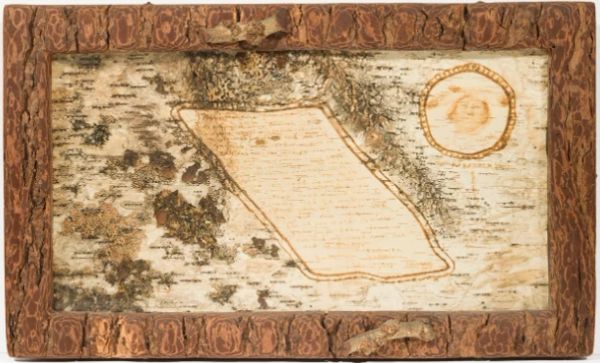
1900 Green River Ojibway birch bark invitation given Alice Longfellow. Birchbark invitation signed by George Kabaoosa, with his portrait by Francis West. He was the grandson of Chief Shingwauk. It is at the Longfellow House National Historic Site.
Odenewasenoquay “The first flash of lightning” was the name the Green River people chose for Longfellow's daughter Alice. She was given the certificate with a a small leather medallion bearing a long-legged bird. The image significance is not documented. At Garden River, however, the symbolism potentially indicates the Chiefs donum. Chief Shingwauk was a member and head chief of the Crane clan, whose traditional role was associated with leadership and the public voice of the community. Historical documentation also records that Shingwauk personally used a plover as his doodem symbol.
THE OJIBWAY TEXT:
- Mah-maun-dah-gosgua dooz / Ah sohgoaum naun Kozewah. Ewh / omegume me-go win Kahiuc kah-duh / ne bo mah gus enon ewh me nik / ga-nuh moon kahween dush we / Kah duh ne boo mah gus-senoon / Ke dah-enaud-daum-nuh Kauga / Ke-we-de-ga-mah gaun-ne wang / Kahy Kedah-nis-e-waug che be / waub-aum me y[?]ng che be ah / yah yaig emah ne we gwou we / ge wauna me naung [?]ah ozhe / to yo[?]ng emah Heawath omin is / e-ming oday ke me waung / egwuh ossibuaig che be dah / zu waub-bum me zaung. / Che ah gwe to gah-ba she / zuamg ge-kaha shewaua / kose nah nig emah and duh / nah ke yaung. / Kabaoosa / Wabanoosa / Boston / Onahbaunegises / DESBRATS / ONT.
- Translation by Alice Longfellow in Thomas Wentworth Higginson’s 1902 biography of Longfellow:
- Ladies: We loved your father. The memory of our people will never die as long as your father’s song lives, and that will live forever.
Will you and your husbands and Miss Longfellow come and see us and stay in our royal wigwams on an island in Hiawatha’s playground, in the land of the Ojibways? We want you to see us live over again the life of Hiawatha in his own country.
Kabaoosa
Wabunosa
Boston, The month of crusts on the snow
NPS Photo / James P. Jones
Genawaaboonagak or “keeping watch while on water"
The Grand Portage Band of Lake Superior Chippewa Indigenous Coast Guard
When the U.S. Coast Guard station at Grand Marais closed in 2022 the Grand Portage Tribal Council had concerns about the loss of “Marine public safety" The chairman of the Grand Portage band testified to the Minnesota Legislature, describing the safety issues from the loss of the government rescue capability on the lake. That testimony, along with collaboration between the Tribe and Lake and Cook county leaders, led to $3 million in state funding for the creation of the Indigenous Coast Guard. Four coast guard coastal type watercraft were ordered. The Grand Portage band will receive two with one each to Cook and Lake counties Sheriff's Departments. The three entity partnership agreed to operate the vessels seasonally, May- November, providing coastal patrols, safety checks, and marine rescue.
The first craft was delivered 6 Sept. 2025, LOA 39 feet It has twin 350-hp outboard motors providng a 50 mph or 43 knot capability. Each craft will be equipped with GPS, radar, sonar, thermal and video imaging, autopilot, spotlights, sirens, and a towing winch.The GPB is the indigenious community to develop Coast Guard capabilities.
© Grand Portage Band of Lake Superior Chippewa
MS Chi-Cheemaun, Manitoulin Island ferry
The name Chi-Cheemaun or"big canoe" in Ojibwe. In 1974 a province wide naming contest was held in Ontario with Chi-Cheemaun being the name chosen. wikicommons
Useage of The "Chippewa" name:

"Chippewa" Lake Superiour side wheeler 1893.
The commercial use of the Chippewa name extended well beyond products and company titles. Businesses, railroads, mining corporations, manufacturers, and ships carried the name into everyday public life through:
- Advertisements
- Ferry tickets
- Railroad timetables
- Invoices and shipping records
- Stock certificates
- Financial reports
- Product labels and packaging
- Boot boxes
- Fishing tackle packaging
- Medicine bottles
- Uniforms
- Official commercial and military records
Each represented another point at which the public encountered the Chippewa name, adding to its historical documentary footprint. For many people, the name was encountered not through history books, but through transportation, commerce, work, recreation, and the ordinary activities of daily life. wikicommons
1845 In Michigan, the Chippewa Copper Mining Company
began work atCopper Peak Chippewa Hill site,
1858-9 Ojibway Gold Mine started with lead and zinc secondary metals. https://thediggings.com/mines/usgs10191492
1873 Ojibbeway Coal Company, Dodgeville Chronicle (Dodgeville, Wisconsin)
1904-5 Chippewa Blood Cordial was marketed in Washington D.C.
1910-7 Immell Bait Company / Immell Bait & Tackle Company, in Blair, Wisconsin produced the Chippewa lure in six different sizes and a dozen colors,
1923-4 Chippewa Coal Mine, Saginaw County, Michigan
1897 The Chippewa Copper Mine began operation in Douglas Co. Wisconsin. https://www.mindat.org/loc-51666.html
1953 and 1954 Studebaker Commander coupes could be ordered in Chippewa Green.
1980 Chippewa Coal Co., Feds Creek, Kentucky
2018 Chippewa fishiing Lures More than a century after their manufacture, Chippewa lures are among the most sought-after name in the collectible sporting goods field. At a major Canadian auction conducted by Miller & Miller Auctions in October 2018, eight of the ten highest-selling lots were Chippewa spinner lures manufactured about 1910 by the Immell Bait & Tackle Company of Blair, Wisconsin. The top example, complete with its original box, sold for CA$10,030. The sale included forty-eight Chippewa lure lots and grossed over CA$175,000.
2024 In a 2024 Blanchard's Auction, a boxed Floating Chippewa Minnow sold for $20,295, and another slightly larger example brought $17,835. Those prices blew past estimates of only $700–1,000.

#152 "Chippewa" a 4-6-2 "Pacific" locomotive with her distinctive color scheme and huge "Hiawatha" logo on the tender. ca. 1940. "Chippewa" was emblazoned on the side of the running boards above the divers. Other non-stream lined locomotives were added with the same colors with "Chippewa" across the top of the tenders. Known locomotives labeled "Chippewa" were engines: # 150, 151,152, and 197. During WWII B-17 43-38889 of the 324th Bomb Squadron, 8th Air Force, was named the "Chippewa Chief-The Milwaukee Road". She logged over 50 missions against Germany and returned to the USA.
The Milwaukee Railroad initated Streamlined passenger service from Chicago to Ontonagon, Michigan in 1937 continuing until 1960. The Milwaukee also ran the Chippewa Valley Line that was initiated in 1882.
© Canadian Pacific Kansas City Ltd.

1868 Wisconsin paddlewheel Packet boat the "Chippewa" on the west Eau Claire Levee. In 1859 the American Fur Company steamboat "Chippewa" was the first packet to reach Fort Benton trading post.[15] The American Fur Company acknowledged the indigenous by naming riverboats for the tribes it traded with. That is not the packet pictured here.
"Names of Steamboats," Compiled by Capt. F.L. (Fielding) Wooldridge (1879-1941)
https://www.umsl.edu/mercantile/pott/pott-collection-supplements/pott013-steamboats-2.html
wikicommons

The tug Chippewa, 1935 on the Eire Canal. She worked for the "Motor Tug Chippewa Inc." In 1940 the US Navy acguired her and renamed her the USS Annawan, YN-50. In Ojibwe "Annawan" literally means “the one who is pulled” or “the one who is given a tug”. The name reflects a deliberate use of the Ojibwe language in commercial maritime service rather than simply the adoption of the ethnonym.

"Chippewa" retired WWII Navy tug YTL-361. She was christened the "Chippewa" in 1976.
©facebook.com/TugChippewa
MV Chippewa car ferry on Puget Sound. At a huge expense she was reconfigured from a passenger ferry into a vehicle ferry in the 1930's.The "Chippewa" was an integral element of life on the sound.
public domain

SS Chippewa, ca.1936
Other vessels named with Ojibwe words not in the Song of Hiawatha or ethnonyms sections:
- KEEGO — yacht 1909 Canadian
- PIKOUAGAMI — tug 1906 Canadian
- BATCHAWANNA — tug 1912 Canadian
- TEMAGAMI — yacht 1905 Canadian
- WAUBAUSHENE — lumber tug 1882 renamed twice, 97 tons Canadian
- WAUBAUSHENE — tug 1904, 135 tons, Canadian
- WAUBIC — freighter 134' 1909 Canadian
- Wawinet ? yacht Canadian
- MACKINAC (1903) — the 110-foot Revenue Cutter taken by the Navy in 1917.
- MACKINAC (1949), WHEC-371 — originally a Navy vessel, transferred to USCG in 1949.
- MACKINAW (1944), WAGB-83 — the original Great Lakes icebreaker.
- MACKINAW (2005), WLBB-30 — Great Lakes icebreaker.

Chief Wawatam railroad ferry unloading at Mackinaw City, Michigan in 1981. Chief Wawatam is famous for being at Fort Michilimackinac and rescuing the fur trader Alexander Henry in 1763.
©Garland McKee

MV Ardmore CHIPPEWA, Oil/Chemical Tanker:
521' length
87' beam,
12 knots
launched 2015
© Ardmore Shipping
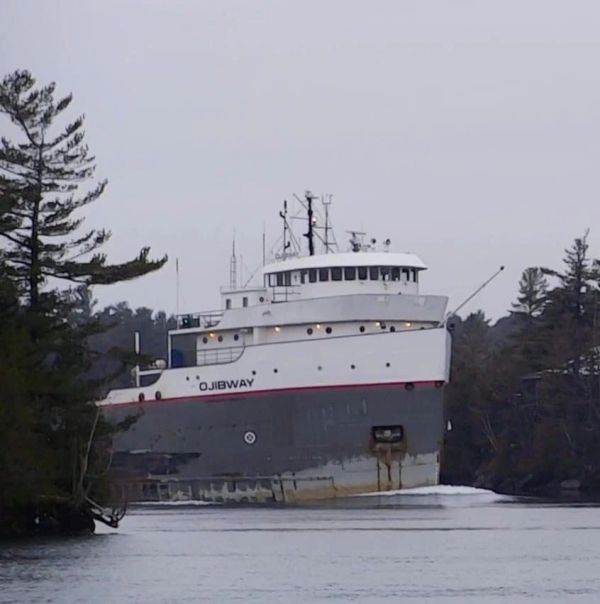
MV Oijbway
renamed Ojibway 2008
642' length
67' beam
14-5 knots
Flagged Canada
launched 1952
scrapped 2023
© Meg Meakin

MV Sunco CHIPPEWA, Chemical/Oil Products Tanker:
154 meters length
22.7 beam
Flagged in Liberia
launched 1980
scrapped 2005
©Sunco
.jpg/:/rs=w:600,cg:true,m)
MV Mississagi Type L6-S-B1
620' length
6o' beam
Flagged Canada
launched 1942
scrapped 2022
wikicommons
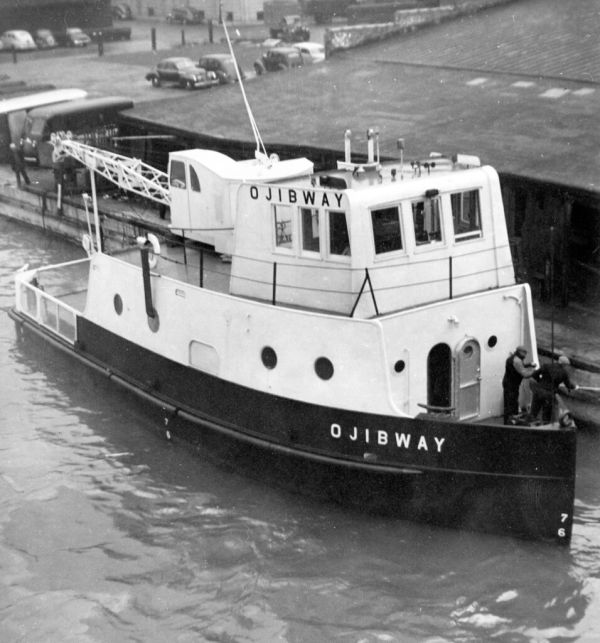
Tug/supply vessel Ojibway
60' length
26' beam
Flagged USA
launched 1943
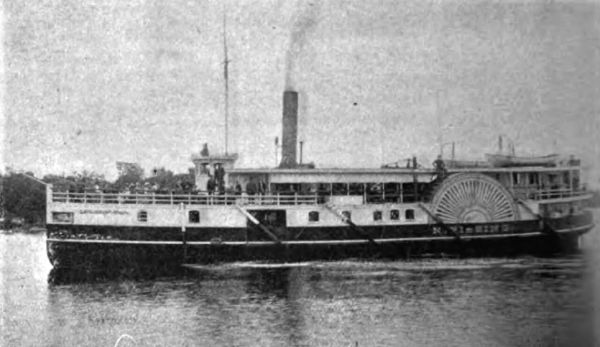
SS Nipissing in 1893
Built 1871 burned and sunk 1887. Raised and rebuilt with the Niipissing name as a sidewheel steamer. converted and renamed RMS Segwun (Ojibwe for "Spring") in 1925. The vessal is the oldest operating steamer in North America.
125' length
21' beam
Flagged Canada
launched 1887
wikicommons
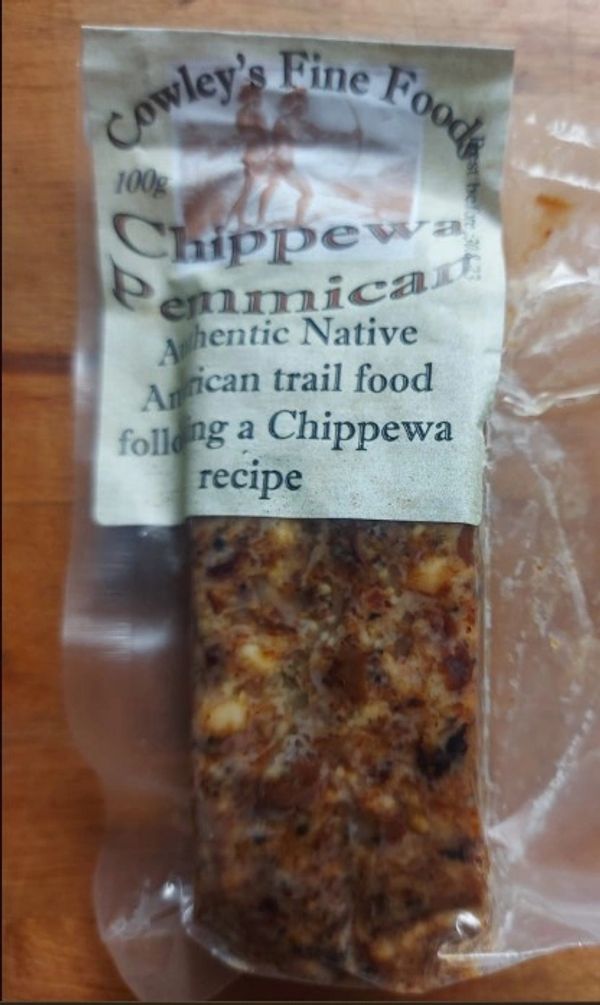
Chippewa Pemmican
Chippewa Pemmican — Cowley's Fine Foods, Trealaw, Wales (United Kingdom). A commercially produced pemmican marketed as "Authentic Native American trail food following a Chippewa recipe." This illustrates the international reach of the Chippewa ethnonym in modern commercial products.
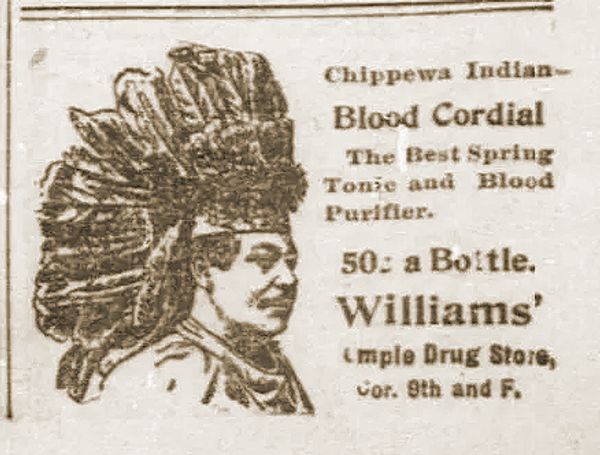
Chippewa Indian Blood Cordial
Marketed as "The Best Spring Tonic and Blood Purifier," This product demonstrates how the Chippewa name was employed commercially during the patent medicine era. The product illustrates another example of the historical documentary and commercial footprint associated with the Chippewa exonym.
Commerical use of the Chippewa name :

©Chippewa Boots, easily the the most successful product to use the "Chippewa" name. The product was marketed for what the name implies: Durability and Toughness. This image documents the commercial footprint of the ethnonym Chippewa.

Chippewa Boots became one of America's best-known work boot brands, widely worn in the construction, trucking, agriculture, forestry, mining, manufacturing, and heavy industrial trades. Founded in 1901 in Chippewa Falls, Wisconsin, the company helped keep the Chippewa name in everyday American commerce for more than a century. Worn by generations of working Americans, the brand became synonymous with rugged durability, dependable craftsmanship, and work performed under demanding conditions. Because every pair bore the Chippewa name, the brand's reputation became inseparably linked to the Chippewa ethnonym itself, making it one of the most enduring commercial footprints of an Indigenous name in North America. In later years, the company became part of Berkshire Hathaway, and U.S. manufacturing eventually ceased as production moved overseas. © Chippewa Boots

Chippewa product labels were preprinted for retailers to add the product name for canned goods. This one had Evaproated Milk added. For these type products the name had the connotation for being natural and healthy.

Chippewa Wagon Works brass sign. Records for the company are not online, but it is believed they were in operation ca. 1880s -1910s, producing the various types of wagons typical for the time. The name conveys that the product was durable. What is notable is Albany, New York was Mohawk land and that name was not used.

Chippewa Grass Rugs advertisement from The Elkins Inter-Mountain (Elkins W. VA) newspaper October 16, 1920, p.3. A simular ad can be found in The Washington Daily News (Washington D.C.) June 1, 1926, p.7.

Chippewa Salt was named for the Chippewa that lived in the Mingo town area, in the Province de Quebec, now Ohio.
"A Survey of Prehistoric People in the Cuyahoga Lands," https://sites.google.com/site/deepcovercleveland/home/prehistoric-indian-earthworks-in-the-city-of-cleveland-and-environs
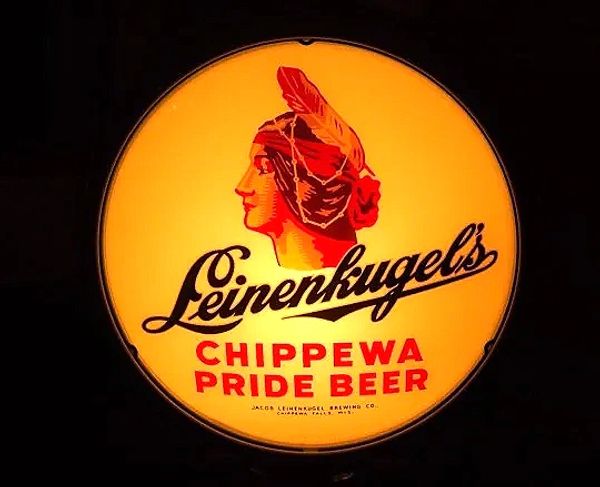
Leinenkugel"s Chippewa Pride Beer lighted sign, ca. 1920-50. Chippewa Falls, Wisconsin. The woman appears to be wearing a eagle feather.
©Leinenkugels

Chippewa Pride Beer serving tray, ca. 1910-50. Both the light above and the tray are highly collectable. A light in mint condition could bring $4,000. A barely used Chippewa Pride tray goes for $600.
©Leinenkugels
Chippewa Spring Water, Chippewa Falls, Wisconsin. The image was revised to a more woodlands appearace replacing the sterotypical headress.
©Purelifewater.com.

Studebaker Chippewa Green
The Chippewa and Ojibwa ethnonyms also entered the vocabulary of commercial color marketing. Automobile manufacturers, paint companies, and specialty finish manufacturers adopted the names for factory paint colors and decorative finishes, further extending the public and commercial footprint of the ethnonyms.
- Studebaker (1953–54) — Chippewa Green (factory automobile).
- Sherwin-Williams — Chippewa Green.
- Sherwin-Williams — Chippewa Red.
- Sherwin-Williams — Chippewa Flat Red.
- Krylon — — — — — Chippewa Sandstone.
- Segreto Finishes — Chippewa Square (SF-6K) yellow-green
- Segreto Finishes — Ojibwa, an earth-brown finish.
- TouchUp King —— Chippewas of Nawash Red 40147 (automotive touch-up color).
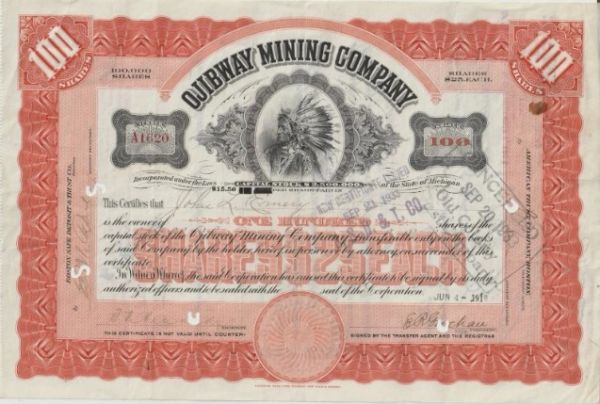
Ojibway Mining Company stock certificate dated: 4 June 1919, Incorporated in Michigan. This image documents the commercial footprint of the ethnonym Ojibway.

Chippewa SC - Medium Lift VTOL Fixed Wing Aircraft, defense sector only,
©IO Aircraft Inc

From Temagami to the YMCA: An Ojibway Legacy in American Family Life
During the early 1920s, Harold S. Keltner, a YMCA leader from St. Louis, traveled to northern Ontario on hunting and fishing trips. His guide was Joe Friday, an Ojibwe man from the Temagami area. During one evening around a campfire, Friday explained the traditional role of an Ojibwe father:
*"The Indian father raises his son. He teaches his son to hunt, to track, to fish, to walk softly."
Those conversations profoundly influenced Keltner. Rather than seeing the Ojibwe father-son relationship as merely an interesting cultural practice, Keltner believed it offered a model that modern American families could learn from. Upon returning to St. Louis, he developed a father-and-son program for the YMCA based on the ideals Joe Friday had shared around the campfire.
In 1926, that idea became the Y-Indian Guides program.
What began with an Ojibwe guide from Temagami, Ontario, Canada, soon grew into one of the YMCA's most successful family programs. Local YMCA chapters across the United States organized themselves into "tribes," "longhouses," and "nations," using Native-inspired names, ceremonies, and activities to encourage fathers and sons to spend time together.
As the program evolved, it was extended to include the entire family. Companion programs were established for fathers and daughters, mothers and sons, and mothers and daughters. What had begun as an Ojibwe-inspired model for strengthening the bond between fathers and sons grew into an inclusive family movement that served generations of American children and parents. In later years, these programs were modernized under the YMCA's Adventure Guides program, but their origins remained rooted in the vision first inspired by an Ojibwe guide from northern Ontario.
The certificate here illustrates that legacy. Issued by the National Council of the YMCA to the "Chippewa Tribe" of the Montclair YMCA. It demonstrates that the "Chippewa" ethnonym had become part of everyday American family life. For the children who belonged to these local tribes, "Chippewa" was not simply a word in a history book—it became the name of their own organization, appearing on membership certificates, patches, banners, handbooks, and countless family activities.
This is an example of the documentary footprint of the Ojibwe people. Unlike a place name or commercial trademark, the Y-Indian Guides program was inspired by an actual Ojibwe model of family relationships. Its roots can be traced directly to conversations between Harold S. Keltner and Joe Friday, an Ojibwe guide from Temagami, Ontario. From those beginnings, an Ojibwe cultural ideal crossed the international border and became part of the lives of generations of American families.
Today, many people remember the Y-Indian Guides only as a childhood activity, if they remember it at all. Few realize that the program itself grew from an Ojibwe example. The certificate issued to the Chippewa Tribe is more than a nostalgic keepsake—it is a surviving artifact of a largely forgotten chapter in the public recognition of the Ojibwe people, illustrating how Indigenous ideas and identity became woven into the fabric of everyday North American life.
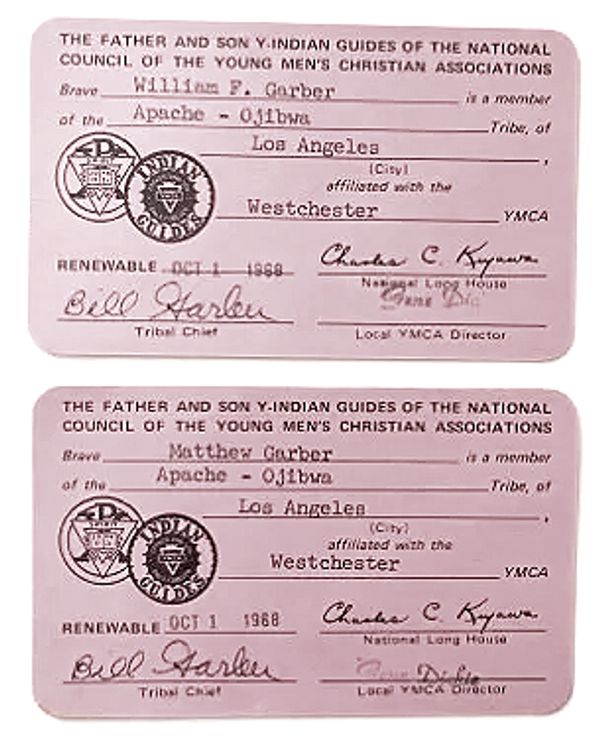
From Temagami to the YMCA: An Ojibway Legacy in American Family Life
The ethnonyms "Ojibwa" & "Apache" were used as the tribal designation on Father and Son YMCA Indian Guides membership cards issued by the Westchester YMCA, Los Angeles, California, 1968.
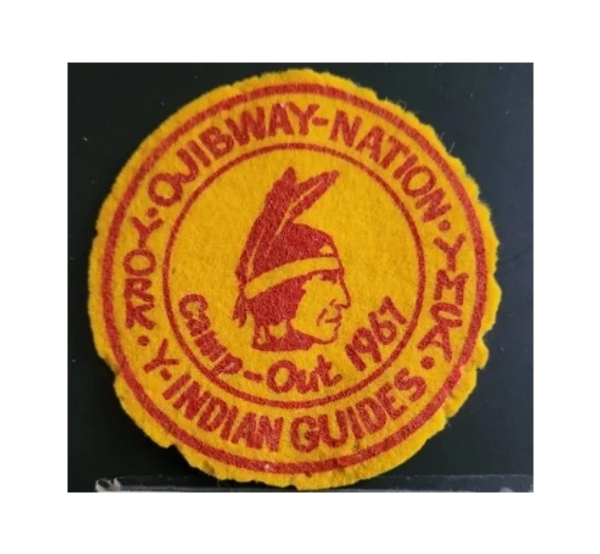
From Temagami to the YMCA: York, Pennsylvania
A 1967 Indian guides patch from a YMCA Indian Guides Camp Out in Pennsylvania.
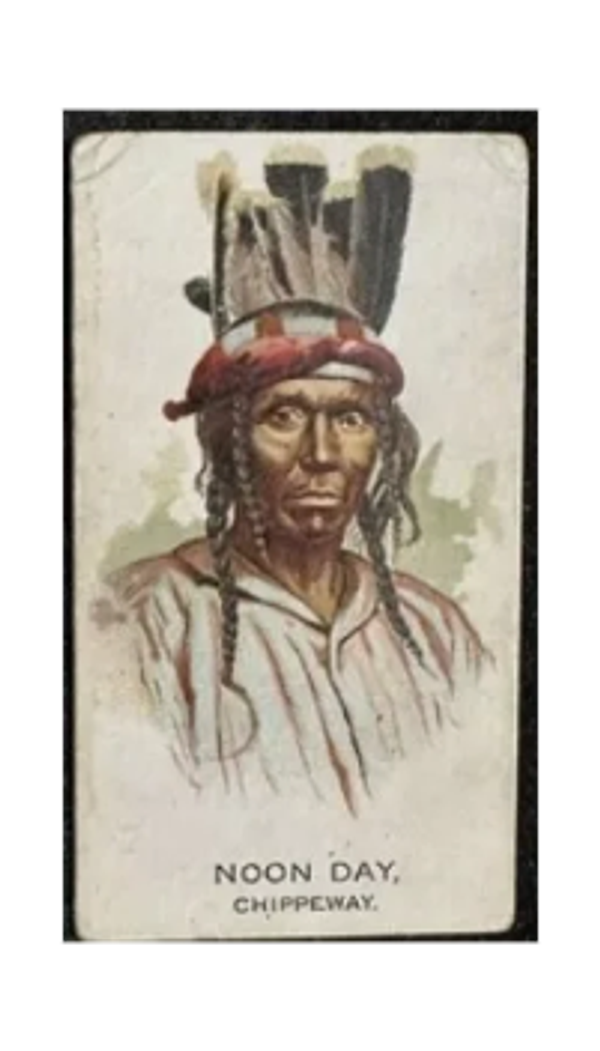
Noon Day (Nung-da-gau) - A Leech Lake Chippeweay Chief in American Trading Cards, 1888–1950
Noon Day (Nung-da-gau), Rabbit Lake band of the Pillagers, had one of the longest commercial lives of any Native American depicted on trading cards. First introduced by Allen & Ginter in 1888, his image was repeatedly reissued by tobacco, caramel, gum, and trading card companies for more than sixty years, appearing in at least ten known card series through 1950. His continued presence reflects the lasting public recognition of both the chief and the Chippewa/Ojibwa people in North American popular culture.
Year Publisher
1888 Allen & Ginter: Celebrated American Indian Chiefs (N2)
1888 Allen & Ginter:The American Indian (N36)
1910 American Tobacco: Indian Chiefs Silks (S67)
1911 Philadelphia Caramel: Indian Pictures (E46)
1927 Weber Bros. Indian Chiefs (D46)
1930 British American Tobacco: Indian Chiefs
1933 Hamilton Chewing Gum: Tee Pee Indians
1934 Papoose Gum: Indians
1949 Topps: X-Ray Roundup
1950 Teepee Gum: Indians
1952 Parkhurst: Tee Pee Gum
1954 Red Man Chewing Tobacco T129
1989 Renata Galasso reprint of the Allen & Ginter
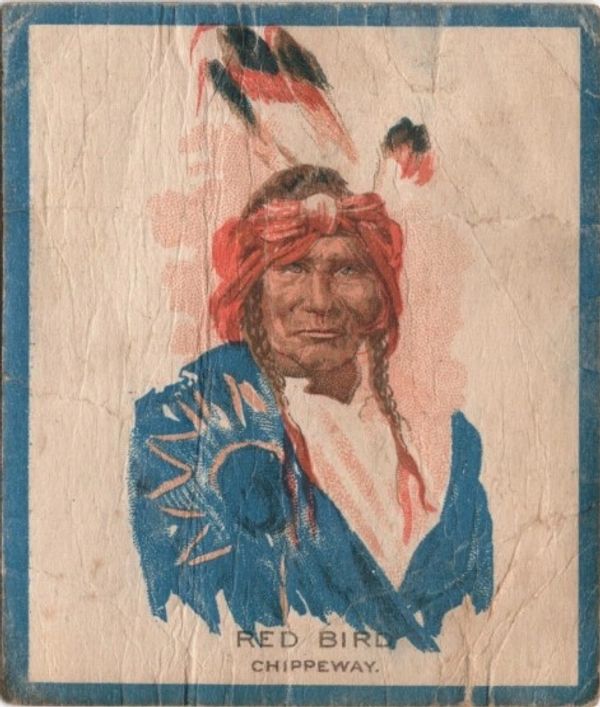
Red Bird (Mis-co-pe-nen-shey) — Commercial Trading Card Appearances
Red Bird's portrait, used from 1888 through 1954, demonstrates a protracted commercial footprint. Over a span of sixty-six years, at least twelve known card series introduced his image to successive generations of Americans and Canadians. Throughout this period, the cards consistently identified him as a "Chippeway" or "Chippewa", making Red Bird one of the most enduring historical figures represented in North American commercial trading cards. The card here is from the Canadian Chewing Gum Co.
Year Publisher
1888 Allen & Ginter: Celebrated American Indian Chiefs (N2)
1888 Allen & Ginter: The American Indian (N36)
1910 American Tobacco: Indian Chiefs Silks (S67)
1911 Philadelphia Caramel Co.: Indian Pictures (E46)
c(D46)
1927 Weber Baking Co.: Indian Chiefs (D46)
1930 British American Tobacco: Indian Chiefs #22
1930 Canadian Chewing Gum Co.: Indian Chiefs (V253)
1933 Hamilton Chewing Gum: Tee Pee Indians (V416)
1934 Canadian Chewing Gum Co.: Papoose Gum Indians (V254) #10
1949 Topps: X-Ray Roundup
1950 Tee Pee Gum: Indians
1952 Parkhurst: Tee Pee Gum #10
1954 Red Man Chewing Tobacco: American Indian Chiefs (T129) #8
1968 A&BC Gum Ltd. Famous Indian Chiefs Stamps, No. 12, Chief Red Bird – Chippeway Tribe
1972 Wagon Wheels, # 25
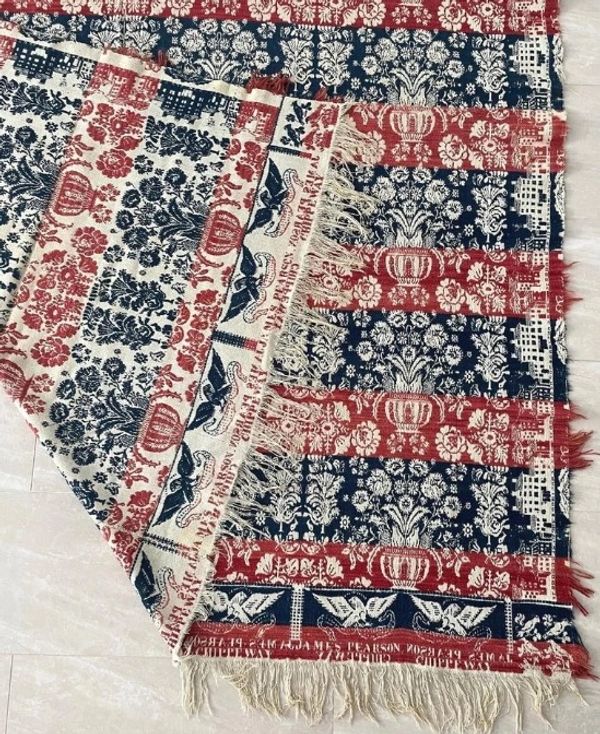
ca. 1830-50 James Pearson, Chippeway, Ohio Jacquard Coverlet 74"x84"
Jacquard Coverlet, ca. 1840s–1850s. The woven border (selvage) repeatedly identifies the maker, James Pearson, Chippeway township Ohio, where the coverlet was woven.
Organized in 1815, the township was named for the Chippeway people. The border alternates normal and mirror-image versions of the word CHIPPEWAY, allowing the inscription to be read correctly from opposite sides of the coverlet, red on one, white on the other. The ethnonym serves not only as a place name, but also as a repeating decorative element in the textiles' design.
More than a nineteenth-century textile, this coverlet serves as a visual metaphor for the historical journey of the Chippewa ethnonym. Woven repeatedly into the border as both identification and ornament, the name became part of the fabric itself. In much the same way, the ethnonym became woven into the fabric of North American life—appearing on maps, townships, railroads, businesses, schools, military units, and countless other aspects of everyday culture. As the name became increasingly familiar, its connection to the Ojibwe people was often overlooked, even though it remained present in plain sight.
Ojibwa products:
Manoomin - wild rice produced by the ©White Earth Nation

©Rocky Boy's Kamut Flour.
©Canoe brand - wild rice White Earth Nation
Produced by the White Earth Nation.
© Wild rice Red Lake Nation
Produced by the Red Lake Nation.
Ziibaakdakaan, Maple Syrup
© Produced by the Chippewas of Nawash Unceded First Nation at Neyaashiinigmiing (Cape Croker), Ontario.