Signed in as:
filler@godaddy.com
THE HISTORIC - ERA APPROPRIATE NAMES ARE USED

Henry Wadsworth Longfellow became permanently associated with the Ojibway through his 1855 epic poem, The Song of Hiawatha. The poem became one of the most widely recognized works of American literature and carried Ojibway names, stories, characters, and cultural imagery into American popular culture and education. Longfellow drew upon material collected by Henry Rowe Schoolcraft, while reshaping that material into his own literary creation and using the name Hiawatha for his central character.
But the documentary record contains a much deeper Ojibway connection to Hiawatha than the familiar statement that Longfellow merely “used Ojibway legends.” At Garden River, Ontario, members of the Ojibway community maintained that their own traditions had been transmitted to Schoolcraft and ultimately to Longfellow. Contemporary newspaper accounts specifically identified the family of Chief Shingwauk as the source of this testimony. One 1900 account reported that members of Shingwauk's family told L. O. Armstrong that the chief had related the legends forming the story of Hiawatha to Schoolcraft, “from whom Longfellow obtained them.”
He was reported performing/reading Longfellow's The Song of Hiawatha “in full costume” before large audiences in the Atlantic States. Volcano Weekly Ledger (Volcano, Amador County, Calif.), February 7, 1857, p.2.
1897 — “Hiawatha the Great: The Story of Longfellow’s Hiawatha”
W. E. Curtis, The Chicago Record, reprinted in the New-York Tribune, July 4, 1897.
Curtis distinguishes the historical Onondaga Hiawatha from Longfellow's literary creation, observing that Longfellow “transforms this grave Onondaga statesman into an Ojibwa demi-god, the son of the West Wind.”
In September 1900, the New-York Tribune reported on an extraordinary performance of The Song of Hiawatha by Ojibway people from the Garden River community. The newspaper described Desbarats as being situated in “the land of Ojibways” and reported that members of the family of Shingwauk, the Ojibway chief, had told L. O. Armstrong that Shingwauk had related the legends forming the story of Hiawatha to Henry Schoolcraft, from whom Longfellow obtained them. The same illustrated article showed the Ojibway performers and the stage on which the drama was presented.
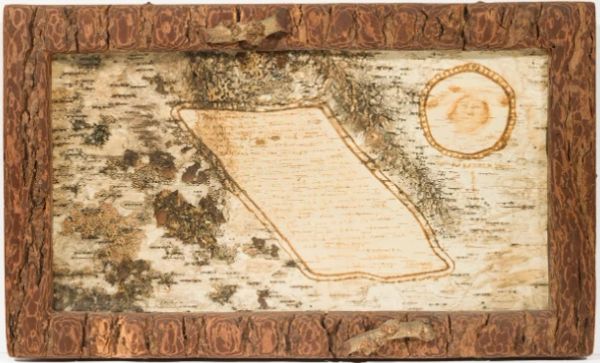
The connection was not simply retrospective. Garden River Ojibway invited members of the Longfellow family to attend the performance. A birchbark invitation preserved in the Longfellow archives survives today. The National Park Service identifies the object as an invitation from George Kabaoosa of Garden River to the Hiawatha performance at Desbarats in 1900.
The invitation was followed by an extraordinary personal encounter. The Longfellow family traveled to Desbarats, where the Ojibway performed Hiawatha for them. During the visit, members of the Longfellow family were formally adopted into the Ojibway community and received Ojibwe names. A contemporary account of the ceremony describes Kabaoosa addressing each person in Ojibway, striking the recipient three times on the shoulder, announcing the new name, and having the assembled Ojibway repeat it. The account states that the names were “valued names in the tribe,” chosen with care and given as proofs of high regard.
The adoption survives not merely in newspaper accounts but in physical objects. Birchbark adoption certificates were created for members of the Longfellow family. Alice Mary Longfellow received the name Odahnewasenoque, also recorded as Odenewasenoquay, translated in the historical record as “The first flash of lightning.” Anne Allegra Longfellow Thorp, Joseph G. Thorp, and Henry Wadsworth Longfellow Dana also received Ojibwe names. The certificates survive in the Longfellow archives.
The certificates themselves are part of the story. They are made of birchbark and carry attached leather medallions bearing a long-legged bird. The National Park Service has documented the objects but has not established the significance of the bird symbol.
The relationship continued after the 1900 visit. Alice Longfellow wrote a 43-page poem describing the family's journey to Desbarats and the Hiawatha pageant. The Longfellow archives also contain correspondence from George Kabaoosa, photographs, notes concerning the pageant, and other material documenting the Garden River connection.
The Garden River production itself developed into an extraordinary cultural phenomenon. Hiawatha, or Nanabozho: An Ojibway Indian Play was performed by Ojibway people, incorporated the Ojibway language, and developed from the Desbarats performances. By 1904 the production and its Native cast traveled to Chicago, Boston, and New York; the following year it traveled to Europe, including a lengthy engagement at Earl's Court in London. The Garden River community continued the Hiawatha tradition for decades.
A connection to the earlier Garden River tradition was also reported: a drum used in the Hiawatha performance had belonged to Chief Shingwauk. It had seen service at the Battle of Queenston Heights during the War of 1812. The Freeland Tribune, Oct. 1,1902., p.2. The report of the drum was repeated in the The Port Gibson Reveille (Port Gibson, Miss.), October 2, 1902, p. 6, LOC. It made the February 17 issue of Sporting Life (Philadelphia), weekly in 1903, p.15.
The poem did not remain confined to literature. The Song of Hiawatha entered American education and became familiar to generations of schoolchildren. At the Pipestone Indian School in Minnesota, students produced The Song of Hiawatha as a school production in 1927. The production became an annual project involving the surrounding community and eventually developed into a regional event.
The Ojibway had, in effect, invaded the American English classroom — thanks to Longfellow. From the elementary grades through the upper grades, generations of American students encountered Hiawatha, Nokomis, Kwasind, Mudjekeewis, Pau-Puk-Keewis, Shingebis, Gitche Manito and other characters and names from Longfellow's Ojibway world. Even students in Thermopolis, Wyoming, were performing Hiawatha on the community stage.
What began as Longfellow's literary interpretation of an Ojibway cultural world had become a national educational and cultural vehicle through which Ojibway names and imagery entered American life.
The reach of The Song of Hiawatha extended far beyond the classroom. Names from the poem appeared on communities, geographic features, transportation, businesses, recreational facilities, vessels, military vessels, schools, horses, and countless other elements of public life. The poem therefore became an important cultural vehicle through which Ojibway names entered the broader vocabulary of North America.
The Milwaukee Road made Hiawatha one of the most recognizable names in American transportation. Beginning in 1935, its streamlined passenger services included the Twin Cities Hiawatha, followed by trains such as the North Woods Hiawatha, Midwest Hiawatha, Chippewa-Hiawatha and Olympian Hiawatha. The railroad also operated the Chippewa service to Michigan's Upper Peninsula, later combining the names as Chippewa-Hiawatha.
The influence reached the visual arts as well. Frederic Remington, Maxfield Parrish, N. C. Wyeth and other prominent American illustrators produced artwork for editions of The Song of Hiawatha, helping carry its characters and imagery into American visual culture.
New-York Tribune, September 16, 1900, p39 https://www.loc.gov/resource/sn83030214/1900-09-16/ed-1/?
The Minneapolis Journal reported on August 31, 1901
https://www.loc.gov/resource/sn83045366/1901-08-31/ed-1/?
The Appeal, Saint Paul, Minn. , August 20, 1904
https://www.loc.gov/resource/sn83016810/1904-08-20/ed-1/?
Among the most enduring names carried into American culture by Longfellow is Nokomis, the grandmother of Hiawatha. Longfellow's use of the name helped make it familiar to generations of readers, and it subsequently appeared on communities, geographic features, neighborhoods, businesses, recreational facilities, vessels and other elements of public life.
The name also entered American naval history. Detroit automobile pioneer Horace Elgin Dodge owned two successive yachts named Nokomis. One entered U.S. Navy service as USS Kwasind (SP-1233), taking the name of Hiawatha's powerful companion in Longfellow's poem. Dodge's second yacht entered Navy service as USS Nokomis (SP-609). A later USS Nokomis (YT-142) served at Pearl Harbor on December 7, 1941, where she assisted vessels during the attack.
Longfellow wrote The Song of Hiawatha in 1855. But the subsequent history of the work was shaped in an extraordinary way by the Ojibway themselves. The Garden River Ojibway transformed the poem into a living Native performance tradition, beginning with their 1900 production at Desbarats. L. O. Armstrong subsequently documented and published that production as “Hiawatha” or Nanabozho: An Ojibway Indian Play. The poem had already entered American literature and education; the Garden River production gave it a new life as an Ojibway performance tradition that could be staged, toured and reproduced.
By the early twentieth century, The Song of Hiawatha had become one of the most widely encountered works of literature in American schools. Generations of students encountered names such as Hiawatha, Nokomis, Kwasind, Mudjekeewis, Pau-Puk-Keewis, Shingebis and Gitche Manito. Through Longfellow's presentation of an Ojibway cultural world—and through the performances that followed—these names entered the broader public vocabulary of North America.
The resulting documentary footprint reflects successive levels of cultural transmission. What began as a literary representation of the Ojibway world became a subject of Native performance, entered American commerce, and spread throughout public life. Names from the poem appeared on communities, geographic features, transportation, businesses, recreational facilities, vessels, military vessels, schools, and countless other aspects of public life. Their adoption across such a wide range of institutions, enterprises, places, and activities documents the reach and lasting presence of this cultural representation in North American society.
A Note on Levels of Cultural Transmission
The appearance of a name does not necessarily represent a direct adoption from Longfellow's work. Names may pass through successive levels of transmission, from literature into geographic names, and subsequently into businesses, institutions, organizations, and other aspects of public life. An enterprise named after a town, for example, may carry forward a name originally introduced through the poem. These intermediate connections are not separate or unrelated occurrences; they are part of the continuing transmission and broader documentary footprint of the Ojibway cultural representation.
During World War I, the U.S. Navy had four ships bearing Ojibwe names associated with Longfellow's The Song of Hiawatha. The yacht Nokomis I, acquired by the Navy in 1917, and renamed USS Kwasind, meaning the vessel carried two different names from the Hiawatha tradition during its history.
This is not intended to be an exhaustive catalogue of every use of Longfellow's Ojibwa names. It is a documentary footprint showing how widely those names and characters moved through American and international culture.
Note: Each of these examples is grounded in the Ojibwa story, no matter how far removed it may be from the people themselves. Multiple levels of transmission moved these names farther and farther from their Native source and into mainstream North American culture, to the point that the original Native source has often been lost, forgotten, or no longer considered.
1867 Hiawatha Co, Newark, New Jersey
The Morris County Chronicle (Morristown, N.J.), October 28, 1913
1890 East Hiawatha Mining Company
The Helena Independent (Helena, Mont.), July 6, 1890, morning edition
1899 Hiawatha Company
The Diamond Drill (Crystal Falls, Mich.), July 1, 1899
1903 The Hiawatha Coal & Coke Company West Virginia
1906 Hiawatha Spring Co, (Minneapolis, New York, Duluth, St. Paul)
La Correspondencia de Puerto Rico (San Juan, P.R.), October 25, 1906
1910 Hiawatha Mercantile Co.
The Salt Lake Tribune (Salt Lake City, Utah), February 17, 1910
1910 Hiawatha Coal Co. & Mine, Hiawatha Utah
The Salt Lake Tribune (Salt Lake City, Utah), December 14, 1911
1911 Hiawatha Land Company
Shoshone Journal (Shoshone, Idaho), March 10, 1911
1912 Hiawatha Company
The Twin Falls Times (Twin Falls, Idaho), January 23, 1912
1912 Hiawatha Mutual Insurance
The Topeka state journal (Topeka, Kansas), January 23, 1912, (LAST EDITION)
1913 Hiawatha Co. Incorporated
10 Sep 1913, Janesville, Wisconsin, USA
1914 Hiawatha Manufacturing Company, Inc.
Yazoo City Herald (Yazoo City, Miss.), September 11, 1914
1919 Hiawatha Medicine Company
The Marietta Journal (Marietta, Ga.), September 26, 1919
1919 Hiawatha Coal Company
The Pleasantville Press (Pleasantville, N.J.), August 2, 1919
1919 Hiawatha Lumber Company
The Oklahoma City Times (Oklahoma City, Okla.), December 10, 1919, late street edition
1922 Hiawatha Manufacturing Company, Inc.
The Port Gibson Reveille (Port Gibson, Miss.), April 27, 1922
1922 Hiawatha Company
The Port Gibson Reveille (Port Gibson, Miss.), May 4, 1922
1930 Hiawatha Company
The Lexington Advertiser (Lexington, Miss.), March 6, 1930
1936 Hiawatha Oil Co. (Wildcat)
San Antonio light (San Antonio, Tex.), August 21, 1936, (HOME EDITION)
1937 Hiawatha Oil and Gas Co.
San Antonio light (San Antonio, Tex.), October 13, 1937, (HOME EDITION)
1946 Hiawatha Plywood Co.
Escanaba Daily Press, 24 Oct 1946, Escanaba, Michigan .
1946 Hiawatha Furniture Co.
Escanaba Daily Press, 24 Oct 1946, Escanaba, Michigan
1954 Hiawatha Broadcasting Company, Centerville, Iowa
1962 Second Hiawatha Corporation, Syracuse, New York
1971 Hiawatha Industries, Hiawatha, Kansas
1975 Hiawatha Produce Company, Winona, Minnesota
1987 Hiawatha Corporation, Farmington, New Mexico
1990 Hiawatha Marketing, Minneapolis, Minnesota
1998 Hiawatha Staffing Services, LLC Red Wing, Minnesota,
2002 Hiawatha Farms, L.L.C. Washington
2006 Hiawatha Enterprises, LLC Washington
2007 Hiawatha Lake, LLC Washington
2010 Hiawatha Valley Mental Health Center, Inc.
2015 Hiawatha Farms, LLC Michigan
2018 Hiawatha Properties East, LLC Washington
2018 Hiawatha Properties North, LLC Washington
2018 Hiawatha Properties South, LLC Washington
2018 Hiawatha Properties West, LLC Washington
2020 Hiawatha Books, LLC Florida
2021 Family Trust and Second Hiawatha Corporation aka Second Hiawatha Corp.Syracuse Post Standard, 7, Feb 2021, New York, NewspaperArchive
Family Trust and Second Hiawatha Corporation aka Second Hiawatha Corp., to 7379 Oswego Road LLC 4242...
2022 Hiawatha Housing LLC Washington
2024 Hiawatha Land Company, LLC Washington
2024 Hiawatha Valley Farms, LLC Washington
* I.O.R.M = The Improved Order of Red Men.- mission is to promote freedom, friendship, and charity through community service, patriotism, and the preservation of American history and traditions
* I.O.O.F. = Independent Order of Odd Fellows- mission is to promote friendship, love, and truth, while providing mutual aid, community service, and support to those in need
Longfellow's Hiawatha Ojibway footprint did not exist only in books, classrooms, theaters and concert halls. By 1910, Hiawatha had entered the American home through the family piano. The Washington Herald, July 3, 1910, reported that more than a million copies of “Hiawatha” had been sold within its first three years, adding that in homes containing pianos, the instrumental or vocal number was rarely absent and that it was part of the repertoire of popular-music players. Samuel Coleridge-Taylor's, Hiawatha's Wedding Feast sheet music sold 126,750 vocal scores + 17,000 tonic-sol-fa copies before World War I.
The school introduced the Ojibwe hero Hiawatha and crew. The theater displayed his tale. The piano brought Hiawatha culture into the home.
Longfellow's The Song of Hiawatha became one of the most widely translated works of American literature. Through editions published across Europe, Asia, and the Middle East, generations of readers encountered Ojibwe names such as Hiawatha, Nokomis, Gitche Manito, Mudjekeewis, and Pau-Puk-Keewis in their own languages. While Longfellow's poem was a literary adaptation rather than an ethnographic account, its extraordinary international circulation extended the cultural and documentary footprint of the Ojibwe far beyond North America. The breadth of these translations demonstrates that Ojibwe names became part of the world's literary heritage.
Documented translations include Albanian, Arabic, Armenian, Belarusian, Bulgarian, Chinese, Croatian, Czech, Danish, Dutch, English, Esperanto, Estonian, Finnish, French, Georgian, German, Greek, Hebrew, Hungarian, Icelandic, Italian, Japanese, Kazakh, Korean, Latvian, Lithuanian, Norwegian, Persian, Polish, Portuguese, Romanian, Russian, Serbian, Slovak, Slovene, Spanish, Swedish, Turkish, Ukrainian, and Uzbek.
The geographic footprint created by The Song of Hiawatha extends well beyond the better-known names Hiawatha and Nokomis. In his 1991 study, Place Names From Longfellow's "Song of Hiawatha," Virgil J. Vogel identified numerous North American places bearing names drawn from the poem. His study includes both documented connections and cases where the connection is probable or suggested by similarity. The following list extracts the Ojibwe names identified by Vogel, minus their broader adoption into everyday life. The numbers indicate the number of places he located with each name.`
Nokomis [grandmother]12
Mudjekeewis [West Wind]1
Osseo [Son of the Evening Star] 4
Wabun / Wabuo [East Wind]2
Shawondasse [South Wind]1
Keewaydio [Northwest Wind]1 definite + 1 possible
Mondamin [corn/maize]1
Nushka [ear of corn]1
Onaway / Onawa / Onoway [uncertain]7
Manito / Manitou [spirit]numerous
Wendigo / Windigo [cannibal/giant spirit]numerous
Ahmeek [beaver]1
Bena [pheasant]2
Dahinda [bullfrog]2
Keego [slender fish]2
Kenabeek [serpent]2
Kenozha [pike]2
Mishe-Mokwa [Great Bear]1
Nahma [sturgeon]1
Omemee [pigeon]2
Opechee [robin]4
Owaissa [bluebird]1
Wabasso [white rabbit]5+
Wawa [wild goose]2
Menahga [blueberry]1 possible
Apukwas [bulrushes/reeds]1
Ishkoodah [comet]1 probable
Muskoday / Muskoda [meadow]2 probable
Wawbeek / Waubeek / Wabeek [rock]4
Pukwana [smoke/smoke signal]1
Ponemah [hereafter/land of the departed]
Chibiabos [spirit/ghost rabbit] 1 + 2 posible
The Hiawatha footprint entered motion pictures almost as soon as the new medium emerged.
* 1901-2 Garden River/Desbarats film footage Charles and Katharine Bowden
* 1903 Hiawatha, the Messiah of the Ojibway, Shot at Desbarats, Ontario with an Ojibway cast.
* 1908 Joseph K. Dixon's Wanamaker expedition produced a motion-picture version of Longfellow's The Song of Hiawatha, using Native performers. Rodman Wanamaker was sufficiently impressed with the production that Dixon subsequently presented 311 illustrated "Hiawatha" lectures in Philadelphia and New York, reaching more than 400,000 people.
1909 Hiawatha, a one-reel silent film
* 1910 The Death of Minnehaha — sequel to Hiawatha
* 1913 Hiawatha a longer silent production, included a native cast
* 1952 Hiawatha entered color feature filmmaking. Directed by Kurt Neumann and produced by Walter Mirisch, the 78–80 minute feature was filmed in Cinecolor and released nationally by Monogram/Allied Artists. The story again drew directly from Longfellow's The Song of Hiawatha.
The story moved again—from literature into mass entertainment. Disney's Little Hiawatha carried Longfellow's literary Hiawatha into another generation of American children. Disney's 1937 animated character was not simply another use of a familiar name; it continued a literary tradition whose principal source was Ojibwa cultural material.
From there, Hiawatha entered children's books, comics, merchandise, and international editions. The books shown here document that movement across languages and national markets, including French, Portuguese, Finnish, Spanish, Dutch, and others.
The publishers were not necessarily preserving Ojibwa culture out of altruism. They were publishing products they believed people would buy. That commercial decision is itself evidence of recognition: Hiawatha was sufficiently familiar and attractive to become a marketable children's character.
Longfellow's literary Hiawatha had traveled a remarkable distance—from Ojibwa cultural traditions into American literature, from literature into mass entertainment, and from American children's culture into books published for children across the seas.
And now the little feet were pounding that Ojibwa cultural footprint into another generation.
The following list was compiled by searching digitized historical newspapers, racing records, breed registries, pedigree databases, agricultural publications, and other surviving online sources. It is not intended to represent every horse ever given an Ojibwa name; rather, it documents the horses that can presently be identified in the accessible historical record.
The significance of this footprint does not depend upon every use being a conscious acknowledgment of the Ojibwe. Quite the opposite. The widespread adoption of Ojibwe names demonstrates how thoroughly they became integrated into the cultural vocabulary of North America. A name such as Hiawatha or Nokomis could be placed on a town, a lake, a horse, a ship, a theater, a train, or a business without explanation because the name had already become familiar to the public. The very absence of explanation is part of the evidence: Ojibwe-derived names had become embedded in mainstream culture.

,Hiawatha and Minnehaha stature 1912 by Jacob Fjelde, Minneapois
© Minnesota Historical Society

wikicommons

Drawn from Longfellow's song of Hiawatha in marble.
wikicommons
Drawn from Longfellow's Song of Hiawatha, Minnehaha and her Father in marble. ©Smithsonian

Odenewasenoquay “The first flash of lightning.” was the name the Green River people chose for Longfellow's daughter Alice. She was given a certificate with a a small leather medallion bearing a long-legged bird. The image significance is not documented. At Garden River, however, the symbolism is potentially significant: Chief Shingwauk was a member and head chief of the Crane clan, whose traditional role was associated with leadership and the public voice of the community. Historical documentation also records that Shingwauk personally used a plover as his doodem symbol.
NPS Photo / James P. Jones
Odenewasenoquay “The first flash of lightning” was the name the Green River people chose for Longfellow's daughter Alice. She was given the certificate with a a small leather medallion bearing a long-legged bird. The image significance is not documented. At Garden River, however, the symbolism potentially indicates the Chiefs donum. Chief Shingwauk was a member and head chief of the Crane clan, whose traditional role was associated with leadership and the public voice of the community. Historical documentation also records that Shingwauk personally used a plover as his doodem symbol.
THE OJIBWAY TEXT:
NPS Photo / James P. Jones

©Minnesota Historical Society

The Chippewa/Ojibwa attended many schools established by Anglo-European institutions from the earliest period of contact. The first schools were founded by Catholic and Protestant missionaries, whose educational efforts continued after responsibility for Indigenous education gradually shifted to the British Crown in Canada and the United States Government. Fur trading companies also participated in education. In 1830 the American Fur Company hired Frederick Ayer to establish a school at its trading post on La Pointe. The following year Ayer moved his classroom to the Company's principal inland post at Sandy Lake, and later to Fort Ripley.
In British North America, Methodist missionaries established a school at Alderville that was promoted in 1848 as a model for Indigenous education throughout the Province of Canada. In the United States, several forms of schools developed, including day schools, mission schools, agency boarding schools, and off-reservation boarding schools.
Among the latter was the Pipestone Indian School in southwestern Minnesota. Although located on the Yankton Reservation, no resident tribal population remained there to supply students. As a result, Pipestone recruited children from reservations throughout the region and functioned much like an off-reservation boarding school. Because many Dakota communities had been removed from Minnesota, the school increasingly recruited students from the Chippewa reservations of northern Minnesota until the Bureau of Indian Affairs eventually prohibited the practice. Consequently, despite being located on Yankton land, the majority of Pipestone's students came by rail from Chippewa communities. During its early years, a chief from White Earth served as a member of the school's staff.
In 1891 Congress made attendance at Bureau of Indian Affairs schools compulsory for many Native American children. Although compulsory school attendance laws already existed in many states, they were not yet universal throughout the United States.
Historically, individual states operated orphanages and institutions for orphaned, destitute, and neglected children. The Bureau of Indian Affairs generally did not provide comparable facilities for Native children. Some tribes addressed this need themselves. The Cherokee Nation established an orphan asylum in 1879, while other communities used boarding schools in part to provide care and education for children who otherwise lacked family support. This occurred among some Ojibwa communities in Minnesota and among the Eklutna in Alaska.
The Daily Alaska Empire, Aug. 14, 1945, p.3 https://chroniclingamerica.loc.gov/lccn/sn83045499/1945-08-14/ed-1/seq-3/
The Daily Chieftain, Oct. 20, 1902, p.1 https://chroniclingamerica.loc.gov/lccn/sn93050700/1902-10-20/ed-1/seq-1/

Pipestone County Historical Society

Pipestone County Historical Society
OTHER "INDIAN" SCHOOLS:
1833 Treaty of Chicago $5,000 was allocated for the Chippewa, Ottawa, and Potawatamie tribe's children to attend the Choctaw Academy, the first boarding school in the U.S.[74] $5,000.00 equates to $187,895.24 in 2024.
1879 The Carisle Indian School opened. Numerous Chippewa students applied to and attended. Their files are available at:
Carlisle Indian School Digetal Centre 2025.
1900 The Carisle School band played the 1900 Paris Exhibition or World's Fair. Louise LaChapelle of the Leech-Lake tribe made the trip. Her school file indicates she was progressive for her time. https://carlisleindian.dickinson.edu/sites/default/files/docs-ephemera/NARA_1327_b047_f2343.pdf
The first Chippewa boarding School in Michigan opened in 1893: Mount Pleasant Indian Industrial Boarding School and closed 1933. It had students from both Wisconsin and Minnesota.
Wisconsin had Chippewa boarding schools:Hayward Indian Boarding School, 1901-1934. The student population was mostly Lac Courte Oreilles band. There was also the Government Boarding School at Lac du Flambeau (on reservation) 1895-1935.
1871 The first boarding school in Minnesota opened at White-Earth. The school newspaper was the "The Chippeway Herald ".
1902 Another school for the Chippewa was the Morris Industrial School for Indians which opened as a Catholic School 1887-96. BIA reopened 1898-1909.
1903 "The Indian Boarding Schools, Non-reservation school, The Need of the Hour" editor, The Tomahawk, Apr. 30, 1903, p.1.
1903 "An Indian's View", letter to the editor of the White Earth Tomahawk, about Indian schools and Indian education, from Kk-che-ze-be-we-ninee.
The Tomahawk, Oct. 8, 1903, p.1.
1904 Col. R.H. Pratt, founder and superintendent of the Carlisle Indian School in the White EarthTomahawk:
"Better, far better, for the Indians had there never been a Bureau" of Indian Affairs."
The Tomahawk, White Earth, May 19, 1904, p.1., MNHS Digital Newspaper Hub.
1904 The Bois Forte and Nett Lake parents refused to send their children to the boarding school at Tower, Minnesota. A student there hadrefused to follow an order from a staff member. Who then stuck the student on the head with a lead billy club instantly killing the student. The staff member was arrested but the intervention of the school superintendant got the charges dropped. "School Boycotted",
The Tomahawk, Feb.12, 1904, p.1, MNHS digital newspaper hub.
1907 Native Indian Art address by Angel De Cora, Carisle Indian Art instructor to the National Education Convention, Los Angeles. https://newspapers.mnhs.org/jsp/PsImageViewer.jsp?doc_id=9f9cced7-0e56-4398-87d3-1f1ab339d023%2Fmnhi0031%2FXETFTD5A%2F07090101
In the north the Canadian Indian residential school system was "funded" by the Department of Indian Affairs and administered by Christian Churches. Attendence became cumpulsory in 1896.
Mount Elgin Industrial Institute aka Muncey Institute – Indian Residential School. The Chippewas of the Thames, the Chippewas of Sarnia, the Moravian of the Thames, and the Mississaugas of the New Credit set aside one quarter of their annuities to support the school, 1850-1946.

wikicommons

This was the pattern of all awards regardless of the award level: Gold, Silver, Bronze, or Honorable mention.
wikicommons

Winners could choose a different pattern, but this one has figures representing North and South America. They could also have smaller versions of their medal made to give as gifts. There is no record the school had medals made for the students. wikicommons

©Chester E. Sogn,1923-47
The topic of "eduacation" is broad when it comes to Native Americans. Typically the schools are lumped together as though they were all the same. Here the focus is on one that was atypical, Pipestone Indian Training School. It was a school built at the request of the Yankton Sioux.
and built upon land the BIA appropriated from the Yankton Pipestone Reservation. That appropiation was not taken well by the tribe and they took it to court and won. Even though the school was on their land and they had the closest reservation to the school, the student population was drawn more from Minnesota's Chippewa reservations, in particular from White Earth. The religious component, typical of many schools, was not an element of Pipestone. Student health was addressed, with the buildling of a hospital on the campus. In 1889 plans and specifications for a Indian School at Pipestone were drawn up.[274] Attendence at non-reservation BIA boarding schools was by application. The length of attendence was specified by the parent on the application they submitted. For Pipestone, many years there were more applications than beds. The Yankton Pipestone quarry site was a culturally significant location for numerous tribes due to the revered red catlinite quarried there.
In 1890 it was reported tribes had requested a school at the Yankton tribe's Pipestone Reservation.[275] An appropriation of $30,000 was requested and $25,000 was approved. The Bureau of Indian Affairs took 100 acres of the reservation land to build the Pipestone Indian Industrial School adjacent to the Pipestone Quarry. The Yankton people long contested that loss and won before the Supreme Court years later. It was one of the BIA's 25 non-reservation boarding schools and amongst the last to be closed. When the school opened the majority of native Americans in Minnesota were Ojibwa and they dominated the school's enrollment throughout it's history. The school had grades 1-8 with a split curriculum, mornings and afternoon groups switching: academics and occupation skills. The school fielded both girls and boys sports teams[276] [277] [278] Post WWI, the Pipestone student body became more diverse, but White-Earth remained the primary source of students until the school closed. Attendance was voluntary and by application. The School superintendent made visits to reservations both in and outside Minnesota to recruit students. The circumstances for the attendance of orphans at the school are not published. In 1952, last year the school was supposed to be open, over 300 students wanted to attend, however due to budget reductions only 130 from Minnesota were accepted. Post WWII newspapers portray the school's secondary tasking as an orphanage.[279] [280] Leaders of the Chippewa were against closing Pipestone School until something could be done to place the kids in permanent situations.[281]
Despite it's location on the Yankton Pipestone reservation it was considered an off-reservation school because their was no resident population.
1891 The Yankton tribe filed a complaint that the school would be placed on the Yankton Pipestone reservation not adjacent to it.[282][283]
1893 The Pipestone Superintendent passed through Marshall, MN with three groups of kids. Two were from White-Earth and Mille-Lacs. The third were Sioux he brought via St Paul.[284]
1894 the Avoca Catholic boarding school for Indian girls closed. The students were transferred to Pipestone and Flandreau after permission was received from the parents.[285]
1895 The Superintendents of the Indian schools at Pipestone and Pierre S.D. both went to White-Earth looking to enroll students. Pipestone got 8 or 9.[286]
1897 Six bright students were escorted back to the Rosebud Agency when classes ended in the Spring [287] In the Fall it was reported 67 Ojibwa children from the Detroit Lakes area were enroute to Pipestone.[288][289]
1899 C.J. Crandall, the first Superintendent of Pipestone, wrote that the legends surrounding the red Pipestone were mostly the creations of the "white man".[290][291]
1900 Congress considered buying the Pipestone Reservation[292]
1901 Pipestone's students won 12 bronze medals in Agricultural Products at the Pan-American Exposition in Buffalo, New York.[293][294]
1902 School enrollment reported at 135 mostly Chippewa.[295][289]
1904 Bids were solicited to provide 35,000 pounds of beef for the school. The desired cuts were specified as well as what would be rejected.[296]
1905 The White-Earth Tomahawk reported the Pipestone School matron, Miss Roy, returned for the new school year accompanied by many White Earth students.[297] White Earth Chief William Madison was the Boys Advisor at Pipestone.[298]
1906 The first 3 students to graduate at Pipestone were Clem Fairbanks, Willie Coffey, and Willie McIntosh from White-Earth. In 1906 enrollment was 215.[299]
1908 the BIA prohibited non-reservation school superintendents from going to reservations and recruiting students.[300] The head of the BIA felt too much money was being spent on the training programs at the non-reservation schools and that they should have the same curriculums as public schools.
1912 the students began publishing a school newspaper that some claim make it the first indigenous newspaper in the country.[301] However, The Oglala Light began publishing at the Oglala Indian Training School in Pine Ridge, South Dakota in 1900.
ca. 1914 Two girls displaying a large example of Ojibwa beadwork at Pipestone.[302]
1915 Congress Approbations for the Minnesota Chippewa: Pipestone School $51,725, $4,000 support of the Chippewa school of the Mississippi bands. A request was made to reserve the mineral rights of all tribal land taken by the whites. Another provision was made for a welfare payment be authorized for any tribal member that was destitute, ill, or incapacitated.[303]
1916 The BIA allocated Indian schools $167/student while PITS was spending $224/student[304] In 1914 the boys made the Tri-state Indian school championship.[305]
1918 School enrollment reported at 165: Chippewa 75, Sioux 55, Winnebago 19, Omaha 19.[289] During commencement PITS displayed a service banner with 35 stars for former students in uniform for WWI.[306]
1927 school enrollment was 340 the school's maximum, many applications were turned down[307]
1927 The school boy scouts preformed Longfellow's Song of Hiawatha for the first time. It became a annual school activity that was later adopted as a community activity. A Charles Morrison was a student from 1910- 1924 who later returned as a teacher. He was helped later, non-native, performers learn the correct pronunciation of the Ojibway words used in the play. (Pipestone Administrative History NM, Chapter VIII, NPS 2025, https://www.nps.gov/parkhistory/online_books/pipe/adhi8.htm )
1930 school enrollment was 315. 375.In 1930 the football team went 7-3 scoring 220 pts vs. their opponents 72. It was notable as almost all their opponents were High schools and Pipestone only went to the 9th grade. The team represented 11 tribes: Chippewa 5, Sioux 5, Gros Ventre 2, Akira 2, Sac-Fox 2, Winnebago 1, Omaha, 1, Oneida 1, and Cheyenne 1. The toughest game was against the Flandreau Indian School team.[308]
In 1932 Pipestone had it's largest enrollment. That year a Hospital was built on the school campus.[309] The building was demolished in 1999.
1940 Applications for enrollment far exceeded school capacity with many turned down to get to the preferred number of 320.
1936 Adam Fortunate Eagle Nordwall and his four brothers arrived from Red Lake and state that enroolment was 136. He also states that 54 of those student entered military service for WWII and that the school prepared them for it. .https://www.pipestonestar.com/articles/band-of-warriors/
1941 The boys basketball team made the news. It was reported that they had won a tournament two years running and were returning. They were noted for defeating the opposition routinely by 15-25 points. Because of this they had to travel over 100 miles to play teams they would or could compete with them.[310]
1947 enrollment demographics and costs per student reported. [311]
1948 the BIA proposed closing all Indian schools. The people of Pipestone said all the other schools could close except Pipestone. Because of the historical significance of the adjoining Pipestone Reservation, it should be exempted. In 1948 the Minnesota Welfare Board insisted that the Pipestone Indian School remain. The governor of Minnesota wrote numerous letters that "many of these children have no homes, no family's, or places to go". [312] That year the school and hospital closures were put off for a year.[313]
1948 Was the last year the School put on the Song of Hiawatha play due to the pending closure. The local community assumed production in 1949.
1949 The school had nearly 400 applications but only 125 were accepted due to reduced funding. Most of those were year round residents. They did not have homes to return to during summer because they were orphans.[314] That year Minnesota U.S. Senator H.H. Humphrey made efforts on behalf of keeping Pipestone open. Le Sueur News-Herald, Mar. 9, 1949, Minnesota Digital Newspaper Hub, 2024, MNHS, St. Paul MN [244]. Communities throughout Minnesota and South Dakota opposed the closing of the Indian School and the Hospital.[315]
In 1952 $135,000 was authorized to fund Pipestone's a last year of operations. That figure equals $1,582,819.32 in 2024 dollars or $12,662/student for 125 students.
1953 the School was scheduled for closure however, $250,000 was appropriated for the 1953-54 school year. The Indian Bureau diverted $72,000 of that money for the Minnesota foster care program for the placement of Pipestone students. The Bureau was ordered to return the monies as well as any Pipestone students it had placed.[316] The Chippewa opposed the closing of the Pipestone school[317][318]
* 1953 Termination Act: House Concurrent Resolution 108 (H. Con. Res. 108), passed August 1, 1953, declared it to be the sense of Congress that it should be policy of the United States government to abolish federal supervision over American Indian Tribes as soon as possible and to subject the Indians to the same laws, privileges, and responsibilities as other U.S.citzens. This includes an end to reservations and tribal sovereignty, integrating Native Americans into mainstream American society.
☆ The solution to the closing of Pipestone was placing the kids in the Foster Home Program.
☆ A student's opinion of Pipestone and "The Writings of Ward Churchill Fulsome and Inflammatory", The Ojibwe News, June 10, 2005, p. 4,5, Minnesota Digital Newspaper Hub, 2024, MNHS, St. Paul MN [245]
☆ PITS, Keeping Victimhood in Perspective, Chuck Trimble, Feb. 25, 2012 Indian Country Today, [246]
☆ Adam Fortunate Eagle Nordwall of the Red Lake Nation with four brothers attended Pipestone. With 8 kids to raise his mother saw Pipestone as a way to solve her situation. Adam credits Pipestone with giving him the training he and his bothers needed to be prepared for military service during WWII.
https://www.pipestonestar.com/articles/band-of-warriors/
☆ In 1929 the US Army turned over to the BIA 3000 Krag rifles with bayonets, scabbards, and ammunition belts for military training at boarding schools.
Evening Star, March 08, 1928, p.6, LOC, https://chroniclingamerica.loc.gov/lccn/sn83045462/1928-03-08/ed-1/seq-6/#date1=1756&index=0&rows=20&words=Army+boarding+Indian+schools&search
☆ The History of Native American Boarding Schools Is Even More Complicated than a New Report Reveals, Olivia Waxman, Time Magazine, May 17,, 2022, https://time.com/6177069/american-indian-boarding-schools-history/
In 1855 Henry Wadsworth Longfellow places the Chippewa at Pipestone in his Song of Hiawatha. He wrote "Here Gitche Manitou called all the tribes together".
2008 Was the last year the Song of Hiawatha was preformed at Pipestone ending what the students started over 70 years earlier.
Chief William Madison made the newspapers after his tenure at PITS. In 1940 he held a press conference with the media concerning the failure of the State to erect monuments acknowledging significant Chippewa history,[319] A decade later, in 1950, he ran for the office of State Senator for Minneapolis.[320]
PIPESTONE STUDENT FILES 1910 -1954 ARE AVAILABLE AT: National Archives at Kansas City, 2025, https://www.archives.gov/kansas-city/finding-aids/pipestone-students.html (RECORD GROUP 75) IS SUPPOSE TO CONTAIN THE YEARS 1894-1910. Direct questions to:
kansascity.archives@nara.gov

Pipestone Indian School bus 4. Chester E.Sogn, Minnesota Historical Society wikicommons

The Red Man, the Carlisle Indian School newspaper at Carlisle, Pennsylvania, January 1, 1898, reprinted an Ojibwa-language article originally published in Anishinabe Enamiad at Harbor Springs, Michigan, in September 1897. The article, “Obstacles Met With in Getting Indian Youth Away From the Old Life,” was dated Mount Pleasant, July 27, 1897, and presents the Ojibwa text together with an English translation. The article is highly critical of the Carlisle Indian School, including allegations concerning its treatment of Native religious beliefs. The text includes the historical Ojibwa word “Anishinabedig,” translated in the accompanying English text as “Indian.”
The entire page can be read at the Library of Congress:
Library of Congress — The Red Man, January 1, 1898, page 2
https://www.loc.gov/resource/2025200871/1898-01-01/ed-1/?sp=2&q=ojibway&r=-0.25,0.824,0.8,0.386,0