Leaders from across the Ojibwa Nation
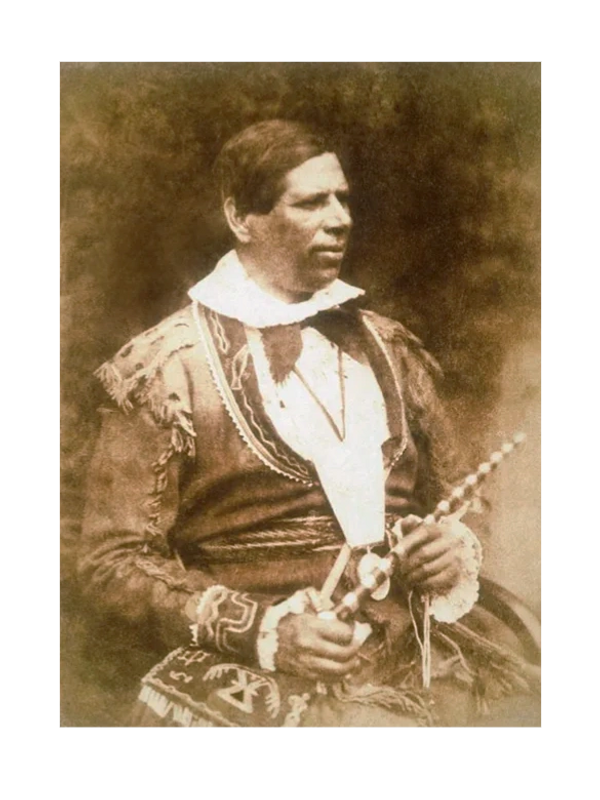
Chief Kah-ke-wa-quo-na-by-was
Calotype of Mississauga band Chief Kahkewaquonabywas, Peter Jones, taken August 4, 1845, Edinburgh, Scotland, by Hill & Adamson. Images taken that day are the oldest known of a Native American. He has a Chiefs medal and his bag has an Ojibwa thunderbird.[4] In 1838 he met Queen Victoria to request the Mississauga Ojibwa be given title deeds to their land. He was a Methodist minister and published a book on the Chippewa in 1861. His son was given his name without "the second or junior" to distinguish him in the records. Chief Kah-ke-wa-quo-na-by-was II or Peter Jones junior became the first Native American to receive a medical degree in British North America. Getty Museum wikicommons

Chief No-Tin or "Wind
1832 Chief No-Tin or "Wind" of the St. Croix band, Henry Inman. Los Angeles County Museum wikicommons

1832 Chief Sha-có-pay or Six
1832 Chief Sha-có-pay or "Six", George Catlin. Saulteaux Chief, at Fort Union, the American Fur Company trading post at the confluence of the Yellowstone and Missouri River in the far west. On Wikipedia this image has been identified as one of the best on Wikipedia. Smithsonian wikicommons
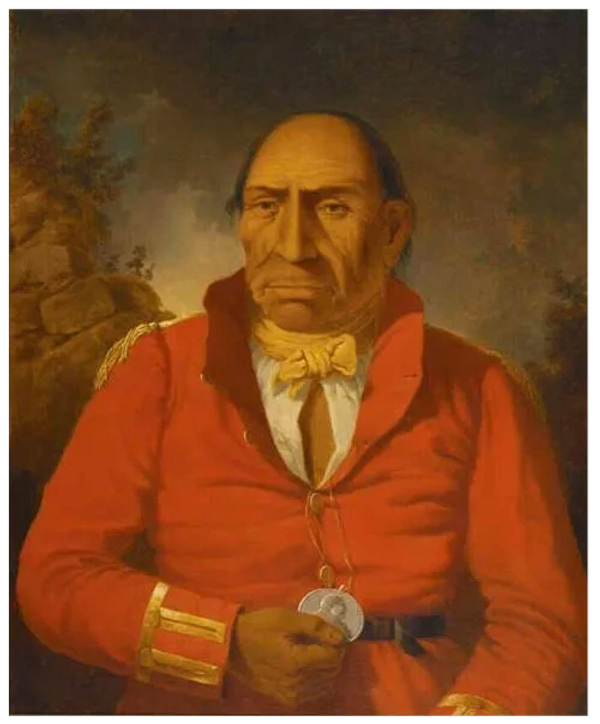
"Chief from Fort William," (Portrait of Chief Maydoc-game-kinungee of the Ojibbeways)
1848 Chief Maydoc-game-kinungee or "I hear the noise of the deer", he was from Fort William, painted by Paul Kane at Fort Michipicoten. The King George III medal likely indicates 1812 service. That would mean he was one of the few that lived long enough to put in for the Military General Service Medal the year before. The verification process took two years or more.
©Royal Ontario Museum

1846 Waw-gas-kontz or "The Little Rat"
1846, Waw-gas-kontz a Saulteaux second Chief, Paul Kane, oil on paper, at Rainy Lake. Most likely the British side of the lake. ©The Stark Art Museum

1845 Nipissing Chief Sha-bo-gesic or "against the heavens"
1845, Paul Kane painted Sha-bo-gesic, oil on paper.
©The Stark Art Museum
Bands that were divided by treaties and or a border:
PEMBINA CHIPPEWA:
The Pembina band lived in the Red river valley of the north. The British first claimed the region in 1670 as part of the royal charter granting Rupert's Land to the Hudson's Bay Company (HBC) giving the HBC exclusive commercial rights over all lands in the Hudson Bay drainage basin as far south as the confluence of the Bois de Sioux and Otter Tail River near Wahpeton, North Dakota, and Breckenridge, Minnesota. Then Pierre Gaultier de Varennes, sieur de La Vérendrye, claimed the area for France in the 1730s. He built a fort at Lake Winnepeg. Britain removed France from the Red River region with the Treaty of Paris in 1763 ending the French and Indian War in North America. The US. and Britian divided the Red River Valley in 1868. During all of this it was the land of the Pembina and Red Lake Chippewa. The creation of Minnesota forced the Pembina band completely into North Dakota onto the Turtle Mountain reservation. On the British side of the border the band became known as the Rosseau River First Nation. In 1849 Father Belcourt wrote Major Woods of the Red River Expedition that the Pembina Chippewa District extended approximately 400 miles from southeastern South Dakota north into Canada and east to west from Cass Lake, Minnesota over 500 miles to the Missiouri River.The Yankton, Yanktonai, and Lakota tribes claimed portions of this same area.
https://www.familysearch.org/en/wiki/Pembina_Band_of_Chippewa_Indians
SAULT STE. MARIE BAND:
The Sault people are the first Anishinaabe to enter the written record in the Jesuit Relations ca.1640. The Ojibwe word "Baawitigowininiwag" was translated to French as "Saulteurs or Saulteaux" meaning "the men at the rapids". France officially claimed Sault Ste. Marie in June 1671, when Simon-Francois Daumont de Saint-Lusson proclaimed the territory surrounding Lake Superior French for King Louis XIV. Fourteen tribes were present including the Chippewa, Ottawa, Potawatomi, Sauk, Menominee, Winnebago, and Cree. Britain took claim from the French in 1761, with the Treaty of Paris in 1763 making it official. During the War of 1812 Britain and the Saulteaux kept control of the Sault Ste. Marie defeating an American attack. However, the area was split for the Sault tribe even though it was their ancestoral land. Those to the north became the Batchewan First Nation. Those to the south became the Sault Ste. Marie Tribe of Chippewa Indians. In 2010 the Sault and Batchewana bands secured the repatriation of tribal remains from the Smithsonian Institution of six ancestors, removed from the burial grounds on Whitefish Island ca.1875
SWAN CREEK AND BLACK RIVER BAND:
Some of the Swan Creek and Black River bands of Chippewa were removed from Michigan by treaty in 1836-7. At first they were sent to Kansas with the Christian Munsee and given a reservation. The government took it making them landless. Many then joined with a band of Potawatomi. This group was known as the Citizen Potawatomi, but by the 1870s they had been moved or removed to Indian Territory with the Cherokee Nation in northeastern Oklahoma. Others had never left Michgan and joined the Saginaw Chippewa Tribe of Michigan.
THE BOIS FORTE BAND:
The Bois Forte Band is an unique 3 way combination in the Anishinaabe world. To the Voyageurs the largest group they named the "Les Songatikitons" or "Strong-wooded Ones". A second group is the Lake Vermilion Band of Lake Superior Chippewa. The third group is another band of Saulteaux that was split by the international border, the southern half of the Little Forks Band of Rainy River Saulteaux.

1874 Cutting the international border "the Slash" across Turtle Mountain. The National Archives UK
Pipestone Indian Training School, one of many:

Girls proudly displaying a large example of Ojibwa beadwork at Pipestone.
©Minnesota Historical Society

Pipestone Indian School students ca.1914 (author's collection)
The Chippewa Ojibwa attended many schools built by anglo-europeans from the earliest contact. The first schools were the work of religious missionaries. Their involvement continued once the British Crown and U.S. Government took over providing indigenious eduction. In addition, fur trading companies hired teachers to establish schools at their trading posts Frederick Ayer was hired by the American Fur Company in 1830 to open a school at the AFC La Pointe trading post. The next year Ayer moved his classroom to the AFC's main inland post at Sandy Lake. From there he moved his classroom to Fort Ripley. In the territory of the British Crown the Methodists opened a school at Alderville that would be promoted as a model to be adopted by the rest of the domain in 1848. In the U.S. different types of schools evolved. One of those was the "off reservation" boarding school. Amongst that group was a unique school at the Yankton Pipestone Reservation, as no one lived on that reservation. So, Pipestone had to recruit students to attend as though it was one of the "off reservation" boarding schools. The BIA took the land for the Pipestone school from the Yankton Pipestone reservation without consent of the Yankton tribe, making it somewhat unpopular with the tribe. Due to the majority of native Dacotah having been evicted from Minnesota, the school Superintendent at Pipestone went to the Ojibwa Chippewa reservations to recruit until the BIA prohibited the practice.So, even though Pipestone sat on Sioux land the majority of the student population, during it's existance, would come by train from the Chippewa reservations in the north. During the early years, a Chief from White Earth was part of the school staff. In 1891 the BIA made school attendance manditory for native american children. While most states had cumpulsory attendence laws in 1891 not all did.
Historically, States dealt with and provided for "orphaned, destitute, and neglected children". The BIA did not do the same for Indian children. The Cherokee Nation created their orphan asylum in 1879 to deal with the issue For some tribes the boarding schools were a means to address the children's issue. It is what the Ojibwa did in Minnesota and what a the Eklutna did in Alaska.
The Daily Alaska Empire, Aug. 14, 1945, p.3 https://chroniclingamerica.loc.gov/lccn/sn83045499/1945-08-14/ed-1/seq-3/
The Daily Chieftain, Oct. 20, 1902, p.1 https://chroniclingamerica.loc.gov/lccn/sn93050700/1902-10-20/ed-1/seq-1/

Students at PITS dated 1914 (author's collection)
OTHER "INDIAN" SCHOOLS:
1833 Treaty of Chicago $5,000 was allocated for the Chippewa, Ottawa, and Potawatamie tribe's children to attend the Choctaw Academy, the first boarding school in the U.S.[74] $5,000.00 equates to $187,895.24 in 2024.
1879 The Carisle Indian School opened. Numerous Chippewa students applied to and attended. Their files are available at:
Carlisle Indian School Digetal Centre 2025.
1900 The Carisle School band played the 1900 Paris Exhibition or World's Fair. Louise LaChapelle of the Leech-Lake tribe made the trip. Her school file indicates she was progressive for her time. https://carlisleindian.dickinson.edu/sites/default/files/docs-ephemera/NARA_1327_b047_f2343.pdf
The first Chippewa boarding School in Michigan opened in 1893: Mount Pleasant Indian Industrial Boarding School and closed 1933. It had students from both Wisconsin and Minnesota.
Wisconsin had Chippewa boarding schools:Hayward Indian Boarding School, 1901-1934. The student population was mostly Lac Courte Oreilles band. There was also the Government Boarding School at Lac du Flambeau (on reservation) 1895-1935.
1871 The first boarding school in Minnesota opened at White-Earth. The school newspaper was the "The Chippeway Herald ".
1902 Another school for the Chippewa was the Morris Industrial School for Indians which opened as a Catholic School 1887-96. BIA reopened 1898-1909.
1903 "The Indian Boarding Schools, Non-reservation school, The Need of the Hour" editor, The Tomahawk, Apr. 30, 1903, p.1.
1903 "An Indian's View", letter to the editor of the White Earth Tomahawk, about Indian schools and Indian education, from Kk-che-ze-be-we-ninee.
The Tomahawk, Oct. 8, 1903, p.1.
1904 Col. R.H. Pratt, founder and superintendent of the Carlisle Indian School in the White EarthTomahawk:
"Better, far better, for the Indians had there never been a Bureau" of Indian Affairs."
The Tomahawk, White Earth, May 19, 1904, p.1., MNHS Digital Newspaper Hub.
1904 The Bois Forte and Nett Lake parents refused to send their children to the boarding school at Tower, Minnesota. A student there hadrefused to follow an order from a staff member. Who then stuck the student on the head with a lead billy club instantly killing the student. The staff member was arrested but the intervention of the school superintendant got the charges dropped. "School Boycotted",
The Tomahawk, Feb.12, 1904, p.1, MNHS digital newspaper hub.
1907 Native Indian Art address by Angel De Cora, Carisle Indian Art instructor to the National Education Convention, Los Angeles. https://newspapers.mnhs.org/jsp/PsImageViewer.jsp?doc_id=9f9cced7-0e56-4398-87d3-1f1ab339d023%2Fmnhi0031%2FXETFTD5A%2F07090101
In the north the Canadian Indian residential school system was "funded" by the Department of Indian Affairs and administered by Christian Churches. Attendence became cumpulsory in 1896.
Mount Elgin Industrial Institute aka Muncey Institute – Indian Residential School. The Chippewas of the Thames, the Chippewas of Sarnia, the Moravian of the Thames, and the Mississaugas of the New Credit set aside one quarter of their annuities to support the school, 1850-1946.
Pipestone Indian Training School 1901 Pan-Am bronze awards

Pan -American Exhibition 14"x18"award Certificate. The Pipestone students would have received 12 of these which authorized their having a Bronze Medal made for each Award they won.
wikicommons

Obverse of the 1901 Pan-American Exhibition Medal
This was the pattern of all awards regardless of the award level: Gold, Silver, Bronze, or Honorable mention.
wikicommons

Reverse of the 1901 Pan-AMerican Medals
Winners could choose a different pattern, but this one has figures representing North and South America. They could also have smaller versions of their medal made to give as gifts. There is no record the school had medals made for the students. wikicommons
PITS, one school's chronology:
The topic of "eduacation" is broad when it comes to Native Americans. Typically the schools are lumped together as though they were all the same. Here the focus is on one that was atypical, Pipestone Indian Training School. It was a school built at the request of the Yankton Sioux.
and built upon land the BIA appropriated from the Yankton Pipestone Reservation. That appropiation was not taken well by the tribe and they took it to court and won. Even though the school was on their land and they had the closest reservation to the school, the student population was drawn more from Minnesota's Chippewa reservations, in particular from White Earth. The religious component, typical of many schools, was not an element of Pipestone. Student health was addressed, with the buildling of a hospital on the campus. In 1889 plans and specifications for a Indian School at Pipestone were drawn up.[274] Attendence at non-reservation BIA boarding schools was by application. The length of attendence was specified by the parent on the application they submitted. For Pipestone, many years there were more applications than beds. The Yankton Pipestone quarry site was a culturally significant location for numerous tribes due to the revered red catlinite quarried there.
In 1890 it was reported tribes had requested a school at the Yankton tribe's Pipestone Reservation.[275] An appropriation of $30,000 was requested and $25,000 was approved. The Bureau of Indian Affairs took 100 acres of the reservation land to build the Pipestone Indian Industrial School adjacent to the Pipestone Quarry. The Yankton people long contested that loss and won before the Supreme Court years later. It was one of the BIA's 25 non-reservation boarding schools and amongst the last to be closed. When the school opened the majority of native Americans in Minnesota were Ojibwa and they dominated the school's enrollment throughout it's history. The school had grades 1-8 with a split curriculum, mornings and afternoon groups switching: academics and occupation skills. The school fielded both girls and boys sports teams[276] [277] [278] Post WWI, the Pipestone student body became more diverse, but White-Earth remained the primary source of students until the school closed. Attendance was voluntary and by application. The School superintendent made visits to reservations both in and outside Minnesota to recruit students. The circumstances for the attendance of orphans at the school are not published. In 1952, last year the school was supposed to be open, over 300 students wanted to attend, however due to budget reductions only 130 from Minnesota were accepted. Post WWII newspapers portray the school's secondary tasking as an orphanage.[279] [280] Leaders of the Chippewa were against closing Pipestone School until something could be done to place the kids in permanent situations.[281]
Despite it's location on the Yankton Pipestone reservation it was considered an off-reservation school because their was no resident population.
1891 The Yankton tribe filed a complaint that the school would be placed on the Yankton Pipestone reservation not adjacent to it.[282][283]
1893 The Pipestone Superintendent passed through Marshall, MN with three groups of kids. Two were from White-Earth and Mille-Lacs. The third were Sioux he brought via St Paul.[284]
1894 the Avoca Catholic boarding school for Indian girls closed. The students were transferred to Pipestone and Flandreau after permission was received from the parents.[285]
1895 The Superintendents of the Indian schools at Pipestone and Pierre S.D. both went to White-Earth looking to enroll students. Pipestone got 8 or 9.[286]
1897 Six bright students were escorted back to the Rosebud Agency when classes ended in the Spring [287] In the Fall it was reported 67 Ojibwa children from the Detroit Lakes area were enroute to Pipestone.[288][289]
1899 C.J. Crandall, the first Superintendent of Pipestone, wrote that the legends surrounding the red Pipestone were mostly the creations of the "white man".[290][291]
1900 Congress considered buying the Pipestone Reservation[292]
1901 Pipestone's students won 12 bronze medals in Agricultural Products at the Pan-American Exposition in Buffalo, New York.[293][294]
1902 School enrollment reported at 135 mostly Chippewa.[295][289]
1904 Bids were solicited to provide 35,000 pounds of beef for the school. The desired cuts were specified as well as what would be rejected.[296]
1905 The White-Earth Tomahawk reported the Pipestone School matron, Miss Roy, returned for the new school year accompanied by many White Earth students.[297] White Earth Chief William Madison was the Boys Advisor at Pipestone.[298]
1906 The first 3 students to graduate at Pipestone were Clem Fairbanks, Willie Coffey, and Willie McIntosh from White-Earth. In 1906 enrollment was 215.[299]
1908 the BIA prohibited non-reservation school superintendents from going to reservations and recruiting students.[300] The head of the BIA felt too much money was being spent on the training programs at the non-reservation schools and that they should have the same curriculums as public schools.
1912 the students began publishing a school newspaper that some claim make it the first indigenous newspaper in the country.[301] However, The Oglala Light began publishing at the Oglala Indian Training School in Pine Ridge, South Dakota in 1900.
ca. 1914 Two girls displaying a large example of Ojibwa beadwork at Pipestone.[302]
1915 Congress Approbations for the Minnesota Chippewa: Pipestone School $51,725, $4,000 support of the Chippewa school of the Mississippi bands. A request was made to reserve the mineral rights of all tribal land taken by the whites. Another provision was made for a welfare payment be authorized for any tribal member that was destitute, ill, or incapacitated.[303]
1916 The BIA allocated Indian schools $167/student while PITS was spending $224/student[304] In 1914 the boys made the Tri-state Indian school championship.[305]
1918 School enrollment reported at 165: Chippewa 75, Sioux 55, Winnebago 19, Omaha 19.[289] During commencement PITS displayed a service banner with 35 stars for former students in uniform for WWI.[306]
1927 school enrollment was 340 the school's maximum, many applications were turned down[307]
1927 The school boyscouts preformed Longfellow's Song of Hiawatha for the first time. It became a annual school activity that was later adopted as a community activity. A Charles Morrison was a student from 1910- 1924 who later returned as a teacher. He was helped later, non-native, preformers learn the correct pronunciation of the Ojibwa words used in the play. (Pipestone Administrative History NM, Chapter VIII, NPS 2025, https://www.nps.gov/parkhistory/online_books/pipe/adhi8.htm )
1930 school enrollment was 315. 375.In 1930 the football team went 7-3 scoring 220 pts vs. their opponents 72. It was notable as almost all their opponents were High schools and Pipestone only went to the 9th grade. The team represented 11 tribes: Chippewa 5, Sioux 5, Gros Ventre 2, Akira 2, Sac-Fox 2, Winnebago 1, Omaha, 1, Oneida 1, and Cheyenne 1. The toughest game was against the Flandreau Indian School team.[308]
In 1932 Pipestone had it's largest enrollment. That year a Hospital was built on the school campus.[309] The building was demolished in 1999.
1940 Applications for enrollment far exceeded school capacity with many turned down to get to the preferred number of 320.
1936 Adam Fortunate Eagle Nordwall and his four brothers arrived from Red Lake and state that enroolment was 136. He also states that 54 of those student entered military service for WWII and that the school prepared them for it. .https://www.pipestonestar.com/articles/band-of-warriors/
1941 The boys basketball team made the news. It was reported that they had won a tournament two years running and were returning. They were noted for defeating the opposition routinely by 15-25 points. Because of this they had to travel over 100 miles to play teams they would or could compete with them.[310]
1947 enrollment demographics and costs per student reported. [311]
1948 the BIA proposed closing all Indian schools. The people of Pipestone said all the other schools could close except Pipestone. Because of the historical significance of the adjoining Pipestone Reservation, it should be exempted. In 1948 the Minnesota Welfare Board insisted that the Pipestone Indian School remain. The governor of Minnesota wrote numerous letters that "many of these children have no homes, no family's, or places to go". [312] That year the school and hospital closures were put off for a year.[313]
1948 Was the last year the School put on the Song of Hiawatha play due to the pending closure. The local community assumed production in 1949.
1949 The school had nearly 400 applications but only 125 were accepted due to reduced funding. Most of those were year round residents. They did not have homes to return to during summer because they were orphans.[314] That year Minnesota U.S. Senator H.H. Humphrey made efforts on behalf of keeping Pipestone open. Le Sueur News-Herald, Mar. 9, 1949, Minnesota Digital Newspaper Hub, 2024, MNHS, St. Paul MN [244]. Communities throughout Minnesota and South Dakota opposed the closing of the Indian School and the Hospital.[315]
In 1952 $135,000 was authorized to fund Pipestone's a last year of operations. That figure equals $1,582,819.32 in 2024 dollars or $12,662/student for 125 students.
1953 the School was scheduled for closure however, $250,000 was appropriated for the 1953-54 school year. The Indian Bureau diverted $72,000 of that money for the Minnesota foster care program for the placement of Pipestone students. The Bureau was ordered to return the monies as well as any Pipestone students it had placed.[316] The Chippewa opposed the closing of the Pipestone school[317][318]
* 1953 Termination Act: House Concurrent Resolution 108 (H. Con. Res. 108), passed August 1, 1953, declared it to be the sense of Congress that it should be policy of the United States government to abolish federal supervision over American Indian Tribes as soon as possible and to subject the Indians to the same laws, privileges, and responsibilities as other U.S.citzens. This includes an end to reservations and tribal sovereignty, integrating Native Americans into mainstream American society.
☆ The solution to the closing of Pipestone was placing the kids in the Foster Home Program.
☆ A student's opinion of Pipestone and "The Writings of Ward Churchill Fulsome and Inflammatory", The Ojibwe News, June 10, 2005, p. 4,5, Minnesota Digital Newspaper Hub, 2024, MNHS, St. Paul MN [245]
☆ PITS, Keeping Victimhood in Perspective, Chuck Trimble, Feb. 25, 2012 Indian Country Today, [246]
☆ Adam Fortunate Eagle Nordwall of the Red Lake Nation with four brothers attended Pipestone. With 8 kids to raise his mother saw Pipestone as a way to solve her situation. Adam credits Pipstone with giving him the training he and his bothers needed to be prepared for military service during WWII.
https://www.pipestonestar.com/articles/band-of-warriors/
☆ In 1929 the US Army turned over to the BIA 3000 Krag rifles with bayonets, scabbards, and ammunition belts for military training at boarding schools.
Evening Star, March 08, 1928, p.6, LOC, https://chroniclingamerica.loc.gov/lccn/sn83045462/1928-03-08/ed-1/seq-6/#date1=1756&index=0&rows=20&words=Army+boarding+Indian+schools&search
☆ The History of Native American Boarding Schools Is Even More Complicated than a New Report Reveals, Olivia Waxman, Time Magazine, May 17,, 2022, https://time.com/6177069/american-indian-boarding-schools-history/
In 1855 Henry Wadsworth Longfellow places the Chippewa at Pipestone in his Song of Hiawatha. He wrote "Here Gitche Manitou called all the tribes together".
2008 Was the last year the Song of Hiawatha was preformed at Pipestone ending what the students started over 70 years earlier.
Chief William Madison made the newspapers after his tenure at PITS. In 1940 he held a press conference with the media concerning the failure of the State to erect monuments acknowledging significant Chippewa history,[319] A decade later, in 1950, he ran for the office of State Senator for Minneapolis.[320]
PIPESTONE STUDENT FILES 1910 -1954 ARE AVAILABLE AT: National Archives at Kansas City, 2025, https://www.archives.gov/kansas-city/finding-aids/pipestone-students.html (RECORD GROUP 75) IS SUPPOSE TO CONTAIN THE YEARS 1894-1910. Direct questions to:
kansascity.archives@nara.gov

Pipestone Indian School bus 4. Minnesota ©Historical Society wikicommons
Henry Wadsworth Longfellow and the Chippewa:
Longfellow is forever linked to the Chippewa by his 1855 "The Song of Hiawatha". It is an epic poem that launched his career. It became a part of 8th grade english across the U.S. for many years The main male character is the Chippewa warrior Hiawatha who is linked to the legend of Nanabozho. In the Song of Hiawatha Longfellow used a large number of Ojibwa words to give authenticity to his sterotyped characters. With a student population primarily Dacotah and Chippewa the Pipestone Indian School boyscouts made the poem a scout production in 1927. It became an annual school project that engaged the local community. It grew to become a regional event that the community continued long after Pipestone closed.
In Michigan Chief George Kabaosa of the Garden River band and, grandson of Chief Shingwaukonse made a stage adaptation of the poem. The tribe first preformed in 1901. Their preformances were popular and went international, with shows in Boston, Chicago, New York, Philadelphia, Pittsburgh, Detroit, London, Portsmouth, Amsterdam, and Antwerp. They also preformed for 20,000 people per night for two weeks at the Toronto Exhibition in 1937. "The Song of Hiawatha", SOOTODAY.COM , 2020 https://www.sootoday.com/columns/remember-this/the-song-of-hiawatha-2147109. From 1905-10 the G.R.& I. R.R. funded and advertised the play at Round Lake, Michigan to promote tourists to see the native American production. They hired Canadian Louis O. Armstrong who worked with Ojibwa from the Garden River Reserve in Ontario. In 2015 the Michigan Historical Commission erected a marker to commerate the history. (Marker # 736.)
It was from this work that the Milwaukee Railroad choose the name for it's "Hiawatha" trains. The "Hiawatha's" served mainlines and were in the everyday vernacular. They ran the mainline from Chicago to St. Paul and the Hiawatha Olympian went to Seattle. Hiawatha's provided service on railroad's Chippewa Valley Line in Wisconsin also. When the railrod updated service to Milwaukee they choose to name the service "Chippewa" for Hiawatha's heritage. It was later changed to Chippewa Hiawatha. But when the railroad went out of business the name did not die. Today's Amtrak still has a "Hiawatha" named for Longfellow's fictional Chippewa warrior.
The artist Frederic Remington created illustrations for the 1891 deluxe edition of Longfellow's The Song of Hiawatha. He did a series of black-and-white oil paintings for each of the poem's cantos. He also did many smaller illustrations and designs for the page margins reflecting the Native American content. Other famous artists that did their versions were Maxfield Parrish; N.C. Wyeth.

Hiawatha and Minnehaha stature 1912 by Jacob Fjelde, Minneapois
© Minnesota Historical Society
_(14782566514).jpg)
Genawaaboonagak or “keeping watch while on water"
The Grand Portage Band of Lake Superior Chippewa Indigenous Coast Guard
When the U.S. Coast Guard station at Grand Marais closed in 2022 the Grand Portage Tribal Council had concerns about the loss of “Marine public safety" The chairman of the Grand Portage band testified to the Minnesota Legislature, describing the safety issues from the loss of the government rescue capability on the lake. That testimony, along with collaboration between the Tribe and Lake and Cook county leaders, led to $3 million in state funding for the creation of the Indigenous Coast Guard. Four coast guard coastal type watercraft were ordered. The Grand Portage band will receive two with one each to Cook and Lake counties Sheriff's Departments. The three entity partnership agreed to operate the vessels seasonally, May- November, providing coastal patrols, safety checks, and marine rescue.
The first craft was delivered 6 Sept. 2025, LOA 39 feet It has twin 350-hp outboard motors providng a 50 mph or 43 knot capability. Each craft will be equipped with GPS, radar, sonar, thermal and video imaging, autopilot, spotlights, sirens, and a towing winch.The GPB is the indigenious community to develop Coast Guard capabilities.
© Grand Portage Band of Lake Superior Chippewa
MS Chi-Cheemaun, Manitoulin Island ferry
The name Chi-Cheemaun or"big canoe" in Ojibwe. In 1974 a province wide naming contest was held in Ontario with Chi-Cheemaun being the name chosen. wikicommons
Useage of The "Chippewa" name:

"Chippewa" Lake Superiour side wheeler 1893.
The name "Chippewa" has seen a great deal of use in the nautical world. Numerous ships or vessels have been christianed with the name; publicly, privately, or militarily. It has also seen extensive use in the commerical world. It has been used as a brand name for salt, patatoes, and beans at the market. It has also seen use in the work world labeling everything from trains and pails to work boots and inner tubes. The Chippewa name has the connotation for toughness, duriablity, dependability, hearty, healthy, and natural. The word Ojibwa has not been adopted for use in a simular manner. wikicommons

#152 "Chippewa" a 4-6-2 "Pacific" locomotive with her distinctive color scheme and huge "Hiawatha" logo on the tender. ca. 1940. "Chippewa" was emblazoned on the side of the running boards above the divers. Other non-stream lined locomotives were added with the same colors with "Chippewa" across the top of the tenders. Known locomotives labeled "Chippewa" were engines: # 150, 151,152, and 197.
The Milwaukee Railroad initated Streamlined passenger service from Chicago to Ontonagon, Michigan in 1937 continuing until 1960. The Milwaukee also ran the Chippewa Valley Line that was initiated in 1882.
© Canadian Pacific Kansas City Ltd.

1868 Wisconsin paddlewheel Packet boat the "Chippewa" on the west Eau Claire Levee. In 1859 the American Fur Company steamboat "Chippewa" was the first packet to reach Fort Benton trading post.[15] The American Fur Company acknowledged the indigenious by naming riverboats for the tribes it traded with.
wikicommons

MV Chippewa car ferry on Puget Sound. At a huge expense she was reconfigured from a passenger ferry into a vehicle ferry in the 1930's.The "Chippewa" was an important part of life on the sound.
public domain

"Chippewa" retired WWII Navy tug YTL-361. She was christened the "Chippewa" in 1976. Tugs are viewed as "tough" which was why the name was chosen.
©facebook.com/TugChippewa

USS Wabanquot (YTB-525), later YTM-525, United States Navy tug 1945 to 1976. Wabanquot was a Hisada-class tug. Named for the famous Chippewa Chief who offered to fight the Sioux in 1862.The tug was the first USN Ship named for a Native American.
wikicommons

Chief Wawatam railroad ferry unloading at Mackinaw City, Michigan in 1981. Chief Wawatam is famous for being at Fort Michilimackinac and rescuing the fur trader Alexander Henry in 1763.
©Garland McKee

MV Ardmore CHIPPEWA, Oil/Chemical Tanker:
159 meters length
26.6 beam,
Flagged in the Marshall Islands,
launched 2015
© Ardmore Shipping

MV Sunco CHIPPEWA, Chemical/Oil Products Tanker:
154 meters length
22.7 beam
Flagged in Liberia
launched 1980
scrapped 2005
©Sunco
Commerical use of the Chippewa name :

©Chippewa Boots, easily the the most successful product to use the "Chippewa" name. The product was based upon what the name implies: Durability and Toughness.

Chippewa boots are widely used in the Construction, Trucking, and Agriculture industries. Founded in 1901 in Chippewa Falls, Wisconsin. The Name sells itself. However, the Company was taken over by Berkshire Hathaway and U.S. production ceased and sent to China. ©Chippewa Boots

Chippewa product labels were preprinted for retailers to add the product name for canned goods. This one had Evaproated Milk added. For these type products the name had the connotation for being natural and healthy.

Chippewa Wagon Works brass sign. Records for the company are not online, but it is believed they were in operation ca. 1880s -1910s, producing the various types of wagons typical for the time. The name conveys that the product was durable. What is notable is Albany, New York was Mohawk land and that name was not used.

Chippewa Salt was named for the Chippewa that lived in the Mingo town area, in the Province de Quebec, now Ohio.
"A Survey of Prehistoric People in the Cuyahoga Lands," https://sites.google.com/site/deepcovercleveland/home/prehistoric-indian-earthworks-in-the-city-of-cleveland-and-environs

Chippewa SC - Medium Lift VTOL Fixed Wing Aircraft, defense sector only,
©IO Aircraft Inc
Ojibwa products:
Manoomin - wild rice produced by the ©White Earth Nation

©Rocky Boy's Kamut Flour.
Ojibwe genre artwork courtesy, zs@z.s.liang
"Searching for the Rogue Bear"

"Solitary Hunter"


"Waiting for the Right Moment"

"Water Lily"

"Solitary Hunter 2006"
©Joe Valequez Ojibwa artwork @ Ansada Group
"The Chippewa"

"Turtle Spirt Shield"

"Healing Light"
"Healing Light"

"Healing Light"
"Autumm Light"
"Ojibwa Night"
"The Growling Rapids"