Nation Leadership:
Traditional Ojibwe Leadership
The Ojibwe Nation extended across the territory that became the international boundary between Canada and the United States. Long before either government introduced its policies concerning Indigenous leadership, Ojibwe communities had established systems of civil authority, military leadership, councils, clan relationships, and spiritual leadership.
The governments of Canada and the United States subsequently introduced different laws and administrative practices intended to replace or diminish traditional political institutions and establish governing structures modeled on Euro-American government.
These policies were not identical, nor were they implemented uniformly. Nevertheless, their combined reach affected Ojibwe communities on both sides of the international boundary.
Understanding the traditional system of leadership is essential to understanding what was changed. The governments were not introducing government to an otherwise unorganized population. They were intervening in existing institutions and changing who could exercise recognized political authority.
Goverance before intervention and displacement by Canadian and United States Government Intervention — 1869 -1936
1. Civil Leadership
The Minnesota Chippewa Tribe's 1978 publication, History of the Minnesota Chippewa Tribe, describes traditional chieftainship as divided into two categories: civil and war.
Civil chiefs held the highest authority within their communities and traditionally received their leadership through hereditary succession. The Crane and Loon clans were identified as principal chiefly clans, although chiefs also came from other clans.
Hereditary succession was important, but leadership was not simply an automatic transfer of office. Personal characteristics, demonstrated ability, and acceptance by the community were important considerations. The historical record also shows that a chief's influence depended upon the confidence and support of the people.
The responsibilities of civil chiefs included:
- Presiding over community councils.
- Making decisions affecting the general welfare of the band.
- Settling disputes.
- Overseeing the use of shared resources and community activities.
- Representing their communities in treaty negotiations, annuity payments, and larger gatherings.
- Maintaining relationships with other communities.
A chief's authority was connected to the people who recognized and supported him. Bands maintained considerable independence, and individuals could join another community.
2. Military Leadership
Military leadership was a distinct function within the traditional system.
War leaders acquired standing through demonstrated ability, courage, military experience, reputation, and their ability to attract followers. Their leadership depended upon the confidence of the warriors who chose to follow them.
Cary Miller, in Ogimaag: Anishinaabeg Leadership, 1760–1845 (2010), distinguishes hereditary leaders, military leaders, elders and headmen, and religious leaders. Miller uses the term mayosewininiwag for military leaders.
This distinction is important. Civil authority and military leadership were recognizable functions, but they did not necessarily represent permanently separated offices. A person could exercise more than one form of leadership.
3. The Relationship Between Civil and Military Leadership
The 1978 Minnesota Chippewa history, reproducing material from William W. Warren's History of the Ojibway Nation, provides a particularly clear description.
Warren identifies Ba-be-sig-aun-dib-ay (Curly Head) as:
"the civil and war chief of the Mississippi Ojibwe."
Warren also identifies prominent military leaders and describes the Bear clan as the acknowledged war chiefs and warriors of the tribe, keepers of the war-pipe and war-club.
The same account describes two headmen associated with a civil chief. They were selected from among the most prominent warriors and acted with the chief on behalf of the band.
These examples illustrate the distinction between civil and military responsibilities, while also demonstrating that the roles could overlap in the same individual.
The system was not a rigid separation in which civil and military leaders could never be the same person. It allowed different forms of authority to operate together.
4. Councils and Collective Authority
Traditional leadership did not necessarily mean that a chief exercised unlimited authority.
Councils, headmen, elders, clan relationships, and community agreement were important elements of political life.
A particularly useful documentary example appears in U.S. Senate Document 444, dated October 24, 1892, concerning the traditional government of the Chippewa at Turtle Mountain.
The document describes the custom of a chief selecting his councilmen from members of the tribe. A councilman served while he could act in harmony with the chief and the majority of the council. When he could no longer do so, he resigned.
It specifically records that Ays Sence, or Little Shell, senior, appointed his council.
This is significant evidence of an established governing system based on customary selection, responsibility, and the continuing relationship between a chief and his council.
5. Spiritual Leadership
Civil and military leadership were not the only sources of authority.
Spiritual leaders, including those associated with the Midewiwin, held important positions within Ojibwe communities. Their influence was connected to spiritual knowledge, religious responsibilities, healing, and relationships with the spiritual world.
Cary Miller's study emphasizes that leadership and authority could derive from overlapping sources, including hereditary standing, demonstrated ability, and spiritual influence.
The traditional system therefore cannot be reduced to two offices alone. Civil and military leadership were important distinctions within a broader structure of community and spiritual authority.
Historical Significance of the Traditional System
The available documentary record describes a political structure that included hereditary civil leadership, recognized military leadership, councils, headmen, clan responsibilities, and spiritual authority.
Communities retained considerable autonomy, while leadership and relationships among communities provided avenues for cooperation and collective action.
The distinction between civil and military leadership is particularly important. It demonstrates that traditional Ojibwe government recognized different responsibilities and forms of authority rather than placing every function under a single office.
This is the political and social structure that must be understood before examining the legislation and administrative policies introduced by Canada and the United States.
CANADA 1869–1906: Introduction and Expansion of the Elective System
1869 — Gradual Enfranchisement Act
On June 22, 1869, Canada enacted the Act for the Gradual Enfranchisement of Indians, the Better Management of Indian Affairs, and to Extend the Provisions of the Act 31st Victoria, Chapter 42.
Section 10 authorized the Governor to order the chiefs of a tribe, band, or body of Indians to be elected by male members aged twenty-one and older.
Elected chiefs would serve three-year terms.
Existing life chiefs were initially protected and could continue in office until death, resignation, or removal by the Governor for specified misconduct.
The legislation established the federal government's authority to introduce an elective system of chiefs. It did not immediately impose elections on every Indigenous community.
1876 — Consolidation of Indian Legislation
The Indian Act of 1876 consolidated earlier legislation and retained provisions for the introduction of an elective system of chiefs.
The government retained authority over the election process, including the power to establish election arrangements and determine the circumstances under which the system would operate.
The available historical study indicates that relatively few bands adopted the three-year elective system immediately following the 1876 legislation.
The Mississauga Band adopted the election provisions by Order in Council on April 7, 1877.
1880 — Indian Act Amendment: Restriction of Hereditary Authority
On May 7, 1880, Canada enacted a further amendment and consolidation of the Indian Act.
Section 72 provided that whenever the Governor in Council considered it advisable to introduce the election system for a band, chiefs would be elected for three-year terms.
The legislation retained the rank of existing life chiefs, but introduced a critical restriction:
Life chiefs could no longer exercise the powers of chiefs unless elected under the new system.
The Department of Indian Affairs' later historical study described this provision as intended to eliminate or diminish the influence of hereditary chiefs.
A hereditary chief could retain his title and rank while losing the political authority traditionally associated with the position.
Circa 1880s — I.W. Powell's Statement on Hereditary Leadership
During discussions concerning the proposed municipal system for Indigenous communities in British Columbia, I.W. Powell, Visiting Indian Superintendent at Victoria, expressed the government's thinking about traditional chiefly authority.
Powell observed that older chiefs continued to exercise considerable influence and that younger elected representatives would create a civilizing influence that would eventually:
"stamp out hereditary chiefship"
He further described hereditary chiefs as the remaining upholders of what he called "ancient ignorance and barbarism."
These are Powell's words, not a description of traditional leadership adopted here.
His statement is reproduced in the Department of Indian Affairs' historical study, Indian Government Under Indian Act Legislation, 1868–1951 (1980).
Powell was discussing Indigenous communities in British Columbia generally, not specifically the Ojibwe. Nevertheless, his statement documents the policy thinking of a Canadian Indian affairs official during the development of the elective system.
1881 — Canada's Stated Assimilation Objective
Prime Minister John A. Macdonald advocated the introduction of municipal government among Indigenous communities considered sufficiently advanced.
In the Department of Indian Affairs' account of Macdonald's policy, he stated that municipal government would accustom Indigenous people to the forms of government prevailing in surrounding white communities and prepare them for earlier amalgamation with the general population.
The proposed changes were therefore connected to the broader assimilation policy of the Canadian government.
1884 — Indian Advancement Act
On April 19, 1884, Canada enacted the Indian Advancement Act.
Its stated purpose was to train Indigenous communities for the future exercise of municipal privileges and powers.
The Act provided for elected councils organized by sections or wards of a reserve.
Male band members aged twenty-one or older could vote. The number of councillors was determined through the Order in Council applying the Act.
After the election, the councillors selected one of their own members to serve as chief councillor.
The Indian agent presided over elections, recorded votes, and had authority to determine who qualified as an elector, subject to appeal to the Superintendent General.
The Act required an Order in Council before it could be applied to a band. It was not automatically imposed on every band in Canada. The Department considered which communities would be permitted to adopt it, while many communities declined or resisted its provisions.
February 26, 1884 — Macdonald Acknowledges Combined Hereditary and Elective Leadership
During the House of Commons debate on the Indian Advancement Act, Prime Minister John A. Macdonald was questioned about the position of chiefs whose authority would be affected by the proposed legislation.
Macdonald acknowledged:
"In some of the tribes there are hereditary and elective chiefs combined. There are great varieties of organizations in the different bands."
He then explained that hereditary chiefs could retain their rank but lose their governing power when the elective system was adopted.
Macdonald also stated that the measure was intended to provide Indigenous people with an opportunity to adapt themselves to the white system.
This is an important statement because it acknowledges that hereditary and elective leadership already existed together in some Indigenous communities. The legislation would not necessarily remove the traditional title, but it could transfer the recognized governing authority to the elected officials.
Macdonald's statement is recorded in the House of Commons Debates of February 26, 1884.
1885–1886 — Initial Application of the Indian Advancement Act
Following enactment of the legislation, the Department sent instructions to Indian agents and superintendents to explain the provisions to bands.
The first band in Canada to adopt the Act was Cowichan, following an Order in Council of January 30, 1886.
Kincolith and other communities subsequently adopted provisions of the Act.
Many bands refused to adopt the system or were considered by government officials unsuitable for its application.
The Department's own historical review reports that by the end of 1886 only three bands had accepted the Act in its entirety. By 1897, only the Mississauga Band and Caughnawaga had accepted it to any substantial degree, although other communities adopted some provisions.
1895 — Expansion of the Three-Year Elective System
On June 15, 1895, an Order in Council extended the three-year elective system to additional bands in the older provinces.
The order included:
- Forty-two bands in Ontario.
- Six bands in Quebec.
- Seven bands in New Brunswick.
The Department's historical study reports no indication that these particular bands had requested the change. It concludes that the government appears to have exercised its authority to place them under the elective system without their consent.
1897 — Department of Indian Affairs States Its Policy
In its Annual Report for 1897, Deputy Superintendent General James A. Smart described the Department's policy in explicit terms:
"The department's policy has, therefore, been gradually to do away with the hereditary and introduce an elective system"
Smart further explained that the new chiefs and councillors were intended to occupy the position of municipal councils in white communities.
This statement is particularly important because it records the Department's stated policy rather than merely the opinion of an individual superintendent.
1899 — Further Expansion of the Elective System
On May 16, 1899, a general Order in Council applied the three-year elective system to bands in Ontario, Quebec, New Brunswick, Nova Scotia, and Prince Edward Island.
There were exceptions.
The Six Nations of Brantford and the Oneidas of the Thames retained their hereditary systems of tribal government. The Mississaugas of the Credit and the Caughnawaga community were already under the Indian Advancement Act.
The Treaty 3 area of northwestern Ontario was legally included in the general order, but officials did not implement the elective system there. The Indian Superintendent and succeeding commissioners did not consider those communities sufficiently advanced for its application.
This illustrates that government policy and actual implementation did not always coincide.
1906 — Consolidation of Indian Legislation
In 1906, the Indian Act and Indian Advancement Act were consolidated into a single statute.
The provisions for the three-year elective system became Sections 93 through 96 of the new Act and remained substantially unchanged.
By this time the government had established a statutory and administrative framework through which traditional chiefly authority could be displaced by elected officials.
The year 1900 was therefore not the date of a single law abolishing hereditary chiefs. The policy had begun decades earlier and developed through successive legislation and administrative orders.
UNITED STATES Federal Allotment, Administrative Intervention, and Elected Tribal Government
Unlike Canada, the United States did not enact one nationwide law declaring hereditary chiefs abolished throughout Indian country.
Instead, the United States used allotment legislation, federal Indian agency administration, and later constitution-based tribal government to reshape Indigenous political institutions.
1887 — General Allotment Act (Dawes Act)
On February 8, 1887, Congress enacted the General Allotment Act, commonly known as the Dawes Act.
The legislation provided for the division of reservation lands into individual allotments rather than maintaining communal ownership.
The Act did not specifically prohibit hereditary chiefs or require the election of tribal leaders.
However, the allotment policy weakened communal landholding and the traditional political and social structures associated with collective ownership and community authority.
Its purpose was also connected to the broader federal assimilation policy, which sought to transform Indigenous people from members of tribal communities into individual landholders and farmers.
1889 — Nelson Act: Minnesota Chippewa
On January 14, 1889, Congress enacted the Act for the Relief and Civilization of the Chippewa Indians in the State of Minnesota, commonly called the Nelson Act.
This legislation was specifically directed at the Minnesota Chippewa.
It established a commission to negotiate the cession and relinquishment of reservation lands and provided for allotments, the sale of surplus lands, and the creation of a permanent fund.
The Act identified the White Earth and Red Lake Reservations as exceptions to the general cession process, although portions of those reservations not required for allotments could also be included.
The Nelson Act was a land and allotment measure, not a law abolishing hereditary chiefs. Nevertheless, its consequences for communal landholding and traditional community organization were substantial.
1892 — Traditional Government at Turtle Mountain Documented
U.S. Senate Document 444, dated October 24, 1892, documented traditional Chippewa government at Turtle Mountain.
It described the custom whereby the chief selected councilmen from the members of the tribe.
Councilmen served while they could act in harmony with the chief and the majority of the council. If they could no longer do so, they resigned.
The document specifically recorded that Ays Sence, or Little Shell, senior, had appointed his council.
This is important documentary evidence that traditional leadership and councils remained active and were organized according to established community customs in the period when federal intervention was increasing.
1892–1932 — Federal Indian Agents at Turtle Mountain
Between 1892 and 1932, federal Indian agents at Turtle Mountain played a dominant role in the selection of tribal governments.
According to the North Dakota Studies historical account, this process disregarded the traditional hereditary leadership system.
Some tribal members continued to recognize Thomas Little Shell as hereditary chief, although he did not assume those duties.
This is a clear example of federal administrative interference with traditional leadership without a nationwide statute expressly abolishing hereditary chiefs.
1918 — Red Lake General Council Constitution
On April 13, 1918, the Red Lake Band adopted a constitution establishing the General Council of the Red Lake Band of Chippewa Indians.
The constitution placed authority in the several chiefs of the reservation and the members they appointed.
Each chief had the power to call a meeting and appoint five members from his band or other bands. The chiefs and their appointees together constituted the Council.
The Council was given authority to decide disputes concerning chiefs.
On August 27, 1918, Article 5 was amended to state that the Red Lake organization and Council would not recognize the General Council of the Minnesota Chippewas as a medium for the transaction of their tribal property business and affairs.
This document demonstrates that Red Lake maintained a distinct governing arrangement under the leadership of its chiefs.
Red Lake did not subsequently join the six-band Minnesota Chippewa Tribe organization established under the Indian Reorganization Act. The Red Lake Nation's own historical account describes its position as a decision to retain traditional hereditary leadership rather than join the proposed organization.
1932 — Turtle Mountain Adopts a Constitution and Elects a Tribal Council
In 1932, the Turtle Mountain Chippewa adopted a constitution and bylaws and elected a tribal council.
This was a locally adopted system of government, established before the Indian Reorganization Act of 1934.
When the federal government subsequently offered the Indian Reorganization Act, the Turtle Mountain people rejected it in a special election and retained their own constitution.
According to North Dakota Studies, the people considered their chosen arrangement a form of self-government.
1934 — Indian Reorganization Act
On June 18, 1934, Congress enacted the Indian Reorganization Act, also known as the Wheeler-Howard Act.
The legislation ended further allotment under the earlier federal policy and provided a framework for tribes to establish written constitutions, bylaws, and elected governing bodies.
Section 18 provided that the Act would not apply to a reservation if a majority of adult Indians voting in a special election rejected its application.
The Act therefore allowed communities to reject its provisions, although the system of written constitutions and elected councils became the principal form of government adopted by many tribes.
The legislation represented a major change in federal Indian policy, but it also encouraged governmental structures that differed from traditional systems of leadership.
1934–1936 — Organization of the Minnesota Chippewa Tribe
The Minnesota Chippewa Tribe was established under the Indian Reorganization Act, bringing six reservations into a single tribal organization.
The six member reservations were:
- Bois Forte.
- Fond du Lac.
- Grand Portage.
- Leech Lake.
- Mille Lacs.
- White Earth.
Delegates participated in the development of a tribal constitution and bylaws.
On May 23, 1936, an order was issued calling for an election on the constitution and bylaws. They were ratified on June 20, 1936, and approved by the Secretary of the Interior on July 24, 1936.
The resulting organization established a representative tribal government under the IRA.
Red Lake remained outside the Minnesota Chippewa Tribe organization.
CONTINUITY OF TRADITIONAL LEADERSHIP
The displacement of traditional authority did not mean that hereditary leadership disappeared.
The Minnesota Chippewa Tribe's own 1978 publication, History of the Minnesota Chippewa Tribe, makes this distinction particularly clear.
It states that, because of the 1934 Indian Reorganization Act, hereditary chiefs no longer possessed the type of leadership authority they had traditionally exercised.
The same publication documents that descendants of hereditary chiefs continued to reside on all the Ojibwe reservations. Some participated in the business and affairs of their bands and served on elected tribal councils. Older community members continued to seek out hereditary chiefs for advice on tribal matters.
Red Lake provides another example of continuity.
Its 1918 General Council was built around the reservation's chiefs and their appointees. A revised constitution was adopted in 1958, followed by the first secret-ballot tribal government election in 1959. The Red Lake Nation continues to recognize seven hereditary chiefs who serve for life in an advisory capacity to the Tribal Council.
These examples demonstrate that traditional leadership survived, even as its formal political relationship to elected government changed.
HISTORICAL SIGNIFICANCE
The governments of Canada and the United States approached Indigenous political organization through different laws and administrative practices.
Canada began legislating an elective system of chiefs in 1869, restricted the authority of life chiefs in 1880, and expanded elective government through subsequent legislation and Orders in Council.
The United States did not enact an equivalent nationwide prohibition. It weakened traditional institutions through allotment and federal administrative interference and later promoted constitution-based elected governments through the Indian Reorganization Act of 1934.
The two governments did not introduce the same system, nor did they affect every Ojibwe community in the same way.
Nevertheless, their policies reached Ojibwe communities across the international boundary. The political consequences extended throughout the Ojibwe Nation, even though the individual bands and communities retained their own identities, customs, and governing relationships.
The historical distinction is essential: the loss of authority recognized by federal governments did not mean the disappearance of traditional leadership or the loss of community recognition.
The significance of this intervention is greater when viewed against the historical record. The decentralized division of civil and military leadership had served the Ojibwe Nation through generations of territorial defense, recovery, and westward expansion. Government intervention constrained the Nation's ability to exercise that established system of leadership and determine its own political direction.
Both governments intervened in existing systems of Ojibwe leadership. They changed the structure through which political authority was officially recognized, but they did not erase the traditions, relationships, or hereditary lines that had sustained leadership within the communities.
Women leaders:
War ogimaakwe — unidentifed Mackinac, 1814 (Jane Schoolcraft)
Agatha Biddle — Mackinac. ca. 1830s
Maw che paw go quay — Chiefess, Mackinac Band. 1853
Ruth Flatmouth — hereditary woman leader, Pillagers, 1889
Lucy LeBlanc — tribal president, Bay Mills, 1937
Elsie Knott — elected Mississauga chief, Curve Lake, 1954
Myrtle Tolonen — elected tribal president, Keweenaw Bay, 1984
Marge Anderson — Minnesota tribal chief executive, Mille Lacs, 1991
2000s–present — multiple Ojibwe women serving simultaneously as elected heads of their bands
Sources and documentary references:
1. Traditional Ojibwe government: Minnesota Chippewa Tribe, History of the Minnesota Chippewa Tribe (1978), especially Chapter One. The publication acknowledges that it adapted pages 42–52 of William W. Warren's History of the Ojibway Nation.
2. Leadership scholarship: Cary Miller, Ogimaag: Anishinaabeg Leadership, 1760–1845 (University of Nebraska Press, 2010).
3. Canada, 1869: An Act for the Gradual Enfranchisement of Indians (1869).
4. Canadian policy and legislation: Wayne Daugherty and Dennis Madill, Indian Government Under Indian Act Legislation, 1868–1951 (Department of Indian and Northern Affairs, 1980). This is the principal source for the 1880 amendment, Powell's statement, Macdonald's 1884 remarks, the 1897 departmental policy statement, and the 1895 and 1899 Orders in Council.
5. Canada, 1884: The Indian Advancement Act, 1884, in Indian Acts and Amendments, 1868–1950.
6. United States, 1887: National Archives, General Allotment Act (Dawes Act).
7. Minnesota, 1889: Nelson Act, January 14, 1889, 25 Stat. 642.
8. Turtle Mountain, 1892 and later: North Dakota Studies, Traditional and Contemporary Chippewa Government at Turtle Mountain. This source quotes Senate Document 444, October 24, 1892, and discusses the federal agents' later involvement in tribal government.
9. Red Lake, 1918: Constitution of the Red Lake Band of Chippewa Indians, adopted April 13, 1918.
10. Red Lake continuity: Red Lake Nation, Tribal History and Historical Photos and Red Lake Nation, Tribal Council.
11. United States, 1934: Indian Reorganization Act, 48 Stat. 984, including Section 18.
12. Minnesota Chippewa Tribe organization: U.S. Department of the Interior, Minnesota Chippewa Tribe background.
13. Territorial and band relationships: Chippewa Indians of Minnesota v. United States, 301 U.S. 358 (1937). The Supreme Court's historical account describes the earlier treatment of the Chippewa as one large tribe and the later recognition of distinct bands occupying separate areas.

.
Leaders from across the Ojibwa Nation

Chief Kah-ke-wa-quo-na-by-was
Calotype of Mississauga band Chief Kahkewaquonabywas, Peter Jones, taken August 4, 1845, Edinburgh, Scotland, by Hill & Adamson. Images taken that day are the oldest known of a Native American. He has a Chiefs medal and his bag has an Ojibwa thunderbird.[4] In 1838 he met Queen Victoria to request the Mississauga Ojibwa be given title deeds to their land. He was a Methodist minister and published a book on the Chippewa in 1861. His son was given his name without "the second or junior" to distinguish him in the records. Chief Kah-ke-wa-quo-na-by-was II or Peter Jones junior became the first Native American to receive a medical degree in British North America. Getty Museum wikicommons

Chief No-Tin or "Wind
1832 Chief No-Tin or "Wind" of the Snake River St. Croix band, Henry Inman. Los Angeles County Museum wikicommons

1832 Chief Sha-có-pay or Six
1832 Chief Sha-có-pay or "Six", George Catlin. Saulteaux Chief, at Fort Union, the American Fur Company trading post at the confluence of the Yellowstone and Missouri Rivers in the far west. On Wikipedia this image has been identified as one of the best on Wikipedia. Smithsonian wikicommons

"Chief from Fort William," (Portrait of Chief Maydoc-game-kinungee of the Ojibbeways)
1848 Chief Maydoc-game-kinungee or "I hear the noise of the deer", he was from Fort William, painted by Paul Kane at Fort Michipicoten. The King George III medal likely indicates 1812 service.
©Royal Ontario Museum

1846 Waw-gas-kontz or "The Little Rat"
1846, Waw-gas-kontz a Saulteaux second Chief, Paul Kane, oil on paper, at Rainy Lake. Most likely the British side of the lake. ©The Stark Art Museum

1845 Nipissing Chief Sha-bo-gesic or "against the heavens"
1845, Paul Kane painted Sha-bo-gesic, oil on paper.
©The Stark Art Museum

Sault Ste Marie Chief Kaw-Baw-Gam. In 1845 he showed a U.S. surveyor iron ore in the roots of a tree in Michigan that began the iron ore industry in the great lakes region.
©The Stark Art Museum

Chief Naagaanab or The Foremost Sitter, Fond du Lac second Chief, ca. 1862
He and his cousin Shin-Gwack were the Fond du Lac Chiefs that met Lincoln just prior to the Mdewakanton Uprising. He was a second chief, Shin-Gwack was the FDL hereditary Chief. Together they sent Lincoln a letter offering to fight the Sioux and remove them from Minnesota. That offer made them national news in 1862 and identified them as Wisconsin Chippewa. Photograph by J. E. Whitney, St. Paul, Minn. Shin-Gwack, or The Balsam, had multiple spellings of his name, Shingoop or Zhingob are others. ( letter is on page 1)
Minnesota Historical Society

Chief Okee-Makee-Quid 1826
In 1825, Chippeway Chief Okee-Makee-Quid attended the Treaty of Prairie du Chien. At the treaty, he made an exchange of apparel with a Sioux warrior. It is possible that this is what he is wearing in this image, painted by James Otto Lewis. Both the artist and the chief attended the 1826 Fond du Lac Treaty in western Michigan Territory. He wears an animal-hide gorget bearing the head of a canid, the species is indeterminate.
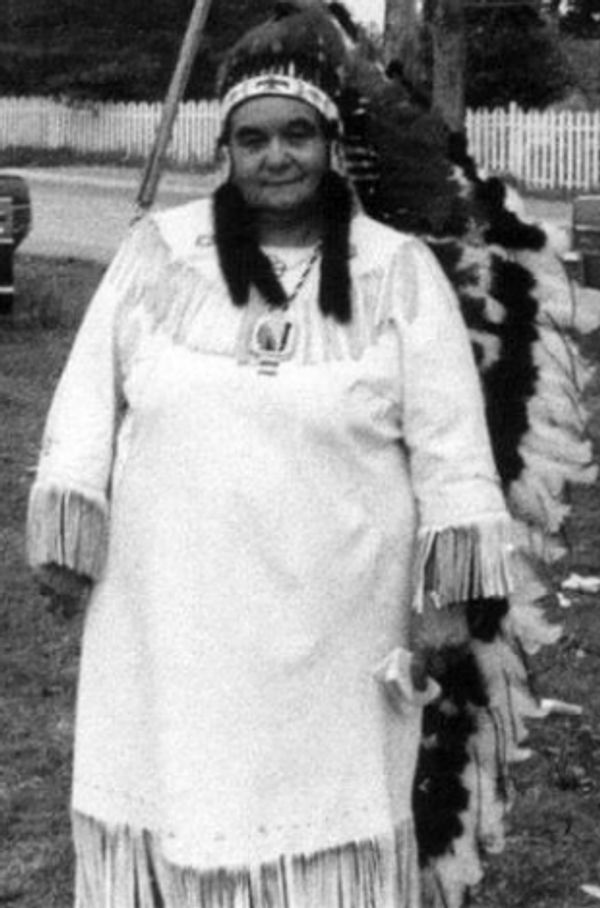
Elsie Knott
Elsie was first woman elected chief in Canada by the Mississaugas of Mud Lake Band in 1954; Curve Lake in 1964. She won in a landslide. In 1951 parliament voted to allow women to run for office.
Photo courtesy of the Curve Lake Cultural Centre Archives