Signed in as:
filler@godaddy.com

In 1900 the San Francisco Chronicle (CA) Jan. 23, on page 6 ran an article "RUNS A WOLF FARM" the Gissler's were "discovered" by a gold prospector, about twelve miles from Rainy Lake City.
Her story made it into numerous newspapers
* Logansport Pharos Tribune, Aug. 19, 1907, p.7 Logansport, Indiana, NewspaperArchive
* Kingwood West Virginia Argus, Aug. 22, 1907, p.1 Kingwood, West Virginia, NewspaperArchive
* Oswego Daily Palladium, Aug. 24, 1907, p.2 Oswego, New York, NewspaperArchive
* Bradford Era, Aug. 31, 1907, p.7, Bradford, Pennsylvania, NewspaperArchive
* The Daily Telegram (Clarksburg, W. Va.), Sept. 11, 1907, p.6, LOC
* The River Press (Fort Benton, Mont.), Sept.18, 1907, p.7, LOC
* Grant County Herald (Lancaster, Wis.), Sept. 21, 1907, LOC
* Saturday News (Watertown, S.D.), Sept. 25, 1908
p.11, LOC
* The Topeka State Journal (Topeka, Kansas), Dec. 7, 1899, (LAST EDITION) LOC
* INDIAN MAIDEN RAISES WOLVES
Cincinnati Commercial Tribune, July 28, 1907, p.19, Cincinnati, Ohio, NewspaperArchive
* QUEEN OF THE WOLVES
Norwich Sun, Aug. 21, 1907, Norwich, New York, p.4, LOC
Oswego Daily Palladium, Aug. 24, 1907, p.2, Oswego, New York, Newspaper Archive
* QUEEN OF THE WOLVES
Bradford Era, Aug. 31, 1907, p.7,Bradford, Penn.
* QUEEN OF THE WOLVES:
Skagway Daily Alaskan, Oct. 2, 1907, p.12, Skagway, Alaska, NewspaperArchive
* Titusville Herald, Sept. 7, 1907, Titusville, Pennsylvania, p.8, NewspaperArchive
* The Daily Telegram (Clarksburg, W. Va.), Sept.11, 1907, p.6, LOC
* Grant County Herald (Lancaster, Wis.), Sept. 21, 1907, p.7, LOC
* Watertown Saturday News, Sept. 21, 1908, p.11, Watertown, South Dakota, NewspaperArchive
* The West Virginia News (Ronceverte, W. Va.) Dec. 21, 1907, p.17, LOC
* QUEEN OF THE WOLVES, Saturday News (Watertown, S.D.), Sept. 25, 1908, p.9, NewspaperArchive
* RAISING WOLVES FOR BOUNTY - QUEER BUSINESS GOING ON IN THE WOODS NEAR PRINCETON, The Saint Paul Globe (St. Paul, Minn.), Feb. 13, 1898 LOC
* Philadelphia Times, Nov. 14, 1899,p.2,Philadelphia, PA NewspaperArchive
* Keeseville Essex County Republican, Nov. 23, 1899, p.2, Keeseville, New York, NewspaperArchive
* The Topeka State Journal (Topeka, Kansas), Dec. 7, 1899, p.7 (LAST EDITION), LOC
* Syracuse Evening Herald, Jan. 19 1900, p.10,Syracuse, New York, NewspaperArchive
* Smethport McKean Democrat, Mar. 2, 1900, p.4 Smethport, Pennsylvania, NewspaperArchive
* Athens Array, Mar. 2, 1900, Athens, Alabama,
NewspaperArchive


.


© St. Louis County Historical Society

Katherine Bonno was born on Sugar Island and was a member of the of the Sault Ste. Marie Tribe of Chippewa Indians.
NewspaperArchive
"The stories of our ancestors are the roots of our strength."
Elder's wisdom

"Ah-Shaw-Way-Gee-She-Go-Qua or Hanging Cloud", was an Ojibwe/Chippewa warrior woman whose reputation was extraordinary even by the standards of her own people. Her father, Na-na-wong-ga-be, was a chief at Rice Lake, Wisconsin, and her family held hereditary standing within the Ojibwe community. His band was a sub-band of the Lac-Court-Oreille.
Accounts of her warrior career differ in their details. One tradition says that she envisioned joining a war party against the Sioux and subsequently led a war party into Minnesota, where she killed and scalped four enemies. Another account says that after her father's death she avenged him by killing three Sioux. The differing accounts make it difficult to determine the precise number of her war honors, but all portray her as a woman who achieved recognized warrior status through her own actions.
A notable contemporary newspaper account, "A Real Amazon or Hanging-Cloud ", The Southern Enterprise Vol. X No. 2, 14 May 1863, p., LOC. [63] states she led a war party and battled the Sioux for two days during the Mdewakanton Uprising. It states the Chippewa killed nine, four of which fell to Hanging Cloud. The account says her war record had made her a figure of extraordinary distinction among her people.
It describes her as the “Forest Queen” and states that she had been elevated to “the highest honors in all their ceremonies.” It also says:
“She alone, of all the females, is permitted at all festivities to associate, mingle and connect with the bravest of the braves of her tribe.”
In 1857 Richard E. Morse, in the Wisconsin Historical Collections, describes her as “the pride of her tribe” and records that she participated in warrior dances and ceremonies, marched with the warriors, and wore the plumes of a warrior. He wrote of her standing among men:
“No warrior nor brave need presume to win her heart or to gain her hand in marriage, who cannot prove credentials to superior courage and deeds of daring upon the war-path.”—Richard E. Morse, The Chippewas of Lake Superior, Wisconsin Historical Collections, Vol. III, 1857, pp. 349–354.
Morse, observing Hanging Cloud at La Pointe in 1855, recorded two warrior plumes in her hair, decorated with colored ribbon devices that indicated the enemies killed and scalps taken by her. After 1862 her warrior insignia would have reflected a greater number of coups.
Hanging Cloud subsequently married three times, all to white men, and had children. Her later life therefore crossed yet another cultural boundary, but the accounts of her warrior career had already established her as one of the most remarkable Ojibwe women to enter the historical record.
Contemporary newspapers called her the “Chippewa Warrior Princess,” a metaphorical expression reflecting her status as a chief's daughter and her extraordinary distinction among her people.
* "A Chippewa Princess," New York Herald, Jan. 13, 1856, p.1, LOC. [64] https://www.loc.gov/resource/sn83030313/1856-01-13/ed-1/?sp=6&q=chippewa+princess&r=0.342,0.018,0.404,0.195,0
* "A Chippeway Princess," New York Dispatch, Jan. 20, 1856, p.1,LOC. [65]
* "Aazhawigiizhigokwe: Hanging-Cloud, Across the Sky Woman," Jaguar Bird, Youtube, 2024. [66]
* “The Princess” Ah-Shaw-Way-Gee-She-Go-Qua The Hanging Cloud: The Chippewas of Lake Superior, Dr. Richard E. Morse of Detroit, Vo. III of the State Historical Society’s Wisconsin Historical Collections, 1857, p.349-354, La Pointe Bands Part 1, Leo Filipczak, Chequamegon History, 2025. [67]
* Shiner Gazette, 25 May 1922, Shiner, Texas, p.3 NewspaperArchive
* Albert City Appeal, 25 May 1922, p.6, Iowa.NewspaperArchive
* Buffalo Center Tribune 25 May 1922, Buffalo Center, Iowa p.8
* Big Sandy Mountaineer, 25 May 1922, Big Sandy, Montana, p.3
* Bellville Times, 26 May 1922, Bellville, Texas, NewspaperArchive
* Heber City Wasatch Wave, 26 May 1922, Heber City, Utah,
* Marshall News Record, 26 May 1922, Marshall, North Carolina, p.3
* The Meridian Times, 26 May 1922, Meridian, Idaho,p.7, NewspaperArchive
* Middletown Transcript, 27 May 1922, Middletown, Delaware, p. 5
* Bingham Canyon News, 27 May 1922, Bingham Canyon, Utah
* Rosedale Bolivar County Democrat, 27 May 1922, Rosedale, Mississippi,
* The Tomahawk, 1 June 1922, White Earth, Minnesota, p.3, LOC
* Grantsville Calhoun Chronicle, 1 Jun 1922, West Virginia, p.4,
* Anita Record, 1 June 1922, Anita, Iowa, p.7, NewspaperArchive
* Leesville Vernon Parish Democrat,1 June 1922, Leesville, Louisiana, p.3
* West Bend Journal, 1 June 1922, West Bend, Iowa, p.8, NewspaperArchive
* Wakarusa Tribune, 1 June 1922, Wakarusa, Indiana, p.3, NewspaperArchive
* Holbrook News, 2 June 1922, Holbrook, Arizona, p.3, NewspaperArchive
* Scandia Journal, 8 June 1922, Scandia, Kansas, p..3, NewspaperArchive
* Narka News, 9 June 1922, Narka, Kansas, p.2, NewspaperArchive
* Kittanning Simpsons Daily Leader Times, 3 July 1922, Pennsylvania p.6
* Olive Hill Carter County Herald, 7 Dec 1922, Olive Hill, Kentucky, p.4
"Bicaganab of the White Earth band"
Bicaganab was another Ojibwa/Chippewa warrior woman whose story personifies bravery, character, and self-assuredness. When Dakota warriors attacked her camp, the fighting separated her from the others and she was driven toward the water. She took to a canoe, but the warriors pursued her in another canoe and attempted to overtake her. Bicaganab fought back with her paddle, destroying their canoe and then striking the warriors until they fled to shore.
According to tradition she repulsed the Sioux, scalped one, put on his war bonnet and declared herself a warrior. She was the great-granddaughter of a fur trader and an Ojibwa grandmother. The oral history came from Bicaganab's grandson, Mr. John W. Carl, who was a nephew of
Chief May-zhuc-ke-ge-shig "Lowering Sky".
Francis Densmore mentions Bicaganab in her book on Chippewa Music: "War Songs Concerning Women" p.130 https://ia803101.us.archive.org/10/items/chippewamusic02densuoft/chippewamusic02densuoft.pdf
* The Coolidge Examiner (Coolidge, Ariz.), November 4, 1932, p.4, LOC
* Atwater Republican Press Oct. 28, 1932, p.6
* The Ely Miner, Nov. 4, 1932, p.7
Ogimaakwe (approximately Oh-gih-maah-quay) is a female leadership title associated with the Ojibwe. The term is used today for women holding leadership positions, and the Pembina tradition preserves Ogimaakwe as a female form of leadership rather than simply a modern adaptation of male chiefly authority. The Pembina Chippewa tradition describes an Ogimaakwe as a “Head-woman” and, in one rendering, a “Warrior-Queen.”
The historical and family traditions of the Pembina bands also preserve a line of women who carried significant authority. Three women identified in the Pembina tradition as Principal Nehiyaw Pwat “Iron Confederacy” Matriarchs are:
The Pembina family's genealogical material identifies these women as sisters and associates them with the Adik Songab lineage and clan authority. Its more recent documentation specifically describes
William S. Piper recorded the Green Mantle tradition in 1918 in A Summer Vacation on the North Shore of Lake Superior. Piper wrote that many of the “old-time Otchipaways, who translated freely, have passed away,” and that he was preserving their stories as they had been told to him years earlier. His account places Green Mantle in the Lake Superior region and tells of her father, Chief Ogama Eagle, and her ancestral home at Red Rock, at the mouth of the Nipigon River. Piper gives her Ojibwa name as “Oyhahwushkwah Okoonaus Ogamahqua,” translated as “Green Mantle Lady.” The 1918 volume also records the separate tradition of Green Mantle Bay and the “Death Chamber” on St. Ignace Island, where Green Mantle was said to have died after the death of her Kaministiquia lover. Piper later expanded the Green Mantle traditions in his 1924 The Eagle of Thunder Cape.
She was the only daughter of Chief Ogama Eagle, a highly respected leader, and Piper describes her as the sole heiress to her father's domain.
Green Mantle was renowned for her beauty, singing and dancing and was frequently chosen to lead the calumet dance. Piper describes her performing the sacred dance before a great gathering, where she received the acclaim of the assembled people. He also describes her as the daughter of a prominent family and records the traditional customs surrounding her future marriage.
Later, Green Mantle was captured by a Sioux war party, taken prisoner, and eventually placed in a canoe at the head of a flotilla traveling down the Kaministiquia River toward Kakabeka Falls. Realizing that the entire party would be swept into the falls, she deliberately maneuvered her canoe toward the riverbank, jumped overboard and escaped to shore, allowing the canoes behind her to be drawn into the rapids. The doomed party was carried over the falls at Kakabeka. Green Mantle fled into the forest while warriors pursued her.
Piper's account therefore gives an ending in which Green Mantle survives.
That is important because another version of the Kakabeka Falls tradition gives the story a different ending: Green Mantle remains in the lead canoe and goes over the falls with the enemy, sacrificing herself in order to save her people. Later accounts of the legend have preserved both versions. The survival version is especially significant because it leaves open the possibility that the Green Mantle who appears in the second tradition—associated with Green Mantle Bay—is the same legendary woman.
Piper gives us a second Green Mantle legend, which he treats separately from the Kakabeka Falls story.
In his 1918 A Summer Vacation on the North Shore of Lake Superior, Piper wrote that many of the “old-time Otchipaways, who translated freely, have passed away,” and that he had attempted to preserve their stories “as told to me years ago.” He states that “about two hundred and fifty years ago” a Nipigon Chief and his daughter visited Kaministiquia. Green Mantle fell in love with a young Kaministiquia brave, who was later killed fighting the Sioux.
On the south side of St. Ignace Island, in Lake Superior, is a beautiful bay known as Green Mantle Bay. Piper describes it as a remarkably clear, almost oval basin, with a smaller inner bay known as the “Death Chamber.” He says the name derives from the following legend.
Chief Ogama Eagle, his wives, and his only daughter, Green Mantle, had visited Nipigon. There Green Mantle fell in love with a young Kaministiquia brave. The two became constant companions and parted expecting to meet again.
Chief Ogama Eagle later went to war against the Sioux. In the great battle, the Ojibways won an overwhelming victory—but Green Mantle's young lover was among the dead.
A great victory festival was held at Rustibou. Green Mantle wore a beautiful green shawl her father had given her, expecting to meet her lover. Instead, she learned that he had been killed. Her grief overwhelmed her. During the second night of the celebration, she quietly disappeared. Her canoe was gone as well.
She had gone to grieve alone.
Two days later, a search party found Green Mantle's body on the shore of the little inner bay, wrapped in her green shawl, with her canoe pulled up from the water. Piper says that this had been one of her favorite camping places. Her friends carried her body to Porphyry Island cemetery, where they buried her beside her lover.
Thus the inner bay became known as the “Death Chamber,” while the larger bay retained the name Green Mantle Bay.
Green Mantle in Television — The story of the Ojibwa heroine Green Mantle did not remain confined to written legend. It reached television audiences through Red Earth Uncovered, with “Princess Green Mantle” as an entire episode devoted to the Kakabeka Falls story. The episode brought the Canadian Ojibwa heroine and her legend into contemporary television programming.
Piper's 1918 A Summer Vacation on the North Shore of Lake Superior provides a snapshot of historical ethnonym usage. In the same work, he uses all three forms: “Otchipaway,” “Ojibway,” and “Chippewa.” He refers to the “old-time Otchipaways” who had shared and translated the traditional stories for him, elsewhere uses Ojibway/Ojibways, and explicitly refers to the “Chippewa (or Ojibway) nation.” The variations are Piper's own usage and illustrate the fluidity of the ethnonym in the historical record.
(see page 6) The name “Ojibwa Princess” also appeared in the Thoroughbred racing record, demonstrating that the concept of an Ojibwa woman of distinction entered popular naming culture beyond historical and literary representations.

Ah-shah-way-gee-she-go-qua, aka Hanging-Cloud gaining warrior status. wikicommons

©St. Louis County Historical Society

"What we do now will echo in eternity; choose wisely."
Elder"s wisdom
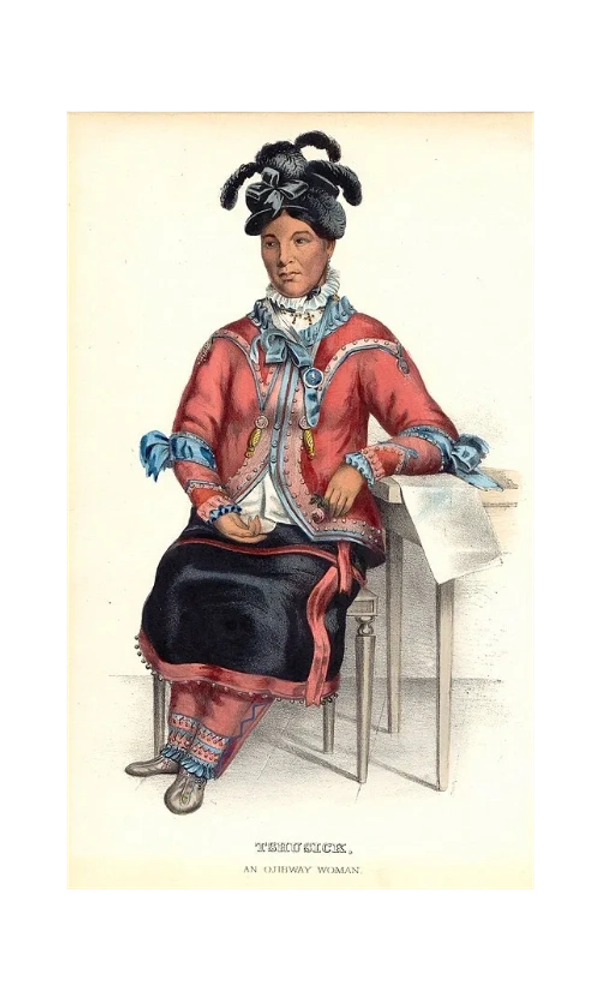
In the winter of 1826–1827, Tshusick, a Ojibway woman, walked from Detroit to Washington, D.C., seeking instruction in the Christian religion. She made the journey on foot. She was fluent in French and requested that her religious conversation be conducted in that language. She was baptized in Washington and given the name Lucy Cornelia Barbouer. Her trek was recorded by Thomas L. McKenney and resulted in a portrait by Charles Bird King. He titled and published as “Tshusick, an Ojibway Woman.” She was still mentioned in the news in 1899.

© St. Louis County Historical Society


©The Stark Art Museum

©Minnesota Historical Society
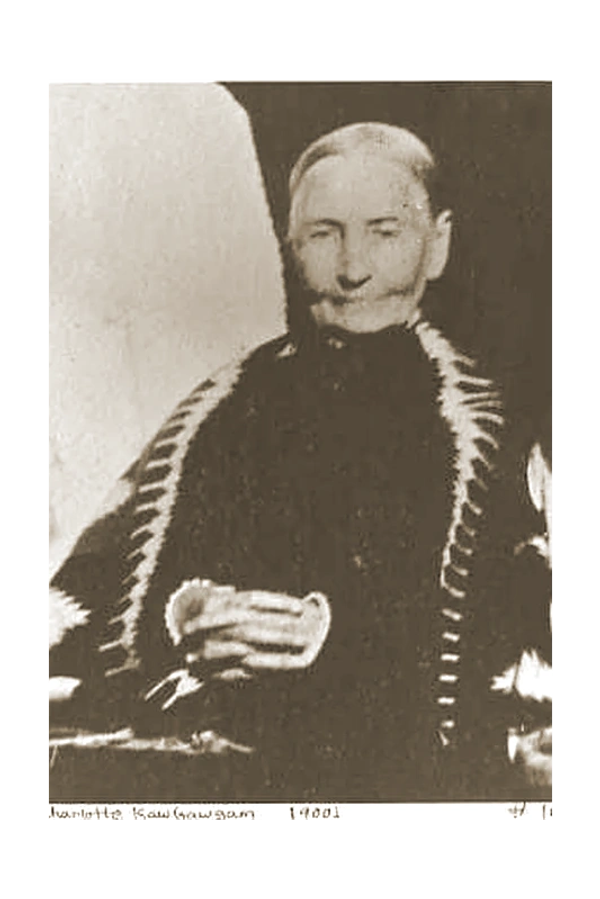

©The Stark Art Museum
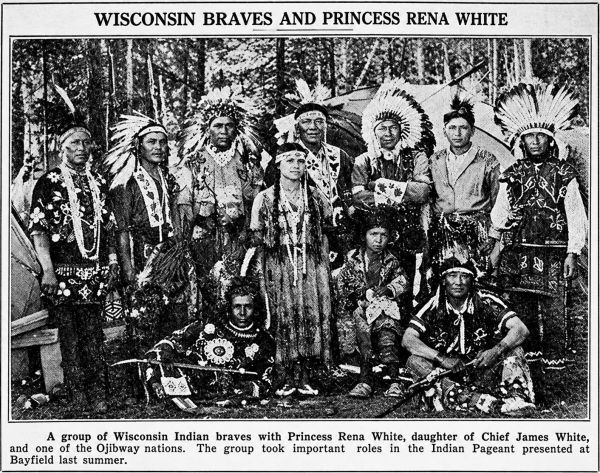
Rena White Danforth, 26, daughter of Chief James White, a Chippewa chief of the La Pointe Band, died at Odanah, Wisconsin, in 1925. She was remembered in the local press as a “Chippewa Indian princess.”
She had served as an assistant matron at the U.S. Indian School at Odanah. She was the first daughter of a Chippewa chief of the La Pointe Band to marry outside her tribe, to a member of the Green Bay Oneida tribe.
Her burial at Odanah was conducted with tribal rites. The newspaper reported that she was buried in a manner “befitting a chief's daughter,” wearing her tribal ceremonial apparel.
Before her marriage, the newspaper noted that she had gained considerable recognition as a soloist, performing at the Apostles Islands pageant and at Bayfield, Wisconsin.
Superior Telegram, February 3, 1925 photograph and caption, Wisconsin Magazine of History, 1925
Wisconsin Historical Society
This website documents the historical acknowledgment and public integration of the Ojibwe (Otchipwe) family as preserved in the documentary record. It preserves the full diversity of the family's historical ethnonyms while tracing the remarkable public footprint that developed—particularly under the name Chippewa—throughout North American history.
Our goal has been to present this history in a manner that is inclusive, balanced, and neutral, allowing the documentary record to speak for itself.
We hope you found something of interest during your visit.
Respectfully,
Brian and John




"Autumm Light"
"Ojibwa Night"
"The Growling Rapids"