Signed in as:
filler@godaddy.com

Library of Congress, wikicommons

Medal of Honor (not awarded), Sergeant Antoine Scott of Co. K 1st Michigan Sharpshooters was nominated for "repeated gallantry" at the Battle of the Crater.[209][210] He along with three other Sharp Shooters were cited for the MOH. In 1896 the three others received their awards from President Grover Cleveland.[211] Scott had died in 1878. Some sources state he was Chippewa others Ottawa. What is known is that he enlisted at Pentwater, Michigan on the 4th of July, the day Ottawa Chief Pawbawme gave an enlistment speach that resulted in 25 men signing up for Co. K.
Sergeant Antoine Scott (LaCroix)[216][217] Battle of the Crater Medal of Honor Citation reads:
“instead of screening himself behind the captured works, this soldier boldly stood up and deliberately fired his piece until the enemy was close upon him, when, instead of laying down his arm and surrendering, ran the gauntlet of shot and shell and escaped.” After covering the retreat of his Company, he was one of the last out of the crater.[218][219][209]
wikicommons

Co.K 1st Michigan Sharpshooters at the Battle of the Crater formed a circle to do a death chant. They were cited for having done "splendid work" by Lieutenant Freeman Bowley Co.G 30th U.S. Colored Troops (USCT). They were out of ammo, wounded, and encircled. Their their stoicism was noted.[212][213] wikicommons
Co. K KILLED IN ACTION:
Pvt. W. Samuel Chatfield,Saginaw, Battle of Reems
Pvt. Charles Carter, Battle of the Crater
Pvt. John Wabesis, Battle of the Crater
Pvt. Moses Williams, Wis. band Battle of the Crater
Pvt. John Dabasequam, Battle of Spotsylvania
Pvt. Etarwegshig, Battle of Spotsylvania
Pvt. Samuel Going, Battle of Spotsylvania
Pvt. Henry Graverteraet, Battle of Spotsylvania
Pvt. Benjamin Green Sky, Battle of Spotsylvania
Pvt. Thaddeus Lamourandere, Battle of Spotsylvania
Pvt. James Mashkaw, Battle of Spotsylvania
Pvt. John Mashkaw, Battle of Spotsylvania
Pvt. Pe-Nay-Se-Way-Be, Saginaw
Pvt. Tay-Baw-Waw-Gay, Saginaw
Sgt. Charles Allen, died from wounds after Fredericksburg
* Pvt. Robert Fisher 9th Michigan Cavalry, Saginaw
* Pvt. Adam Brock 10th Michigan, son of Chief Shaw-Shaw-Waw-Na-Beese, Saginaw
* Pvt. Daniel Ashman, Saginaw
ANDERSONVILE PRISON:
(Andersonville National Cemetery grave # listed for those that died)
Pvt. Amos Askebugney
Pvt. Joseph Gibson, Na-Baw-Na-Ya-Sang #7,741
Pvt. James Hamlin #11,260
Pvt. Michael Jeandron/Jondreau #12,396
Pvt. Louis Marks
Pvt. Louis Miskoguon
Pvt. William Maxinnasaw # 11,511
Pvt. Jacko Penaiswanquot # 11,705
Pvt. William Newton
Pvt. Adam Sawbequoem #11,508
Pvt. John B. Shomin
Pvt. Peter South #12,310
Pvt. Joesph Stevens
Pvt. Payson Wolf (Ottawa)
The second night after their arrival the Andersonville Raiders attacked the men of Co. K to take what they could from the men. It was a mistake that was never repeated, as two of the attackers were killed and others retreated injured. New York Times. https://archive.nytimes.com/opinionator.blogs.nytimes.com/2014/06/23/american-indians-in-confederate-territory/
POW CAMP LAWTON PRISON:
Pvt. Daniel Ashman died remains disinterred moved and now are lost
Pvt. Joseph Nesogot
DANVILLE PRISON
Pvt. Amable ( Jean-Baptiste?) Ketchebatis (died)
LIBBY PRISON
Belle Island Prison
SALISBURY PRISON
Pvt. John Kedgnal
Pvt. Isaac Duvernay (died)
Camp Lawton Prison
Pvt. William Newton
ANDERSONVILLE releasees on the RIVERBOAT SULTANA April 27 1865 when it exploded.
The survivors were:
Pvt. Amos Askebugney
Pvt. Louis Miskoguon
* K Co. 1st Michigan grave markers:
https://www.findagrave.com/virtual-cemetery/184911?page=1#sr-51155253
Bill to honor Native American Civil War veterans advances in Michigan legislature.
House Bill 5078/Senate Bill 41: to dedicate a section of M-22 in Leelanau County as a memorial highway for
Co. K 1st Michigan Sharpshooters

Co. K. 1st Michigan Sharpshooters, Andersonville
©Kokopelli

Co. K. 1st Michigan Sharpshooters had 15 men captured at the Battle of Petersburg and sent to Andersonville Prison. Of them, 7 died due to the conditions in the camp. Their headstones are here or in the gallery. The gallery also has the headstones of three men from Walpole Island.
wikicommons

Co. K. 1st Michigan Sharpshooters, Andersonville
©Kokopelli

Co. K. 1st Michigan Sharpshooters, Andersonville
©Kevin Frye
Co. K. 1st Michigan Sharpshooters, Andersonville
©Kokopelli
Co. K. 1st Michigan Sharpshooters, Andersonville
©Kevin Frye
From the Andersonville Diary,
of
JOHN L. RANSOM,
1st SERGEANT 9th MICH. CAV.,
AUTHOR AND PUBLISHER.
AUBURN, N. Y.
1881.
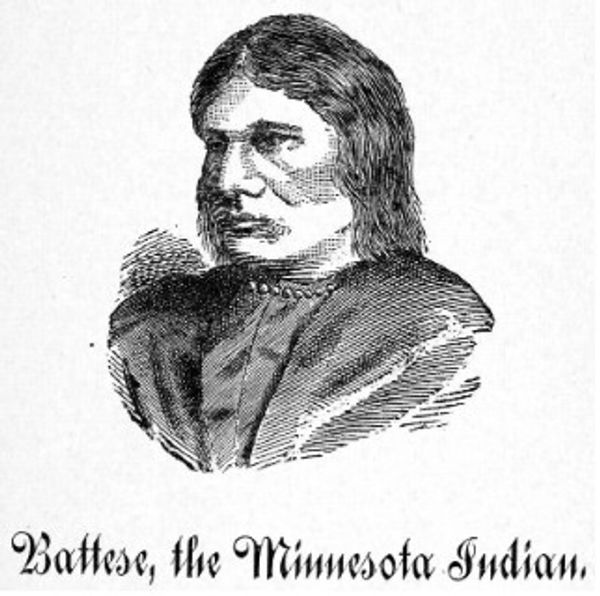
Sgt. Ransom's entry for Oct. 12, 1864 states that Battese "was taken prisoner with 18 other Indians and he and one other were the last alive". In The Finis of his journal Sgt. Ransom wrote: " Although for many months I was in his immediate presence, he said nothing of where he lived, his circumstances, or anything else. I only know that his name was Battese, that he belonged to a Minnesota regiment and was a noble fellow. I don’t know of a man in the world I would rather see to-day than him, and I hope some day when I have got rich out of this book (if that time should ever come,) to go to Minnesota and look him up." Both men were transferred from Amdersonville to Camp Lawton prison near Savannah, GA.
In the book "Deadly Aim" by Salley Walker, Battese and Pvt. Penaiswanquot made medicine to give Pvt. Gibson of Co. K.
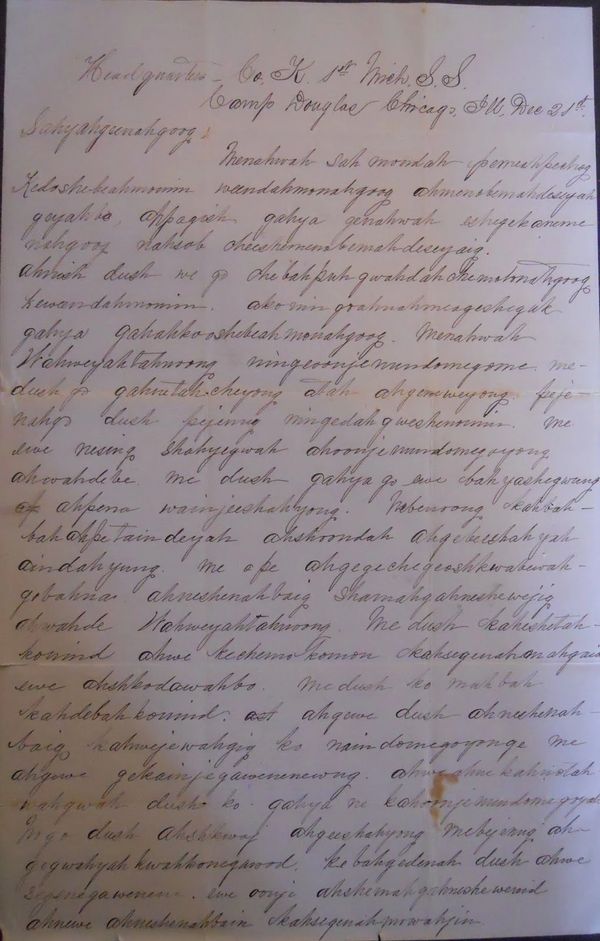
Headquarters Co. K 1st Michigan Sharp Shooters
Camp Douglas Chicago, Ill, December 21 1863.
My Loved Ones,
Once again I am writing to tell you that I am still doing well, while knowing all of you are also doing well. It would make you cry how much I laugh at them I tell you. As I am writing to you all it is Sunday today. We rode out from Detroit so we dreaded returning there yesterday we arrived at last. That's the third time we've been sitting here riding around so once more as always we must go there. Last summer I was gone for so long from camp here where we live. This was when the Indian soldiers got really drunk over at Detroit. This was made possible because of that American who poured the alcohol. So then he was put on trial and the Anishinaabeg who were his companions thought about it and were witnesses while I translated for them and then we rode out from there. At last we went before staying too long and allowing the bootlegger to again be among the Anishinaabe soldiers who had done bootlegging with him. It's as if he was always causing trouble even before he was a soldier. So this is my correspondence and greeting to you.
Greetings to you then,
Charles Allen
In 1905 the U.S Army created the Civil War Campaign Medal with a blue and gray ribbon and Lincoln's bust on the medal that all of the men listed below were entitled to wear. Pvt. Oliver Ar-Pe-Targe-Zhik's is displayed at the Walpole Island Heritage Centre.
Unknown unit:
* Pvt. Alexander DeLaronde, Nipigon Ojibway of Lake Superior
* Pvt. Daniel Herkimer, Mississauga of the Credit
* Pvt. Charles Augustus Jones, Mississauga of the Credit
1861 Michigan’s legislature dismissed the proposal of fielding a regiment of Native Americans by George Copway.[216]
Saginaw Chippewa Chief Nockkechickfawme warned that a Confederate victory would leave the tribe with "no protection for us; we shall be driven from our homes, our lands, and the graves of our friends" Ottawa Chief Pawbawme did much the same.
1864 Gold Hill Daily News (Gold Hill, N.T. [Nev.]), May 12, 1864, p.3, LOC reported that the 1st Michigan Sharpshooters had two companies of Chippewa.
Company K muster:
https://nativesharpshooters.blogspot.com/2016/03/the-natives-of-company-k.html
It was noted that when Company K prepped for battle they covered their blue uniforms with dirt or mud for camouflage. The entire regiment copied their lead when they saw how effective it was. The Company saw action at:
1st Michigan Sharpshooters:
Co. B
* Drummer boy, John D. Kedgnot, Saginaw Chippewa
* Pvt. John Keshechp, Saginaw Chippewa
* Pvt. William Neveaux. A youth from La Pointe, Wisconsin.
1863 Co. K:
Co. K was nearly entirely Michigan Chippewa/Ottawa men. They are identified as the largest group of indigenous in Northern service, 140 enlisted before the end of the war. [214][215]
🍁Co. K had four men from Walpole Island, British Lower Canada:
* Pvt. Oliver Apargeshick, died of wounds at Petersburg
* Pvt. Andrew Jackson
* Pvt. Henry Wassagezik
* Pvt Joseph Ka-ka-kee, Owen Sound
* Pvt. Leon O-tash-qua-bon-o (born Canada)
* Pvt. Dan Pemas-se-gay, deserted 1863.
* Cpl. Thomas Wau-ba-no, died in a accident at Camp Douglas POW Camp, Chicago, ILL. Post war Isabella Co. GAR Post 205 Wab-ba-no was named for him, 1884-1923. The Isabella Co. Auxiliary to the GAR Woman's Relief Corp Wau-ba-no Post No. 56 was named for him also.
* Pvt. John Keeses/Kesis
* Pvt. John Shomin, Cross Village
* Pvt. John B.S. Shomin, Cross Village
* Pvt. Lewis Shomin, Cross Village
The Wilderness
* Sgt. Charles Allen mortally wounded
* Pvt. John Davis/David mortally wounded
* Pvt. Andress (Ni River engagement)
At the Battle of Spotsylvania Court House the 1st Michigan Sharpshooters had 80 men captured, 14 were Chippewa of Company K.[220] They were sent to Andersonville Prison where eight died. Company K had 6 more captured at the Battle of the Crater.[216][221] Company K has men buried in Arlington National Cemetery, Annapolis National Cemetery, and Andersonville National Cemetery to name a few.[222]
SPOTSYLVANIA: 7 KIA the wounded are listed below:
* Pvt.Charles Agargo (died 19 Jan 1865)
* Pvt. George Ashkebug
* Sgt. Louis Genereau (Ottawa)
* Pvt. David L. George
* Pvt. Thomas Ke-chi-ti-go
* Pvt. Simon Keji-kowe
* Pvt. Edward Misisaius
* Pvt. George W. Mogage finger amputated
* Pvt. Daniel Mwa-ke-wenah
* Pvy. Mark Pe-she-kee
* Pvt. Joseph Shaw-au-ase
* Pvt. Joseph Shaw-au-os-sang
Siege of Peterburg:
2nd Lieutenant Garrett A. Graveraet, the company commander, was bi-racial Ottawa. Died of wounds. He recruited his father Henry Graveraet,to be company sergeant, KIA, and who was the only "white" in the enlisted men.
* Pvt. John Andrew, WIA
* Sgt. Peter Burnes/Bunes, WIA died later, Arlington
* Pvt. Issac Williams, WIA
* Pvt. Otto Markus, WIA amputee
Battle of the Crater
Co. K had one Delaware Tribe volunteer when the Regiment went east:
* Pvt. Charles Carter, mustered in July 7, 1864, from Hagerstown, MD. KIA July 30, 1864 at the Battle of the Crater, Petersburg, VA.
* Pvt. Stephen Chatfield died of wounds, Battle of the Crater
Ottawa taken prisoner at the Crater:
* Pvt. Michael Johony (Jondrau?)
* Pvt. Louis Maraks (Miicksquat?)
* Pvt. William McSatraw (Mixinasaw?)
* Pvt. Jacko Pe-nais-now-o-quot
* Pvt. Peter Penarroquaquaw
* Pvt. Adam Schohgsquaheern
* Pvt. Jackson Wargishwabber
Battle of Fort Stedman
* Pvt. Thomas Wesaw WIA
* Pvt. Jacob Greensky WIA
* Pvt. Cornelius Hall lWIA
* Pvt. Freeman Sutton WIA
Other Co. K wounded:
* Pvt. Marcus Otto, amputation
* Pvt. Louis Miskoguon, scurvy
* Pvt. Amos Askebugney, scurvy
* Pvt. Charles Chatfield went awol, returned, but numerous aliments including malaria, pneumonia, repeated diarrhea, wounded before Petersburg, last recorded at DeCamp U. S. Army General Hospital at David's Island New York harbor 1865.
Company K wounded then listed absent:
* Pvt. Otto Solomon, (Peebles Farm?)
* Pvt. Mark Pe-She-Kee, (Petersburg)
* Pvt. Jacob Collins
* Pvt. Otto Solomon
* American Indians in the Civil War? 1st Michigan Sharpshooters graves at Petersburg National Battlefield, Jim Burnett, National Parks Traveler, Dec. 17, 2010, [215]
* Why We Serve, Civil War, National Museum of the Native Americans, Smithsonian, Washington D.C. [216]
* Michigan Indians in the Civil War, Petersburg National Battlefield, Kate Fort, Dec. 21, 2010. [217]
* Civil War soldier’s grave dedicated at Chippewa burial ground, Lania Rocha, Swartz Creek View, Michigan, Jun. 18, 2015. [218]
* Michigan indigenous soldiers in the Civil War, Steve Charnley, Daily News, Montcalm County and Ionia County Michigan, Oct. 14, 2023. [219]
* Michigan's Company K: Anishinaabe Soldiers, Citizenship, and the Civil War, Michelle K Cassidy, Michigan State University Press, Sept. 2023, ISBN 9781611864632. [220]
* The story of Company K: Native Americans from Michigan who saw tough action in the Civil War, Michigan Radio, By Staff, Aug. 23, 2017, Michigan Radio NPR, 535 W. William St, Suite 110, Ann Arbor, MI. [221]
10th Michigan Infantry:
* Pvt. Peter Bennet, Co. B, Saginaw Chippewa
* Pvt. Abraham Brock, Co. B Saginaw Chippewa,
(Son of Chief Shaw-shaw-wah-naw-breese)
* Pvt. G. Brown, Co. B, Saginaw Chippewa
* Pvt. Jim Gruet, Co. B, Saginaw Chippewa
* Pvt. James Gruet, Co. B, Saginaw Chippewa
* Pvt. G. Maner, Co. B, Saginaw Chippewa
* Pvt. William Westbrook, Co. B, Saginaw Chippewa
7th Michigan Cavalry:
* Pvt. Peter Campeau, Co. D
* Pvt. Adolphus St. Andre, Co. K mother Ottawa/Chippewa, 1865 transferred Co. C 1st Michigan Cav. discharged 1866 Salt Lake, Utah
* Pvt. Charles B. St. Andre, Co. K mother Ottawa/Chippewa, 1865 transferred Co. C 1st Michigan Cav. discharged 1866 Salt Lake, Utah
* Pvt. William H. Blanchard, Co. K grandmother Chippewa, 1865 transferred Co. C 1st Michigan Cav. discharged 1866 Detroit, hand amputated
* Pvt. Andrew J. Chapman, Co. K mother Chippewa Mackinac Island, 1865 transferred Co. C 1st Michigan Cav.
* Pvt. Isaac Lapine, Co. K, Mackinac Island
* Cpl. Edward Lasley, Co. K , mother Sault Chippewa
* Pvt. Gabriel Pelotte, Co. K, Mackinac Island, 1865 transferred Co. C 1st Michigan Cav.
* Pvt. Joseph Augustus Truckey, Co. K, 1865 transferred Co. C 1st Michigan Cav. discharged 1866 Salt Lake, Utah, Chippewa Mackinac Island
At the end of the Civil War 290 men from the 7th were transferred to the 1st Michigan Cavalry.
https://voyageurheritage.wordpress.com/2017/11/03/mackinac-men-in-the-american-civil-
8th Michigan Cavalry:
* Pvt. John Fisher, Co. I, Saginaw Chippewa
* Pvt. Samuel Fisher, Co. M, Saginaw Chippewa
* Pvt. Joseph Fisher, Co. M
9th Michigan Cavalry:
* Pvt. Dan Covert/ Dan Sunshine, Co. K, Saginaw Chippewa, pow
* Pvt. James Fisher, Co. K, Saginaw Chippewa
* Pvt. Joseph Fisher, Co. K, Saginaw Chippewa
* Pvt. Robert Fisher, Co. K, Saginaw Chippewa, died in Georgia 1864
* Pvt. William Kay-ne-go-me , Co. K, Saginaw Chippewa
* Pvt. Robert Fisher, Co. K, Saginaw Chippewa
* Pvt. Kego, Co. K, Saginaw Chippewa
* Pvt. Mark Neome, Co. K, Saginaw Chippewa
* Pvt. Lewis Pe-che-kka, Co. K, Saginaw Chippewa
* Pvt. Sag-a-tup, Co. K, Saginaw Chippewa
* Pvt. James Shawabanassau, Co. K, Saginaw Chippewa
* Pvt. Tay-baw-se-gay Co. K, Saginaw Chippewa
10th Michigan Cavalry:
* Pvt. John Chatfield, Co. B, Saginaw Chippewa
* Sgt. William Chatfield, Co. B, Saginaw Chippewa, wounded
23rd Michigan Infantry
* Pvt. Madison Fisher, Co. D, Saginaw Chippewa
29th Michigan Infantry
* Pvt. Joseph Michael (Alias McAdams) Red Cliff Chippewa, Wisconsin.
https://www.apg wi.com/ashland_daily_press/news/civil-war-veterans-grave-re-discovered-in-red-cliff/article_bb5b2e6d-ecc9-5287-9762-5630ba563580.html
* Mackinac, Michigan men of French-Canadian and Chippewa Métis in the Civil War https://voyageurheritage.wordpress.com/2017/11/03/mackinac-men-in-the-american-civil-war/
Less than a month after the attack on Fort Sumpter a Chippewa and Sioux delegation traveled to Washington to tender 300 warriors for military service to the Government. California Farmer and Journal of Useful Sciences, Vol 15, No. 11, May 10, 1861, California Digital Newspaper Collection, UC Riverside, CA. [222]
2nd Minnesota Cavalry:
* Co. M, 2nd Minnesota Cavalry, six mixed-race Chippewa at South Bend, Blue Earth County, Pioneer and Democrat, Jun. 10, 1864, p.5 Minnesota Digital Newspaper Hub, MNHS.
* Pvt. Baptiste Chupan, Co. H
* Pvt. Eustash Belcore, Co. M
1st Minnesota Infantry
Co A was largely formed from Gov. Ramsey's Pioneer Guard militia. These men are believed to have been Chippewa in the Guard.
* Pvt. John Bourcier, Chippewa
* Pvt. Simon Dufort
* Pvt. Pierre Lamin
* Pvt. Peter Langlais
* Sgt. Camille Langois
* Pvt. John B. LaRoque
* Pvt. Paul Milette
* Pvt. Thomas Milner
2nd Minnesota Infantry:
* Pvt. James Blunt, Co. K (substitute)
* Pvt. George Hardin, Co. K
* Cpl. Joseph LaRoque, Co. B
* Capt. George Matrious, Co. G (substitute)
* Pvt. Mis-e-gan-e-buck, Co B (substitute)
* Pvt. William Moores, Co.B (substitute)
* Pvt. Dwight G. Too Good, Co. B
* Scout Ros, Co. D
* Pvt. Sangonen, Co.D (substitute)
* Pvt. Ta-sa-ba-nas, Co. K
* Pvt. Thomas Warren, Wah-wun, Co. K
* Pvt. Charles Weaver, Co. K
* Pvt. William West, Co. K
4th Minnesota Infantry:
* Pvt. Peter Tudochert, Mah-quah, Co. A (substitute)
* Pvt. William Frank, Co. A White Earth
* Pvt. John B. Duford, Co. C
* Pvt. Henry Hanks, Co. D Leech Lake https://newspapers.mnhs.org/jsp/PsImageViewer.jsp?doc_id=5f9ef777-8d4b-42cd-af9e-74b8717cd759%2Fmnhi0007%2F1DFBWQ5B%2F14031701
* Pvt. Charles Howard, Co. D (substitute)
* Pvt. George Johnson, Gah-ge-gay-yaush, Co. D (substitute)
*.Pvt. Joseph Paquin, Co. D
* Pvt. Peter Parker, Co D (substitute)
* Pvt. George Peak, Co. D
* Pvt. John Shaw, Co. D
* Pvt. William White, O-je-mah-iance, Co. D
* Pvt. Peter Tubesing, Co. F
5th Minnesota Infantry:
* Pvt Joseph Adams, Co. F
* Sgt. Antoine Bagae, Co. F
* Pvt. Charles Bottineau Co. F, Pembina Chippewa, Born one mile south of Fort Garry. (cousin of Peter Bottineau)
* Cpl. Peter Bottineau, Co. F, Pembina Chippewa
* Pvt. Antoine Cluckey Co. F, Pembina Chippewa
* Theodore B. Rock Co. K deserted (enlisted in several other units)
* Pvt. Francis Turpin, Co. G
* Pvt. Joseph Turpin, Co. G
* Pvt. Severe Turpin, Co G
6th Minnesota Infantry:
* Pvt. Joseph January, Co. I
* Pvt. Louis January, Co. I
8th Minnesota Infantry
* Pvt. Felix Blow (Bottineau), Co. H,
* Pvt. Etienne R. Blau, Co. H
* Pvt. John Gobarre, Co. H,
9th Minnesota Infantry, Co. G
Most of the men in the Company came from White Earth before there was a reservation there.
* Pvt. Roger Aitkin*
* Pvt. Salem Aitkin*
* Capt. Charles H. Beaulieu, Lac du Flambeau, White Earth*
* Pvt. Henry H. Beaulieu
* Cpl. John Beaulieu was appointed 1st Lt. but war ended*
* Pvt. Edward Belland (obit says born east Canada so possibly Mississauga & was scout for Sibley)*
* Pvt. John Brown, Quaysegood*
* Pvt. Thomas Butts (wounded Brice's Crossroads, KIA Duvall's Bluff Ark.)*
* Pvt. Henry Charron*
* Pvt. Alex. Chaboilley*
* Pvt. Charles Comptois
* Pvt. Joseph Comptois, killed Fort Abercrombie*
* Pvt. John Charrette,
* Pvt. Joseph Charette, Wain-ge-mah-dub, Chief*
* Pvt. Louis Charrette*
* Pvt. Francois Dufoe*
* Pvt. Jean Bat. Dufort (buried White Earth)
* Sgt. Albert Fairbanks*
* Cpl. William Fairbanks*
* Pvt. Charles Foster
* Pvt. Henry Foster She-muck-e-nah- go (buried White Earth)*
* Pvt. Robert Fox*
* Pvt. Roy Frank (Dacotah Chippewa)?
* Pvt. Frank Gabo (deserter)
* Pvt. John H. Hanks, Pun-ja-min*
* Pvt. Eustash Jourdain*
* Pvt. Fabien LaFebvre
* Pvt. Charles Mason (Dacotah Chippewa? buried White Earth)*
* Pvt. James McDonald
* Pvt. John McDonal
* Pvt. Antione Montreuille (buried White Earth)
* Pvt. John Parker (KIA Fort Gaines, Alabama)
* Pvt. Peter Parker*
* Pvt. Joseph E. Perrault, (White Earth/Pembina band Chief)
* Pvt. Edward Reese, Leech Lake Pillager
* Pvt. Francoise Roi (Dacotah Chippewa)?
* Pvt. John Small, died Memphis
* Cpl. Almon Sutton
* Pvt. John Tanner (born Lac du Flambeau)
* Pvt. Frank Theibault/Tebeau*
* Pvt. Thomas Swan/Suan, Shay-Day, Red Lake (buried White Earth)*
* Pvt. Andrew Veseur Pembina
* Pvt. William Wallace KIA Battle of Nashville
* Pvt. Myla S. Converse?
* Pvt. George Johnson?
* Pvt. James VanWert?
* Pvt. Moses Greenleaf Co. F
* Pvt. Damon Greenleaf Co. F?
* Pvt. Frank LaFond, Co. I
* Pvt. Joseph Couture, Co. K
* Pvt. Fred LaChappell, Co. K
NOTE: an asterisk denotes 1914 Theodore Beaulieu list
11th Minnesota Infantry
* Pvt. Napoleon Duford, Co. B
* Pvt. Peter Gamache, Co. E
* Color Sgt. Albert Morrell, Co. G color Sgt.
1st Heavy Artillery:
* Pvt. Joseph Martin, loss an eye
* Pvt. Xavier DeMarre Co. B White Earth, died Tennessee
Mounted Rangers:
* Pvt. F. Bagge
Hatch's Battalion:
* Pvt. James Dagneau (deserter)
* Pvt. Peter Dagneau (deserter)
* Pvt. Manuel Foire
* Pvt. Joseph Ganion
* Pvt. Louis LaPierre (deserter)
* Pvt. Francois Primeau (deserter)
UNITS NOT IDENTIFIED:
* Pvt. Henry H. Blanlien/Bland
* Pvt. John Ellis
* Pvt. George W Gardner (Garden) Gah-goonce, Leech Lake Pillager
* Pvt. Julian LaDuc
* Pvt. Thomas Warren
G Company 9th Minnesota had a large contingent of Chippewa and biracial Chippewa that mustered in at St. Cloud, Minnesota in mid-August 1862. [225] One man was killed by "friendly fire" near St. Cloud by militia that did not know Chippewa were in Government service and was assumed to be Dacotah.[226]
John Strong G Co, 9th Minnesota was killed by "friendly fire" near St Cloud, by milita, that did not know Chippewa were in U.S. service and was assumed to be Dacotah. Letter From Capt. McCoy, St. Cloud Democrat, Apr. 30, 1863, p.2, Minnesota Digital Newspaper Hub, MNHS. [51]
G Co. John Strong, 1st KIA , a St Cloud GAR post named for him The Sauk Centre Herald. Oct. 1, 1931, p.4. [52]
Capt. Hall, Commander of Fort Ripley, made a request for Lt. Beaulieu and G Company be sent to the fort. His request was reported in many papers. The Winona Daily Republican, Aug. 28, 1862, p.2, Newspapers Archive. [223]
The Philadelphia Inquirer, Sept. 2, 1862, p. 2, Newspapers Archive. [224]
G COMPANY SERVICE:
G Company was posted forward to Fort Abercrombie. They arrived on Sept. 3, 1862 to find the Fort under attack which they help rout. G Company became part of the Fort's garrison. The Sioux returned to besiege the Fort until 23 Sept. [225]
May 21, 1863 G Company arrived in St. Louis, MO. The St Louis Republican predicted that "they would give a good account to themselves in action" in an article titled "Big Injuns". [225]: p.105 As part of the rear guard at Brice's Crossroads G Company saw action. There their marksmanship and skirmisher tactics enabled 400 men of the 59th U.S. Colored to not be overtaken by confederate cavalry at a bridge. Afterwards the Chippewa and African Americans fell back in unison.[225] : p.198-204 G Company losses and commendations described: Ninth Regiment, St. Cloud Democrat, Jun. 30, 1864, p.3, LOC. [225]
100 Chippewa in 9th Minnesota, The Weekly Union Record, Jul. 02, 1864, p.2, LOC. [226]
List of Company G Chippewa as well as names of Chippewa in other Minnesota Civil War units. White Earth Chippewa Civil War Veterans, Gichiziibiwinini(David Beaulieu), Big River Man News-American Indian Education, May 04, 2010, [228]
White Earth Minn. The Minneapolis Journal, May 9, 1904, p.13, Newspapers Archive. [227]
9th Regiment, Chippewa's and Colonel Wilkin's praise, The Weekly Pioneer and Democrat, Aug. 18, 1865, p.5, Newspapers Archive. [229]
Joseph Charette (Way-ond-ji-mah-dub or Wain-ge-ma-dub) joined G Company winter 1862-3, was elected to Chief of White-Earth. [227]
At the end of the Civil War the government told the troops that they could keep they guns for $6. G Co. muster out rolls indicate most if not all of the White Earth men paid the $6 from their final pay to keep their Springfield rifles.
G.A.R. button- Joseph Charette, Star Tribune, Aug. 24, 1919, p.36, Newspapers Archive [230]
White Earth Minnesota, The Minneapolis Journal, May 9, 1904, p.13, Newspapers Archive. [231]
Co. G, John Strong, 1st KIA, St Cloud GAR post named for him The Sauk Centre Herald, Oct. 1, 1931, p.4, Newspapers Archive. [232]
Captain Charles H. Beaulieu, Co. G, 9th Minnesota.[228] [229]
* Sept 2-3 News accounts indicate Co. A 6th Minnesota had troops in the Battle of Birch Cooley that were of Dacotah/Chippewa heritage. During the battle the Dacotah called out for them to leave, "their blood was not wanted just the whites".[224]
1865 Minnesota Governor Miller had General Pope refuse his offer to raise two Companies of Chippewa for service in the south.
The Weekly North Iowa Times, Apr. 5, 1865, p.2, LOC.
Minnesota State Senator Charles S. Marden did all he could to get official State recognition for the Chippewa efforts during the Sioux uprising as well as the Civil War. In 1912 he attempted to get a State monument to the 300 Chippewa that served in various Minnesota Regiments.[230] In 1912 he also authored a bill for the Mau-zoo-mau-nee monument.
* To Honor the Chippewa,Saint Peter Tribune, Aug. 19, 1914, p.1, MNHS. https://newspapers.mnhs.org/jsp/PsImageViewer.jsp?doc_id=f3ee3e52-dc18-4de7-9ff3-76a6a5e510b1%2Fmnhi0031%2F1DFC665B%2F14081901
* Lest We Forget, Ni-mah-mi-kwa-zoo-min. Nov. 1, 1982 https://newspapers.mnhs.org/jsp/PsImageViewer.jsp?doc_id=b0e780ce-3f60-4737-9502-3c5861d696ca%2Fmnhi0061%2F0BZ11K5I%2F82110101
To Be a Soldier: Native Americans from Minnesota and Wisconsin Participate in the Civil War, p.12-13 & appendix. https://pines.bemidjistate.edu/cgi/viewcontent.cgi?article=1219&context=honors-cap
* White Earth has put up 56 headstones for Chippewa veterans buried on the reservation. https://www.mprnews.org/story/2023/11/10/white-earth-group-has-been-quietly-rewriting-wrongs-correcting-native-veterans-headstones
* Pvt. Joseph Wakazoo, Co.. K 1st Michigan Sharpshooters is one of those.
The Taylor Falls Reporter newspaper published that Sam Fifield editor of the Polk County Press opined Wisconsin should organize a Brigade of Chippewa Braves to fight the south. Taylors Falls Reporter, Jul. 17, 1862, Minnesota Digital Newspaper Hub, 2023, MNHS [233]
190 Wisconsin Chippewa are known to have enlisted in the Civil War.[232]
Wisconsin Chippewa "Half-breed Regiment", Superiour Journal, Sept. 1892.
Wisconsin Chippewa "Half-breed Regiment", The Saint Paul Daily Press, Sept. 20, 1862, Minnesota Digital Newspaper Hub, MNHS. [234]
Wisconsin Chippewa "Half-breed Regiment", Prescott Journal, Sept. 24, 1862, p.1, LOC. [235]
1st Wisconsin Infantry received 14 Chippewa replacements, ... zu den zur Auffüllung nachrekrutierten Soldaten gehörten 14 Chippewa Indianer, die bald zu den besten ... auf der Homepage von Eberhard Ref - Wisconsin Eberhard, https://www.eberhard-ref.net [236]
3rd Wisconsin Infantry received 12 Chippewa replacements in Atlanta 1864. [233]
* Pvt. Au-reb-ka-we-ka, Clear-Day, Co. F
* Pvt. John Kanrannara, Co. F
* Pvt. Joseph Menagre, Co. F
* Pvt. Joseph Moose, Co. F
* Pvt. Naw-he-ga Noch-e-ker, Co. F
* Pvt. Manshe-Osan, Co. F
* Pvt. Chief Sunday, Co. F
* Pvt. Wau-he-ga, Co. F
* Pvt. Semoren Has-quoe-quoe, Co. F
* Pvt. Meost Mac-quaw, Co.F
* Pvt. Pa-ga-mi, Co. F
7th Wisconsin Infantry:
* Cpl. Lewis Mishler, Co. A, pow, wounded, Gettysburg, Bad River band
* Pvt. John Buck Co. G died disease
* Pvt. Alex Cadotte Co. G
* Cpl. Joseph Cadotte Co. G
* Pvt. John R. Day Co. G sick, muster out
* Pvt. Charles Hart Co. G
* Pvt. Thomas Hart Co. G wounded
* Pvt. Joseph King Co. G
* Pvt. Alexes La Prairie Co. G
* Pvt. John B. La Prairie Co. G wounded, muster out
* Pvt. John Moses Co. G pow
* Pvt. Joseph Morrow Co. G discharged disability
* Pvt. George Metawos / Metwaves
* Pvt.Charles Razor Co. G wounded
* Pvt. Joseph Razor Co. G KIA
* Pvt. James Rice Co. G
* Pvt. George Samuel Co. G
* Pvt. John Singog / Singoy Co. G wounded died
* Pvt. Henry Sous
* Pvt.. John Winslow Co. G
https://archive.org/details/rosterofwisconsi01wisc/page/561/mode/1up
https://thecivilwarandnorthwestwisconsin.wordpress.com/2014/04/15/1864-april-9-l
11th Wisconsin Infantry:
* Pvt. J. H. Beaulieu, Co. I
14th Wisconsin Infantry:
* Pvt. John LaFond, Co. F
17th Wisconsin Infantry:
* Pvt. John Martin, Co. B, Bad River band
23rd Wisconsin Infantry:
* Pvt. Vincent Roy Jr., Co. F
28th Wisconsin Infantry:
* Pvt. John Vaughn, Co. I, Bad River band
30th Wisconsin Infantry:
* Pvt. William Cadot, Co K, (Nipissing Mother)
* Pvt. Vincent Crowe, Co. K
* Pvt. Elisha Ermatinger, Co. K
* Pvt. Francis La Rush, Co. K
* Pvt. Baptiste Saint Martin, Co. K
36th Wisconsin Infantry:
* Pvt. Charles Corbine, Co. K, Bad River band
* Pvt. George P. Warren, Co. K, born La Pointe, wounded Cold Harbor 6/3/1864
52nd Wisconsin Infantry:
* Pvt. James H. Beaulieu, Co. E
(see 29th Michigan Infantry)
Unknown unit:
* Pvt. Louis Beche
* Pvt. John Scott or Kawche Cheekezik, Lac Courte Oreilles
The 7th Wisconsin put 14 Chippewa replacements in Co. A. The spring of 1864 30 Chippewa replacements were put in Co. G. The 7th saw action at:
7th Wisconsin, Chippewa Warriors volunteer, The Polk County Press, Apr. 1864.
7th Wisconsin, Chippewa Warriors volunteer, Janesville Daily Gazette, Apr. 22, 1864, p.2, Newspapers Archive [237]
7th Wisconsin, some 30 Ojibwa Warriors join, Madison Journal, Jun. 1864.
7th Wisconsin, some 30 Ojibwa Warriors join, State News, Janesville Weekly Gazette, Jun. 24, 1864, p.2, Newspapers Archive. [238]
7th Wisconsin, 14 Ojibwa Warriors Join the Battle of Spotsylvania, Wisconsin Historical Society. [239][234]
8th Wisconsin, A Lac-du Flambeau-Band Chief gave a Bald Eagle to the Co. C that became the Regimental mascot. Company C was known as the Eau Claire Eagles or the Chippewa Eagles.
30th Wisconsin K Company had a number of Chippewa that went to Dakota territory with Gen. Sulley 1863. [240]
190 Chippewa served in Wisconsin Civil War Regiments. [241]
The Lac-du-Flambeau Band of Lake Superior Chippewa and the Great War, Gary Entz, WXPR, Jun. 23, 2021, Public Radio, Rhinelander, Wisconsin. [242]
The Chippewa had two men serve in the war from the Wisconsin Yellow River band, Rocky Run George and Good Hunter, their unit is not identified. https://usgennet.org/usa/wi/county/clark/neighbors/wood/history/1923WisIndians.htm
The Pioneer Press (Miller, Hand County, S.D.), Sept. 9, 1897, p.2, LOC reported that 30 La Pointe Indians had fought in the Civil War. One William Nevieux served as a drummer boy.( 1st Michigan Sharpshooters)
CSA Guerrilla
* Wisconsin had one Chippewa fight for the south. In newspapers he was known as "Ojibway Joe" . It was also reported that his name was Joe Ski. Ski translates to "Zhooshkoshimaan" in Ojibwe. At the end of the war he was the leader of a guerrilla band in Kentucky. His rifle had 113 notches in it for northern soldiers he had killed. After the war he returned to Superior, Wisconsin where he died. His passing was mentioned in many papers. Onee paper states he was chosen to be Chief to succeed the "great chief Menitowa" who had fought the Sioux.
* The Eddy Current (Eddy NM) Apr.2, 1898, p.8, LOC. https://chroniclingamerica.loc.gov/lccn/sn93061674/1898-04-02/ed-1/seq-8
* Ojibwa Joe is Dead, The Saint Paul Globe., Feb. 14, 1898, p.6.
* Indian Sharpshooter, The Argus (Holbrook, AZ) May 21, 1898, p.8.
* Ojibway Joe is Dead, The Even Times, Washington D.C, Feb. 7, 1898, p.4.
* "News in Brief", The Copper County Evening News (Calumet, MH), Feb. 26, 1898, p.5.
* Indian Sharpshooter, Dakota Farmers' Leader, Apr. 29, 1898, p.6.
K Co. 37th Wisconsin had a large Native American contingent of at least 39 Menomonie. One source claims that all but two of K Company were Native American but fail to identify who or what tribe the other men were from.
1863 24 February 1863 — The steamer Chippewa Valley, loaded with cotton, was captured by the Union gunboat USS Forest Rose below Island No. 63 near Vicksburg. An 1860 101 ton Union stern-wheeler, sank on the Cumberland River, April 30th, 1864 also named the Chippewa Valley The vessel's name represents a Civil War-era use of the Chippewa ethnonym.
81st Pennsylvania Volunteers was organized by Colonel James Miller and nicknamed the “Chippewa Regiment”— or the Fighting Chippewas. Patriotism of Carbon Co,. Pennsylvania, J.D. Laciar, 1867, p.107

1903 Michigan Andersonville Prison Cemetery memorial. The state has 7 Chippewa buried there. ©NPS
☆ ☆ ☆ ☆ ☆ ☆ ☆ ☆ ☆ ☆ ☆ ☆ ☆ ☆ ☆ ☆ ☆ ☆ ☆ ☆ ☆ ☆ ☆ ☆ ☆ ☆ ☆ ☆ ☆ ☆ ☆ ☆
1865 Chief Hole-in-the-Day still wished that his offer to raise a battalion of Chippewa to go fight the South had been accepted.
* The Weekly Pioneer and Democrat, Aug.11, 1865, p.10 https://newspapers.mnhs.org/jsp/PsImageViewer.jsp?doc_id=743969f0-a2e4-4040-b787-2822eb24bcea%2Fmnhi0031%2F1DFC4V56%2F65081101
* Saint Peter Tribune, Aug. 30, 1865, p.1, MNHS
* The Hastings Conserver, Sept. 5, 1865, p.4.
* Rochester Republican, Sept. 6, 1865 p.1.
* The Weekly Pioneer and Democrat, Aug. 11, 1865, p.10, MNHS, "it is to be regretted that his offer to the Government to raise a battalion of Chippewa soldiers to go South under his command was not accepted"
1865 Minnesota Governor Miller offered two Companies of Chippewa for service in the south which was refused by Gen. Pope.
* The Free Homestead, Mar. 2, 1865, p.2.
* The Stillwater Messenger, Mar. 21, 1865, p.2.
* Saint Peter Tribune, Mar. 22, 1865, p.2.
☆ ☆ ☆ ☆ ☆ ☆ ☆ ☆ ☆ ☆ ☆ ☆ ☆ ☆ ☆ ☆ ☆ ☆ ☆ ☆ ☆ ☆ ☆ ☆ ☆ ☆ ☆ ☆ ☆ ☆ ☆ ☆
1865 Confederate Col. William Brooks attacked Union riverboats on the Arkansas River, capturing the "New" Chippewa, a paddleboat pressed into government service, after she ran aground at Ivey's Ford. Union soldiers, the vessel's crew, and civilian refugees—including African Americans—were taken prisoner before Confederate forces stripped the vessel of supplies and burned her.
1866 United States v. Repentigny, 72 U.S. 211 p.72
The case concerned ownership of the land at Sault Ste. Marie on the American side. Page 72 U.S. 219 quotes a letter of the Marquis de la Jonquiere stating the Chief of the Sault had adopted Sieur de Repentigny as a nephew. The King of France granted the land in 1750 to Chevalier de Repentigny and Captain Louis De Bonne, including at the Saut de St. Marie. The necklace mentioned was possibly a British peace medal. The Mississauga are mentioned too. https://supreme.justia.com/cases/federal/us/72/211/
Red-lake Chippewa attack Minnesota Sioux at Fort Gerry, Chicago Tribune, Jul. 14, 1866, p.1, LOC [108]
1866 Portage la Prairie engagement between the Red Lakers and the Mdewakanton reported as "near Fort Garry". Cannibalism also was reported. Fight between the Sioux and the Chippewas, The Mankato Weekly Record, Jul. 14, 1866, p.2 Minnesota Digital Newspaper Hub, 2024, MNHS. [162] [163][164][165][166][37]: p.176 According to Alexander Morris five Sioux were shot by the Red Lake Saulteaux.
1866 Chief Kahkwaquonaby of the Mississauga band graduated from Queen's College with a medical degree, the first native American to do so in Canada.[153]
1866 Chief Ah-Moose (Little Bee),
On March 19, 1866, the Evening Star of Washington, D.C., reported the death of Ah-Moose, or Little Bee, described as “head chief of a tribe of Chippewa Indians.” He and three others had come to speak with the “Great Father” and became ill with “black measles.” He was interred in the Congressional Cemetery, grave number R53/211.
1866 Chippewa Treaty of April 7 created the Bois Forte (Nett Lake) reservation in Minnesota.
1866-67 President Johnson gave the Chippewa the last Peace Medals they would receive for treaties.
1866 Chippewa Treaty of March 19 created the White Earth reservation in Minnesota.
1867 "The Mighty Confederacy of the Chippeways have conquered from the Dakotas of Northern Wisconsin and Minnesota." George Gale, Upper Mississippi, 1867, p.267
1867 Ten Chippewa Chiefs met President Johnson including Chief Bagone-giizhig (Hole-in-the-Day), Chief Wab-an-quot, and Chief Fine Day. The While Earth Reservation was created and several Chippewa reservations ceased to exist in Minnesota.
1868 Chief Hole-in-the-day was assassinated by Pillagers.
1868 Chief Wabon-o-quot with a small group attended a presentation by the Fusi Yama (Fuji Yama) Japanese Troupe in St. Paul's Ingersoll Hall. The Chief was so impressed with the show he requested an audience. He invited the Japanese north for the best Ojibwa meal in his wigwam. He was told it did not fit their schedule, but the performers spent some time with the Ojibwa. "Meeting between Japanese and Chippewa", The Lake City Leader, Jun. 12, 1868, Minnesota Digital Newspaper Hub, 2023, MNHS. [161]
1868 — The Australian ketch Chippewa, built at Sydney in 1866, was lost with all four crew off Seven Mile Beach, New South Wales. The vessel illustrates that the Chippewa ethnonym had spread beyond North America and was adopted as the name of a commercial vessel in New South Wales, Australia.
1869-70 Red River Resistance. The Saulteaux community had close family ties to the Metis in the Resistance as well as the events, directly or by association.
* Land Sale & Threat (1869): The Hudson's Bay Company (HBC) sold Rupert's Land to Canada without consulting the Cree, Saulteaux, or Métis.
* October 1869: The Cree Saulteaux Métis leader Louis Riel formed the National Committee of the Métis and stopped the surveying of the international border.
* November 1869: Fort Garry was taken over.
* November 1869: Chief Harry Prince (MIS-KOO-KE-NEW) "Red Eagle" son of Chief Peguis offered 100 Saulteaux warriors to help Col. Dennis deal with the Métis. Col. Dennis accepted twelve to protect Fort Garry.
* December 1869: An independent Provisional Government was formed to represent the Red River valley and negotiate terms for Manitoba's entry into the national Confederation.
* Jan.-Mar. 1870: Thomas Scott incident.
* May 1870: Manitoba Act & Provincehood
* August 1870: Wolseley's Expedition and Riel's exile. Riel's second in command was Elzéar Goulet was stoned and drowned by some of Wolseley's troops. Elzéar's maternal grandmother was an Ojibwe Métis from Sault Ste. Marie. Elzéar had offered to take personal responsibility for Thomas Scott, in opposition to his execution.
1870 The Red River Expedition led by General Garnet Wolseley utilized Saulteaux and Mohawk voyageurs to provide crucial logistical support in the Canadian wilderness to assert Canadian authority at Fort Garry to end Louis Riel's Provisional Government.[60] The General was so impressed with the native voyageurs' skills he specifically requested their assistance again in 1884 from Canada. Not just voyageurs, "native voyageurs".
1870s The Sioux introduced the Saulteaux to the Ghost dance which was made the Ojibwa Dream or Drum dance. Sioux oral history has that they gave the Saulteaux a drum.
1870 The Sioux tried twice to get Chippewa Chief Ah-gun-as-e to join them in attacking the survey & construction of the Northern Pacific Rail line.
Image 7, The New York Herald [N.Y.], Feb. 1, 1873, Library of Congress.
1871 Treaty 1 was signed at Fort Garry by seven Ojibwa Nations and the Canadian Government. The Chief's medal designed for the signing became famous for its symbolism even though it took three different medals to arrive at it.[167] The Chiefs were less than impressed with the first two medals. Of those signers, today the Peguis First Nation is the largest in Manitoba. In Ontario the Chippewas of the Thames First Nation are the largest and only tribe to sign Treaty 21. For Treaty 2, also 1871, Ojibwa Chiefs Francois (Broken Fingers) Mekis, Ma-sah-kee-yash, Ke-wee-tah-quun-na-yash, and Sou-sonce received the Victoria Peace medal.[168] Chief Mikiseesis (Little Eagle) represented the Ojibwe for Treaty No. 3, received the medal in 1873. Queen Victoria actually signed Treaties 1, 2, 3, 4, 7 with the Chippewa, Cree and Saulteaux.
Treaty No. 1 called for reserves for these nations:
* Brokenhead Ojibway Nation, 1874 the Brokenhead reserve was surveyed.
* Long Plain First Nation, had reserve lands allocated in 1871.
* Peguis First Nation,
* Roseau River Anishinabe First Nation
*Sagkeeng First Nation's Fort Alexander 3 Indian Reserves were formed.
* Sandy Bay Ojibway First Nation, Portage Band gets a reserve that they name "White mud" and in 1877 they move to Sandy Bay, Manitoba, todays home to the Sandy Bay First Nation. The reserve was confirmed in 1913 as IR 5.
* Swan Lake First Nation
1871 Treaty No.2 reserves:
* Dauphin River First Nation Reserve 48A.
* Ebb and Flow First Nation Reserve 52
* Keeseekoowenin Ojibway First Nation, ( Riding Mountain Band ) moved onto their reserve in 1875 adjacent to the HBC Riding Mountain House trading post.
* Lake Manitoba First Nation
* Lake St. Martin First Nation has two reserves 49 & 49A
* Little Saskatchewan First Nation 48 reserve
* O-Chi-Chak-Ko-Sipi First Nation received reserve Crane River 51, on the shore of Lake Manitoba.
* Pinaymootang First Nation reserve is Fairford 50.
* Skownan First Nation former Waterhen Indian Reserve No. 4
1871 The Indian Appropriations Act of 1871 ended the U.S. government's practice of treating tribes as sovereign nations via treaties and instead treated them as wards of the state placing them under the control of congress.
1871 December, Minnesota Senator Ramsey introduce a bill to to Congress to name a territory "Ojibway" between the 49th and 49lth parallels from Minnesota to Montana.
1872 The Vinton Record (M'arthur, Vinton County, Ohio), Feb. 10, p.2
ran and article the Dakota Territory was to be split with the north half named Ojibway.
1872 February amendment offered to change the proposed Territory name from "Ojibway" to "Pembina".
1872 During the annual Tammany Hall celebration in New York City, the ceremonial program included groups identified by numerous Native ethnonyms, among them Ojibbeway and Chippewas, illustrating the continued public recognition and symbolic use of these names in nineteenth-century American civic and political culture. New York Herald (New York, N.Y.), Jan. 12, 1872, p. 7, LOC.
1872 U.S.Senate Bill No. 360 proposed establishing the"Territory of Ojibway" from northern Dakota Territory, Marysville Tribune 7 Feb 1872, Marysville, Ohio, p.1, Newspaper Archive
1872 In Colorado the name Manitou was chosen by the Denver & Rio Grande Railroad in 1872 as a "romantic western" name for tourist marketing of the Railroad's town. The name "Manitou," reportedly created postal confusion, with mail intended for the resort occasionally finding its way to Canada. To resolve the problem, "Springs" was added and the community became "Manitou Springs". Ironically, the name itself derives from an Algonquian term associated with the Great Lakes region and Gitche Manitou rather than the Ute people whose territory surrounded the springs.
1872-3 49th Parallel survey. The Boundary Commission’s Metis Scouts (military escort), the 49th Rangers, had many with Saulteaux heritage. The international boundary crosses Turtle Mountain.
1872 Act of Congress
Special legislation addressed the failure to deliver land promised to the Michigan Cheboygan Band under the 1855 treaty.
1873 The Lac Des Mille Lacs reserve was surveyed in the Thunder Bay District of Ontario.
1873 The Peguis First Nation Reserve was first created. It is now made up of nine reserves.
1873 The Northwest Angle 33 reserve was set aside. (Treaty 3)
1873 Niisaachewan Anishinaabe Nation reserve was set aside.
Formerly called the Dalles First Nation and Ochiichagwe'Babigo'Ining Ojibway Nation.
1873 Red Gut band reserve was originally called Rainy Lake Indian Reserve 26A. It is now called Nicickousemenecanning First Nation Reserve.
1873 The Assabaska reserve was never surveyed. 1979 Big Grassy and the Ojibwa of Onigaming filed a land claim that in 1999 became the Assabaska reserve. The Assabaska band changed it's name to Onigaming.
1873 Rainy River Saulteaux reserves:
* Hungry Hall 1 Band of Rainy River Saulteaux - Hungry Hall (Bishop) 14
* Hungry Hall 2 Band of Rainy River Saulteaux - Hungry Hall (Paskonkin) 15
* Little Forks Band of Rainy River Saulteaux (part) - Little Forks 10
* Long Sault 1 Band of Rainy River Saulteaux - Long Sault 12
* Long Sault 2 Band of Rainy River Saulteaux - Long Sault 13
* Manitou Rapids 1 Band of Rainy River Saulteaux - Manitou Rapids 11
* Manitou Rapids 2 Band of Rainy River Saulteaux - Manitou Rapids 11
* Rainy River First Nation was created by unifying seven historical Rainy River Saulteaux bands. Six either sold or transferred their Reserves to the Crown in 1914-15. In the 1960s the First Nation was reduced to two reserves Long Sault 1 & Manitou rapids 1.
1873 How England Treats the Tribes. The Saulteaux tribe of Ojibbeway made the news in the U.S.
1873 In a proposal to Congress advocating for the publication of an "Encyclopedia of the Indian Race," geologist John W. Foster discussed Longfellow's The Song of Hiawatha and referred to the Ojibwe as "Ojibway-ugs (Ochippewais)." Foster's usage illustrates the diversity of Ojibwe ethnonyms in nineteenth-century scholarly literature.
1873 The "Ojibbeway Coal Company" appears in a The Dodgeville Chronicle (Dodgeville, Wis.), June 13, p.22 anecdote. The company's coal was humorously described as being so poor it would not burn, even on the Day of Judgment. For the joke to work, readers had to accept "Ojibbeway Coal Company" as a plausible business name. This suggests that the ethnonym Ojibbeway was sufficiently familiar in 1873 to be recognized instantly by readers. Even fictional businesses contribute to the documentary footprint by illustrating how Indigenous names had become part of everyday language and popular culture.
1873 Alexander Morris, described the Manitoba Sioux' application for a reserve to his successor, Lieutenant-Governor Morris. He states:
“A reserve was proposed to them on the Lake Manitoba, but they were unwilling to go there, being afraid of the Saulteaux, and especially the Red Lake Saulteaux.”
1873 Dakota Territorial Governor John Burbank sent President Ulysses S. Grant a memorial requesting that the Pembina band of Chippewa be removed east to the White Earth Reservation in Minnesota. Congress appropriated $25,000 to purchase a township at White Earth for the Pembina and $10,000 to assist with their removal. But removal did not mean that the Pembina surrendered their claim to lands they maintained had never been ceded. About 200 of approximately 560 Pembina moved to White Earth; others remained in the Turtle Mountains and refused to remove until their claims to the unceded lands were addressed. The federal government still attempted to relocate the Pembina while their claims to lands outside the reservation remained unresolved.
1873 Moccasin Bill; or, Cunning Serpent the Ojibwah: A Romance of Big Stone Lake — dime novel by Paul Bibbs. An ethnonym in leisure time reading.
1873 President Ulysses S. Grant, October 29,
Executive Order: Establishment of Winnebagoshish Reserve in Minnesota.
1873 President Ulysses S. Grant, November 4,
Executive Order: Amendment and Reservation of Land for Leech Lake Bands of Chippewa.
1874 President Ulysses S. Grant, February 4,
Executive Order: Revocation of the 1864 Little Traverse Land Withdrawal in Michigan.
1874 President Ulysses S. Grant, May 26,
Executive Order: Reserving Land for Pillager and Lake Winnebagoshish Bands.
1874 Treaty No. 4 set aside these Saulteaux Nations reserves:
* Ebb and Flow First Nation - Treaty 2 signatory council member, with the reserve designated Ebb and Flow 52.
* Gamblers First Nation - Treaty 4 signatory though in Treaty 2 territory reserve at Riding Mountain Treaty 4.
* Keeseekoowenin Ojibway First Nation - Treaty 2 signatory council member, also known as the Riding Mountain Band.
* O-Chi-Chak-Ko-Sipi First Nation - Treaty 2 signatory council member, Crane River 51 Reserve on the shore of Lake Manitoba.
* Pine Creek First Nation - Treaty 4 signatory though in Treaty 2 territory, Pine Creek 66A reserve is located on the southwestern shore of Lake Winnipegosis.
* Rolling River First Nation, Treaty 4 signatory though, Treaty 2 territory, reserve lands were formalized in 1897.
* Skownan First Nation - Treaty 2 signatory, Waterhen Indian Reserve No. 45 was mostly occupied in 1875.
* Tootinaowaziibeeng Treaty Reserve First Nation main reserve is called Valley River 63A.
* Muscowpetung First Nation was allocated reserve in 1881.
* Okanese First Nation land was surveyed near Crooked Lake in 1876, but never allocate. A claim was filed in 2021, asserting that Canada did not fulfill its obligations, court has agreed.
* Pasqua First Nation Indian Reserve (IR) No. 79 was surveyed 1876.
* Kinistin Saulteaux Nation was granted a reserve in 1900.
* Muskoday First Nation treaty 6, Reserve was surveyed in 1876.
* Yellow Quill First Nation Nut Reserve was created 1881 when a survey was done at Fishing and Nut Lakes.
* Fishing Lake First Nation Fish Reserve was created 1881 when a survey was done at Fishing and Nut Lakes.
* Muskowekwan First Nation Reserve wasn't surveyed until 1884
* Coté First Nation Reserve was granted 1877
* Keeseekoose First Nation, the first reserve on Swan River flooded, so the band was relocated to their present reserve near Pelly and Kamsack, Saskatchewan.
* The Key First Nation Reserve was surveyed on Swan River 1878, it flooded causing the band to be relocated to current location near Fort Pelly in 1880.
* Zagime Anishinabek, formerly known as the Sakimay First Nation, reserve is north-east of Regina, Saskatchewan and has 24 reserves.
1874 Kahkewistahaaw First Nation Reserve was establish, but not surveyed until 1881.
1874 Edward F. Wilson, an Anglican missionary, wrote "The Ojebway Language: A Manual for Missionaries," based upon his experience at Garden River and Sarnia.
1874 Major J. E. Yard, commander Fort Pembina, reported on two groups of Chippewa. One group of 100 warriors was preparing for a two day ride west to attack 80 lodges of Sioux, the second group was heading to Devils Lake to make peace with the Sioux. New-York Tribune, Aug. 10, 1874, p.1 LOC.
1874 The New Orleans Republican, p. 3, identified the location of the Episcopal Children's Home as being "between Chippewa and St. Thomas streets." The routine use of Chippewa Street as a geographic reference illustrates the ethnonym's integration into the everyday civic landscape more than 1,000 miles from its homeland. The street itself appears to have been laid out and named in the 1830s–1840s by surveyor Barthélemy Lafon, indicating the ethnonym had become part of New Orleans' urban landscape decades before the Civil War.
Newspapers in New Orleans routinely referred to Chippewa Street as a geographic reference. The New Orleans Bulletin, December 3, 1874 Advertisements offered lots for sale on Chippewa Street and identified a business at the corner of Chippewa and Orange streets, illustrating the ethnonyms' integration into the city's everyday residential and commercial life.
Note: That street may be among the earliest streets named for the Ojibwe nation. To date, we have not found an earlier example.
1874 Ookemasis, Saulteaux Chieftainess , Berens River / Little Grand Rapids region, Manitoba, ca. 1874–75. Her husband had been chief at his death she assumed his position at the request of her people. She traveled from her distant community to Rev. Egerton Ryerson Young's new mission at Berens River, where she spent time questioning him about his religion. Young later traveled by dog sled to her village in February 1875.
1875 Rat Portage Reserve lands selected for reserves 38A, 38B, 38C, & 38D.
1875 The Anishnabe of Wauzhushk (Wauzhushk First Nation) main reserve was created, Kenora 38, Treaty 3.
1875 Treaty 5 produced Ojibwa reserves that had land allocated at 160 acres per family of 5.
* Berens River First Nation, Manitoba, Berens River 13 & Pigeon River 13A.
* Bloodvein First Nation, Bloodvein First Nation reserve on the east side of Lake Winnipeg, Manitoba.
* Kinonjeoshtegon First Nation Manitoba, Jackhead 43 & Jackhead 43A reserves
* Black River First Nation, Manitoba, Black River 5 Indian Reserve
* Little Grand Rapids 14 First Nation, Manitoba
* Pauingassi First Nation gained reserve status in 1988 and became a separate First Nation from the Little Grand Rapids First Nation in 1991.
* Poplar River First Nation, Manitoba surveyed 1889.
* Pikangikum First Nation Ontario achieved full Band and reserve status in 1978 after separating from the Pikangikum First Nation.
1876 In Canada the Indian Act created "status Indian" and "non-status Indian" legal classifications. Indigenous people had to register to gain "status Indian".
1876 Swan Lake First Nation's reserve was established around 1876, when Chief Yellowquill settled his people in south central Manitoba.
1876 Manitou Rapids Indian Reserve was made by combining two adjoining Ojibwe reserves but it would be changed.
1876 O'Chiese First Nation reservation land was set aside in Treaty 6.
1876 A Canadian ship named Chippewa arrived at Greenock, Scotland on November 1 from Quebec.
1876 Rev. Henry Chasse or PAHTAHQUAHONG, a Mississauga, traveled to Paris as the President of the Grand Council of Indians of Canada. He was a cousin of George Copley and had worked as in interpreter, 1840-42 at Sandy Lake Minnesota. In pictures he displays two medals, one a King George III of his grandfather's. When the Prince of Wales visited Canada he read a speech the tribes had drawn up.
1877 Henvey Inlet First Nation was granted Henvey Inlet Indian Reserve No. 2.
1877 The Daily Press and Dakotan (Yankton, Dakota Territory), November 19, 1877, reprinted from the Winnipeg Standard, discussed the earlier proposed northern territory by Senator Alexander Ramsey. The article identified the principal inhabitants of the region as the Cree, Otchipwe, and Sioux
The usage is noteworthy because the article employed the ethnonym Otchipwe rather than the more commonly contemporary forms Chippewa, Chippeway, Ojibwa, or Ojibway. The reference appeared several years after Ramsey's 1871 proposal for an "Ojibway Territory".
The article demonstrates that the form "Otchipwe" remained in newspaper circulation and was sufficiently familiar to be used in reporting the proposed territory and its inhabitants. The usage demonstrates the coexistence of multiple Ojibwe/Chippewa ethnonyms within the historical record.
1877 The New York Tribune reported
A territorial naming debate identified Pembina as an Indigenous name associated with Chippeway families living in the region, challenging the proposed name “Huron.”
New-York Tribune, New York, N.Y., February 3, 1877, LOC.
1877, August, 18 — “Charlie Jacobs aka Sitting Bull” was reported as of Ojibway birth. Another version had that he was "half Chippewa".
A New York World special from Fort Walsh, August 18, 1877, reported that Sitting Bull said he was Charles Jacobs, a native of Fort Garry and an alumnus of St. John’s College. The report said that old traders remembered Jacobs as “a half breed of Ojibway birth” who had disappeared from Fort Garry about 1853. It further stated that his father, Henry Jacobs, had been an interpreter for Father Proulx on Manitoulin Island. The story was widely reprinted in newspapers in 1877 and was revived again in 1891.
Image 1 of Evening Star (Washington, D.C.), September 7, 1877, p.1 https://www.loc.gov/resource/sn83045462/1877-09-07/ed-1/?sp=1&q=charlie+jacobs-sitting+bull&r=-0.044,0.125,1.316,0.634,0
Abbott Martin stated that there were several "ridiculous stories about Sitting Bull's origins and education. The New York Herald (New York [N.Y.]), December 5, 1877 https://www.loc.gov/resource/sn83030313/1877-12-05/ed-1/?sp=10&q=charlie+jacobs-sitting+bull&r=-0.006,1.296,0.268,0.129,0
1879 The Carlisle Indian School opened and before it closed a number of Chippewa attended there.[169][170]
1879 The Bismarck Tribune (Dakota Territory), August 30, 1879, p.7 published and Indian Legend from the St. Paul Illustrated and Fireside Companion. It says the the Chippewa had a Ki-e-le-pa (old teepee ground) on Me-De-Wa-Ka (Lake Como, St. Paul Minn.).
1880 The Cowessess First Nation reserve was surveyed in 1880 at Crooked Lake, Saskatchewan. The band did not occupy until 1883.
1880 In August a party of American Gros Ventres and Mandans from Fort Berthold fought a party of Canadian Stoney's or Chippewas near the Coteau Hills. The U.S. Indian Office investigated the affair because it had become an international issue involving the Canadian government. The report says a Gros Ventre/Mandan man, Walking Wolf, had been killed about 60 miles northwest of Fort Berthold, and roughly fifty men went out seeking revenge. The resulting fight was with the “Stonys or Chippewas”(or Ojibways depending on the source) from near Moose Mountain , led by Oceanman and White Bear. They lost eight men plus women and children. The Gros Ventres re-covered their losses leaving three Winchesters. Weekly Times 21 Oct 1880, Cincinnati, Ohio
1880 "The Mille-Lacs stood as a unit on the side of the whites in 1862". History of Morrison County, Little Falls Transcript, Apr. 23, 1880, p.1, Newspapers Archive. [163]
1880 "The Mille-Lacs may stay as long as they are good" Chief Moose-o-ma-na (Mou-zoo-mau-nee) letter to President R.B. Hayes, Little Falls Transcript, Apr. 16, 1880, p.1, Newspapers Archive. [164]
1880 Leech-Lake Head Chief Naw-wa-ge-schick, noted for good services during dark days of 1862. Little Falls Transcript, Apr. 23, 1880, p.1, Newspapers Archive. [165]
1880 Mille-Lacs Indian Reservation, Little Falls Transcript , Mar. 26, 1880, p., LOC. [166]
1880 In its September 17, 1880 edition, the Benson Times (Minnesota) referred to the Chippewa River as the "Ojibbeway River." Likewise, the analytical index to The American Cyclopaedia identifies Wisconsin's Chippewa River as "Chip'pewa, river of Wisconsin," while the corresponding article states that the river was "called by the Indians the Ojibway, or Ojibbeway." Together, these examples suggest that nineteenth-century editors and writers regarded the ethnonyms Chippewa, Chippeway, Ojibway, and Ojibbeway as synonymous and often used them interchangeably, extending that practice to geographic features as well as to the people themselves.
Note: The analytical index spells the entry as "Chip'pewa," while the article itself uses the standard spelling "Chippewa." The apostrophe was possibly an indexing or pronunciation convention rather than part of the name itself.
1881 Sioux and Chippewa have a skirmish at Joseph on the Pembina River. The dead were 3 Sioux, 3 Assintonies, and 6 Chippewa, but the Sioux gave up 40 horses. Massachusetts Weekly Spy (Worcester, Mass.), Jul, 10, 1861 p.3 (1861 date typo?)
1881 Muscowpetung First Nation was allocated reserve lands in southern Saskatchewan.
1881 The Chippewa preformed the "Sioux Dance" at Rat Portage in July 1881 for John Campbell, 9th Duke of Argyll, Governor General of Canada. (Who was called the Marquis de Lorne VII in "The London Graphic" on his trip to the Great Northwest.) Chief Mawedopenais brought 500 Satuteaux to meet the Governor General. Chief Manitobahiness was there also. Manitobahiness refused an address of welcome prepared by the Indian agent, insisting that he would prepare the address himself. .The Lake Wabigoon Ojibbway Chief addressed Lord Lorne thanking him for his medal from the Queen and for her fair treatment unlike the Indian agents in the United States. The Benton Weekly Record (Benton, Mont.), Sept. 1, 1881, p.1(see Dance gallery p.7)
Note: Chippeway Indians Dancing the Sioux Dance at Rat Portage, Ontario, July 3, 1881. Sydney Prior Hall's contemporary illustration records the Chippewa performance as the Sioux Dance during the visit of the Marquis of Lorne, Governor General of Canada. The image is notable for what it contains—and what it does not. No drum is depicted. Instead, the dancers are accompanied by a large flag bearing the British Union Jack and the name of a chief, while some participants carry what appear to be a spear and knife. The illustration provides contemporary evidence of the form in which the Sioux Dance was performed at Rat Portage in 1881.
1881 President Chester A. Arthur, December 20
Executive Order of Vermilion Lake Indian Reservation.
1882 Shoal Lake 40 First Nation reserve was surveyed. The Nation was moved to a man-made island between 1912-19 where they are today.
1882 A 20 ton schooner named Chippewa was reported on Lake Michigan.
Northern tribune (Cheboygan, Mich.), May 20, 1882, p.5, LOC.
1882 Northwest Angle 37, Animakee Wa Zhing #37 survey date recorded.
1882 President Chester A. Arthur, December 21,
Executive Order: Drawing Turtle Mountain Reservation Boundaries.
1882 Amunikence (“Little Thunder”) Reported as a Survivor of the Custer Massacre
The New-York Tribune (New York, N.Y.), August 15, 1882, published a front-page account of the death of Amunikence or “Little Thunder,” a Chippewa chief at Mercy Hospital in Chicago on August 14, 1882. The newspaper claimed that he was one of two survivors of the Battle of the Little Big Horn, the other man was described as a teamster.
Note: Amunikence does not appear in current lists of recognized participants or survivors of the Battle.
1883 Father John F. Malo received $1,000 for opening a Mission school in 1882 for the Turtle Mountain band of Chippewa of Dakota from the Secretary of the Interior. Indian School, House of Representatives, 48th Congress 2d Session, Ex. Doc. No. 240, February 15, 1885.
1883 Minnesota State Senator J.B. Gilfillan offered the Chippewa resolution for citizenship and the right to vote citing the preamble of the Minnesota Constitution.[171] [172] The bill passed under suspended rules.[173]
1884 The Mille-Lacs: The Attempt to Dispossess Them of Their Lands Thwarted. The Saint Paul Globe, Jun. 19, 1884, p.3, Newspapers.com, 2023. [167]
1884 Siege of Khartoum, 30 Ojibwa voyageur volunteers from St. Peter's reserve served as boatmen on the Nile for General Lord Garnet Wolseley's group.[176] They were led by Chief William Prince, great grandfather of Sgt. Tommy Prince.[177] The men received two awards the unnamed Khedive Bronze Star medal from the Sultan of the Ottoman Empire and the silver British 1884-89 Egypt Medal with the 1894-5 Nile River bar. Those voyageurs that made it to Khartoum received the additional bar "Kirbekan". The mission was the first overseas military operation that Canadians took part in. The recipients name was engraved on the border of the British medal along with "Ottawa Contingent". When Canada received the request for men the powers that be immediately set about getting Anglo-Europeans. They were taken aback when the War Office specified "Native Voyageurs ". Due to foot dragging and bigotry 20 Ojibwe from Fort William weren't included that Indian Agent J.P. Donnelly had recruited. p.54 https://hssh.journals.yorku.ca/index.php/hssh/article/view/4211/3409
1884 Wabigoon Lake reserve was laid out in 1884 but not confirmed until 1915.
1884 President Chester A. Arthur, March 29,
Executive Order: Chippewa Land Restored to Public Domain.
1884 President Chester A. Arthur, June 3,
Executive Order: Restoring Chippewa Indian Land to Public Domain.
Hole-in-the-Day III Late in 1885 ex-Governor Ramsey escorted Hole-in-the-Day's youngest son Joseph to Washington D.C. as a candidate to West Point.[178][179][180][181] The trip's mission made national news with all accounts reporting he was a fine candidate. They also expected he would be accepted. In April 1886 he made his petition in person to President Cleveland.[182] There are no news accounts for his not being accepted. He made news again in November 1887 when his stepfather adopted him and he took his surname Woodbury.[183] The following December he made news again for giving the USPS his notice of resignation to become Chief on the White Earth Reservation. In 1898 he enlisted as a private in the 14th Minnesota Infantry for Spanish American War service.
1885 Col. T. J. Sheehan became the Indian agent at the White Earth Agency. In 1862 he was supposed to escort the Chippewa Treaty Commission to meet the Red Lake and Pembina bands to sign a treaty when he was diverted by the Mdewakanton Uprising.
1885 The Red Rock Indian Reserve was surveyed along the Nipigon River and the band received 480 acres in 1886. The reserve wasn't official until 1914.
In 1885 the war dead were transferred from the Fort Abercrombie cemetery to Fort Lincoln. The interred native American scouts were included. One was identified as Matatabnahee.[134]
1885 North West Resistance: The Saulteaux community had close family ties to the Métis in the Resistance as well as the events, directly or by association.
Mar. 1885: Battle of Duck Lake, Metis victory
Apr. 1885: Battle of Tourond’s Coulée, Metis victory
May, 1885: Battle of Batoche, Metis defeat
* Pvt. Richard Hardisty, KIA, Red River Cree, Saulteaux, Metis. He was one the Nile voyageurs in 1884-5.
May, 1885: Battle of Frenchman's Butte, Metis victory
Jun. 1885: Battle of Steele Narrows, Metis defeat
Jul. 1885: Big Bear surrendered
Nov, 1885: Eight Cree and two Assiniboine warriors, including Frog Lake War Chief Wandering Spirit, were hung at Battleford. Three men had their convictions commuted. Many had fled south to join Rocky Boy's Chippewa in Montana and the Turtle Mountain Chippewa in North Dakota. By 1887 250 Metis and 100 Cree Chippewa had moved to Turtle Mountain. Some never returned north. Winter 1887-8 Turtle Mountain saw 151 die of starvation. Veterans and Families of the 1885 Northwest Resistance, Lawrence J. Barkwell, 2011, p.13 Cree Chief Little Bear and his people sought refuge by Rocky Boy. That lasted until the U.S Government labeled them "foreign" refugees, not recognized on US reservations and "deported" over 500 in 1896. However, Little Bear returned and worked with Rocky Boy to get a reservation. In 1916 the the U.S. Chippewa and Canadian Cree got their wish. It was named the Rocky Boy Chippewa Cree reservation.
1885 “Ojibway," pseudonym used by a newspaper correspondent, The Livingston Enterprise (Livingston, Mont.), June 6, 1885, p.2.
1885 An article originally published by The Toronto Mail and reprinted in The Morning Star (Carlisle, Pennsylvania) on May 1, 1885, p. 2. The author identified "Chippeway" (Otchippewe, Ojibway) as the "parent language" of many neighboring dialects and described it as one of the principal Indigenous languages of eastern Canada.
The same article treated the Saulteaux as a distinct people rather than simply another name for the Chippeway. It explained that French missionaries called them Saulteaux because they were first encountered at Sault Ste. Marie, while adding that the Chippeways referred to them as "Big Ears," a reference to the distended earlobes produced by wearing heavy brass or iron earrings.
Note: This source is from 1885 and does not reflect the sensitivity used today. It calls the Saulteaux “bad” for rejecting Christianity and civilization, but then goes on to describe the people as “magnificent,” proud, and hot-tempered.
1885 William W. Warren's History of the Ojibway People was published. In the introductory pages, Warren explained his preferred spelling, writing that he made use of "O-jib-way" as being "simpler spelled, and embodying the truest pronunciation." This provides a contemporary explanation for one of the many historical spellings found in the documentary record.
1885 The Morning Star, Carlisle, PA. reported:
Toronto Daily Mail reports Chippeway (Otchipewe, Ojibway) as the “mother language” of the related dialects. The Chippeways called the Saulteux “Big Ears,” while the Saulteux called themselves “anishinabewok” (“men”). The name Saulteux was attributed to the missionaries’ first encounter with them at Sault Ste. Marie.
1887 Ottawa Chief Blackbird published his History of the Ottawa and Chippewa Indians of Michigan.
1886 The Washington National Tribune, Feb. 25, p.2,opined that Dakota Territory should be split with the southern portion retaining the name while the northern portion should be named "Chippeway" of "Ojibway" as it was historically their lands.
1888 RED LAKE CHIPPEWA INDIANS OF MINNESOTA
H.R. Rep. No. 789, 50th Cong., 1st Sess. (1888)
https://digitalcommons.law.ou.edu/cgi/viewcontent.cgi?article=5612&context=indianserialset
1888 Dawes Act was successfully resisted by only the Red Lake Band of Chippewa giving them the only Chippewa Reservation in the United States not broken up by allotment. It makes their Reservation "closed" giving the Red Lake Nation complete sovereignty over it. There were a few other nations in the U.S. that opted to retain their lands in this manner.
1888 J.D.C. Atkins: "Barbarous Dialects Should Be Blotted Out ..." Excerpts from the 1887 Report of the Commissioner of Indian Affairs. https://www.languagepolicy.net/archives/atkins.htm#:~:text=The%20instruction%20of%20the%20Indians,not%20exclusively%20taught.%20...
1888 "Theodore H. Beaulieu and his cousin Gus published the first edition of the fist Ojibwa newspaper in Minnesota named "The Progress". The U.S. Indian agent on the White Earth Reservation immediately seized the press, charging the Beaulieu brothers with voicing ”incendiary and revolutionary sentiment.” The brothers took the BIA to court for violating their First Amendment rights. In November 1886, the U.S. Circuit Court at St. Paul ordered the return of Beaulieu’s press and awarded Gus $250 which equals $8,459. in 2025. They then had a hearing before the U.S. Senate Subcommittee of the Committee on Indian Affairs in Washington, D.C. who ordered the BIA to allow Gus back on the reservation to resume publishing." ELIZABETH MCNEIL https://escholarship.org/content/qt8mm5813d/qt8mm5813d.pdf " When the Progress resumed publishing it had criticisms of the federal Indian Bureau as well as current local, national, and international news. It also ran a 12 month series on Ojibwa Chippewa culture.
* It is important to note that two White Earth Midewiwin society elders, Saycosegay and Day Dodge were the source of the material in the 12 Ojibwa articles that were published in "The Progress" reservation newspaper. Day Dodge was “Grand Sachem and Medicine Seer of the White Earth tribe” p.87. .https://escholarship.org/content/qt8mm5813d/qt8mm5813d.pdf
* Another observation to note is that in 1888 the people of Minnesota felt the Chippewa were entitled to the freedom of the press in a court of law.
* Theodore was not native to White Earth. He was born at La Pointe, Madeline Island, WI.
1889 Nelson Act of 1889. This act was the forced consolidation of the Minnesota Chippewa onto the White Earth Reservation. Several reservations ceased to exist with the passage of this bill. The Red Lake Nation stood firm in it's opposition but lost a portion of their reservation. The larger bands impacted by the Nelson Act were:
1889 Curve Lake First Nation reserve was created after the band had moved there in 1829.
1889 Three hundred "whites" were hired to dig a drainage ditch at Mille Lacs Lake. Chiefs Great Bear and White Snake told them they needed to stop and they did not. Mille Lacs warriors attacked them killing seven.
"The Worst Confirmed", Wichita eagle (Wichita, Kan.), Jun. 15,1889, p.1, LOC. the ditch was never completed.
1889–90 U.S. House record says that when Chief Flatmouth II was residing in Canada, his sister Ruth Flat mouth was the “acknowledged Queen, or leader of the Pillagers.” It then says that two other women of hereditary right acted as leaders of their respective bands and, at the request of the chiefs, were permitted to sign agreements.
1890 Tales of the Ojibwa, The New York Times, Jan. 19, 1890, p.10, Newspapers.com, 2024. [168]

G Co. 9th Minnesota Chippewa ca. 1867. Hoard & Tenney Photographers' © MNHS
1890 Mille-Lacs head chief Shaw-Bosh-Kung memoriam by Bishop H. Whipple, "brought all the warriors he could to Fort Ripley".
* Shaw-bosh-kung, Bishop H. Whipple St. Paul Daily Globe, Mar. 10, 1890, p.4 Minnesota Digital Newspaper Hub, 2023, MNHS [169]
* Shaw-bosh-kung, The Minneapolis Tribune, Mar. 9, 1890 Minnesota Digital Newspaper Hub, 2023, MNHS [170]
* Indian Humor, Public Press (Northumberland, Penn.) May 16, 1890, p.2, Newspapers.com, 2023,[171]
* Indian Humor St. Louis Globe-Democrat, May 11, 1890, p.7, Newspapers.com, 2023. [172]
* Shaw-bosh-kung, Still had his brains, The Fort Worth Record and Register, Dec. 26, 1909, p.15, Newspapers.com, 2023. [173]
* Indian Keenness, Manchester Weekly Times and Examiner (England), Jun. 16, 1890, p.14, Newspapers.com, 2023 [174]
* Shaw-bosh-kung, Not to be Gulled The Whitstable Times and Herne Bay Herald (Kent England), Nov. 15, 1890, p.6, Newspapers.com, 2023 [175]
* Shaw-bosh-kung (obit), The Wahpeton Times, Feb. 13, 1890, p.5 Newspapers.com, 2023 [176]
* Shaw-bosh-kung (obit), The Sun (Morris Minn), Feb. 13, 1890, p.3, Newspapers.com, 2023 [177]
* Shaw-bosh-kung (obit), The Great West (St Paul, Minn.), Feb. 14, 1890, p.3, Newspapers.com, 2023 [178]
* Shaw-bosh-uing (obit), New Ulm Review, Feb. 12, 1890, p.3, Newspapers.com, 2023 [179]
* Shaw-bosh-kung (obit), The Mercury (Spring Valley, Minn.) Feb. 13, 1890, Newspapers.com, 2023 [180]
* Shaw-bosh-kung (obit), The Record and Union (Rochester, Minn), Feb. 14, 1890 [181]
* Shaw-bosh-kung (obit), Willmar Argus (Willmar, Minn) Feb. 13, 1890 [182]
* Shaw-bosh-kung letter to President Hayes 1880Little Falls Transcript, Apr. 16, 1880, p.1, LOC. [183]
* More About the Mille-Lacs Indians, Little Falls Transcript, Nov. 1, 1889, p.3, LOC. [184]
* Chief Shaw-bosh-kung who led the Chippewa forces to Fort Ripley has a road, park, and a lake point named for him at Mille-Lacs lake.
1891 The legend of White Bear and Manitou Island, The Saint Paul Globe, Jul. 12, 1891, p.12, Newspapers.com, 2024. [185]
1891 Father Jean Cuoq published the Grammaire de la langue algonquine ('Grammar of the Algonquin language') describes Nipissing speech pages 41-119.
1891 Father Martin Férard, S.J., Jesuit missionary and linguist, completed his monumental French–Ojibwa Dictionary shortly before his death. The work represented many years of study of the Ojibwa language and became one of the most significant unpublished Jesuit linguistic manuscripts of the nineteenth century. Today, Father Férard's bound manuscript dictionary, together with his research notes and transcriptions, is preserved in the Northern Ontario Indigenous Languages Collection at the Archive of the Jesuits in Canada, https://archivesjesuites.ca/en/author/haton/?
1891 War Department General Order No. 28, issued March 9, 1891, authorized Native Americans to be enlisted in the Regular Army and serve in Indian Companies within Regular Army infantry and cavalry regiments except for the Buffalo soldier regiments.(due to strict Army segregation rules)
1891 The Song of Hiawatha, illustrated by Frederic Remington. Houghton, Mifflin and Company, Riverside Press was published. In 1911 another version went to print — The Song of Hiawatha, illustrated by Frederic Remington, Maxfield Parrish, and N. C. Wyeth.
1891 A notice of location was filed for the Chippewah placer mine on December 4 in Anaconda, Montana.
1891 “Chippewa Indian village near Sawyer, Minn., was destroyed by a hurricane.” with many injured. Alexandria Gazette (Alexandria, D.C.), Aug. 12, 1891, p.2 LOC
1891 Chippewah, a Cruising Yacht Designed by Thomas Clapham, Roslyn, Long Island, New York
In 1891, boat designer and builder Thomas Clapham developed a longer cruising version of his innovative Bouncer racing scow, naming the new model Chippewa. The design combined the scow's distinctive shallow, broad hull with a raised, bubble-shaped cabin top. Clapham had introduced the original 17-foot Bouncer in 1890, demonstrating that the unconventional scow hull could outperform much larger conventional racing yachts under the Seawanhaka Rule. The Chippewah was reported in the San Francisco Morning Call on November 1, 1891.
1891 — Chippewa Plantation, Orange City, Volusia County, Florida
A December 27, 1891, p.2 articlt in the Eau Claire Leader documents a Florida agricultural property known as the Chippewa Plantation, owned by Banker Seymour of Chippewa Falls, Wisconsin.
1892 10 Cent Treaty, Turtle Mountain Heritage Center, 2025.
http://www.chippewaheritage.com/heritage-blog2/the-10-cent-tr
1892 — The British three-masted barque Chippewa departed Liverpool for Santos, Brazil, with goods. The crew was forced to abandon ship in the North Atlantic. She carried the Chippewa name on trans Atlantic trade, illustrating the global reach of the ethnonym. https://www.wrecksite.eu/wreck-search.aspx?&se=ZFE1f8yIxQZz1AnsxOL61w==
1894 The death of Chief Naw-gaw-nub was reported in many newspapers with no mention he sent Lincoln a letter offering to fight the Sioux.
1896 The Beargrease brothers. "Indians as Mail Carriers" Shenandoah Herald (Woodstock, Va.), Jan. 31, 1896, p.4 LOC.
1897 Chief Naw-gaw-nab's passing made the front page of the New York Times.[189]
1897 Legislation introduced to the Minnesota legislature to provide a $120/year pension for Chief Mou-zoo-mau-nee's widow. ($4,328.00 today) The Princeton Union Apr. 8, 1897, Minnesota Digital Newspaper Hub, 2023, MNHS. [186]
1897 War Chief Mazomanie or Mou-Zoo-Mau-Nee widow legislation re-introduced H.F.688 The Saint Paul Globe, Apr. 14, 1897, p.5, LOC. [187]
1897 War Chief Mazomanie or Mou-Zoo-Mau-Nee widow legislation H.F.688 failed due to Major R. B. Bassford/Basford (ex 16th Wis. sutler) The Saint Paul Globe, Jul. 22, 1897, p.8, Minnesota Digital Newspaper Hub, 2023, MNHS. [188]
1898 A Wisconsin Chippewa wedding made the news. The grandson of Chief Buffalo and the granddaughter of Chief Waubezig. . Five hundred Indians attended. The bride was the the daughter of a civil war drummer boy William Nevieux 1st Michigan Sharpshooters.
The River Falls Times ( Wis.) Sept. 7, 1897
The Pioneer Press (Miller, S.D.), Sept. 9, 1897, p.2 LOC
1898 Battle of Sugar Point was the last battle of the Indian Wars. The combatants were the Pillager Band and the 3rd U.S. Infantry. At Red Lake a number of men wanted to join the Leech Lake band against the government. Red Lake Chief Peter Graves told them that if they went they could not come back to Red Lake, they would have to join the Leech Lake band. His firmness kept Red Lake out of the hostilities. https://www.d.umn.edu/cla/faculty/troufs/Buffalo/PB_Graves-Peter.html
1898 Mille-Lacs NON-REMOVAL, An Indian's Answer, Toronto Saturday Night, Oct. 29, 1898, The British Newspaper Archive, 2023. [189]
1898 Mille-Lacs NON-REMOVAL, Not to be Gulled Kilburn Times, Nov. 14, 1890, The British Newspaper Archive, 2023. [190]
1898 The Pillagers historic superiority and Esk-ke-bug-coshe (Flat Mouth). A Powerful Indian Nation, The Chippewas, The Strongest Branch of the Old Algonquian Family, The Minneapolis Journal, Oct. 10, 1898, p.6, Newspapers.com, 2024. [191] In military terms the Pillagers served as advance skirmishers for the Chippewa against other tribes.
1898 Pillager incident.[190][191]
1898 White Earth Pow Wow. Other bands invited: Mille Lacs, Red Lake & Leech Lake bands and the Sioux. "A Chippewa Pow Wow", Little Falls Weekly Transcript, June 14, 1898, p.7, Minnesota Historical Society
1898 500 Chippewa offer to serve if war breaks out with Spain. The Mankato free press (Mankato, Blue Earth County, Minn.), March 25, 1898, from the New York mail and Express, LOC.
1899 Chippewah Placer a named placer-mine was in a sheriff's sale in the Anaconda Standard, April 9, 1899, p.4,
1899. The Philippine-American War - "Indians Versus Filipinos-Captain Tillman Authorized to raise a Company of Chippeways" was a headline in the The Penny Press 15 Sep 1899, Middletown, Connecticut.
1900 Before 1900, tribes had limited recourse for holding the U.S. accountable for treaty violations. Tribes could sue the U.S. in the Court of Claims through special acts of Congress which first started in 1891. In 1908 the Chippewa filed a claim for the taking of reservation land to create the Chippewa National Forest.
1900 The village of the Cheboiganning-Burt Lake Band of Ottawa and Chippewa was arsoned. The reservation ceased to exist at the doing of the local banker. The band signed a treaty in 1836 recognizing them but they remain without a reservation today. https://healingmnstories.wordpress.com/2019/03/09/burt-lake-burnout-a-story-of-land-theft-and-indigenous-perseverance/
1900 The yacht "Ojibway" won the Atlantic Yachts Club's Select Regatta 25 foot class. She was designed John R. Brophy who chose native names for his Q class boats. One was the Ojigwan (Ojibwe for "Sun").
Brooklyn Daily Eagle, 1 July 1900, Brooklyn, New York, p.41
1901 In September over 2000 indigenous Canadians attended the Assembly of Indian Tribes in Calgary where the Duke and Duchess of Cornwall and York gave head Chiefs Silver Indian Peace Medals dated "1901" that are rare today.[192]
1901 White Earth Reservation, Minnesota, Chippewa Dance Hall was reported torn down by the police in the
1902 The Mille-Lacs were Loyal, Government Owes them a Debt, The Minneapolis Journal, Aug. 26, 1902, p.11, LOC. [192]
1902 The Mille-Lacs Ojibways... "were given absolute possession" The Princeton Union, Aug. 28, 1902, p.2, LOC. [193]
Department of the Interior
Office of Indian Affairs
Washington, January 11, 1902
The Superintendent,
Round Valley, California
Sir:—
This Office desires to call your attention to a few customs among the Indians, which, it is believed, should be modified or discontinued.
The wearing of long hair by the male population of your agency is not in keeping with the advancement they are making, or will soon be expected to make, in civilization. The wearing of short hair by the males will be a great step in advance and will certainly hasten their progress towards civilization.
On many of the reservations the Indians of both sexes paint, claiming that it keeps the skin warm in winter and cool in summer...
You are therefore directed to induce your male Indians to cut their hair, and both sexes to stop painting.
With your Indian employes and those Indians who draw rations and supplies it should be an easy matter, as a non-compliance with this order may be made a reason for discharge or for withholding rations and supplies.
... if they become obstreperous about the matter a short confinement in the guard-house at hard labor, with shorn hair, should furnish a cure.
The wearing of citizens clothing, instead of the Indian costume and blanket, should be encouraged. Indian dances and so-called Indian feasts should be prohibited. In many cases these dances and feasts are simply subterfuges to cover degrading acts and to disguise immoral purposes. You are directed to use your best efforts in the suppression of these evils.
On or before June 30, 1902, you will report to this Office the progress you have made in carrying out the above orders and instructions.
Very respectfully,
W. A. Jones
Commissioner.
The Wisconsin Weekly Advocate (Milwaukee, Wisconsin), Jan. 25, 1902, reported that Indians encamped at La Crosse, Wisconsin, would “resist, if necessary.”
1902–1909 – The Chippeway Herald was published by the White Earth Boarding School on the White Earth Reservation, Minnesota, It was edited by Gus H. Beaulieu, who was of Ojibwa and French ancestry. The first issue caused the the local BIA agent to confiscate the press and ordered Beaulieu off the reservation, Beaulieu successfully challenged the action in federal court at St. Paul. The court ordered the return of the press, restored his right to return to White Earth, and imposed a fine. The controversy attracted Congress, where the BIA was sharply criticized. The case became an important early test of freedom of the press and government censorship, affirming that a Native American editor could invoke the protections of the courts against unlawful actions by federal officials, despite the unsettled legal status of Native American citizenship at the time.
1902 The U.S. Supreme Court ruled against Minnesota in Minnesota v. Hitchcock, decided May 5, 1902. Minnesota lost its claim to the disputed school sections within the Red Lake Indian Reservation, and the Court dismissed the state's case.
1903 Charles Albert "Chief" Bender of White Earth joined the
Philadelphia Athletics. In 1953 he was the first Native American elected to the Baseball Hall of Fame.
1903 Elijah Edward Pinnance, Walpole Island, pitched for the Philadelphia Athletics and later a Michigan barnstorming team.
1904 President Theodore Roosevelt appointed Marie Louise Bottineau Baldwin of the Pembina Chippewa to the Office of Indian Affairs. She was a Native American rights activist, and suffragist that graduated from the American University Washington College of Law in 1914. The school was the first law school founded by women for women in 1896.
1904 Five day Pow Wow at Ashland Wisconsin. The Ghost dance was performed and traditional games were played with one of the prizes being a British flag taken at Fort Mackinac in 1812. https://www.loc.gov/resource/sn85042792/1904-10-06/ed-1/?sp=3&q=Chippewa+pow+wow&r=0.09,0.533,0.466,0.237,0
1904 At the St Louis World's Fair in Missouri the U.S. Dept. of Anthropology, featured tribes, one being the White Earth Chippewa : 24 men, 15 women, & 7 children. Two Chiefs in the group Chief Odinigun and Chief Yellow Hair. The intent of these "living tableaux" has become controversial in hindsight.
1904 Antoine Paquette, an 85-year-old Ojibwe guide of Sault Ste. Marie, died. He had been a guide and a winter dog sled mail carrier. His obituary informed that he and John Boucher were the ones to bring news of Lincoln's assassination to upper Michigan.
Illinois Staats-Zeitung (Chicago, Ill.), July 30, 1904, p. 4, LOC
1905 The Fort Hope Indian Band was named. Renamed Eabametoong First Nation in 1985. (isolated nation)
1905 Lansdowne House First Nation (originally as part of the Fort Hope Band) Neskantaga Reserve was created.
1905-6 Treaty 9 First Nation reserves:
1906 Long Lac 77 First Nation (now Ginoogaming First Nation) was given a reserve in northern Ontario.
1906 Mattagami First Nation reserve was established after the signing of Treaty No. 9.
1906 English River First Nation, Saulteaux Treaty No.10 allocated lands for their reserve.
1906 Wahgoshig First Nation's reserve is known as Abitibi Indian Reserve No. 70, for the HBC trading post and for Lake Abitibi.
1906 O-dub-e-neau-e-quay, called the Queen of the Chippeways, died at White Earth. Her passing made multiple newspapers. The Indian leader (Lawrence, Kan.), May 25, 1906, p. 4, LOC
1907 Brunswick House First Nation was created in Ontario. In 1973 the reserve was moved to Duck Lake 76B and a new reserve Mountbatten 76A.
1907 Loyalty of the Mille Lacs Chippewas in 1862, D.H. Robbins, The Princeton Union, May 16, 1907, p.6, LOC. [194]
1907 The Ojibway Copper Mine opened in Keweenaw county Michigan.
1907 Elizabeth Bender / Roe Cloud, of White Earth, received teaching credentials from Hampton Normal & Agricultural Institute in Virginia. It was founded as a school for freed slaves that added a program in 1878 for Native Americans. She became a noted activist and academic. In 1915 she assisted her husband, Henry Roe Cloud, create the American Indian Institute (for college prep) in Wichita, Kansas. She had siblings attend, Hampton. Two brothers went into baseball from Carlisle, one a Hall of Famer.
1908 The sale of the Dokis band's timber made them the wealthiest in Canada thanks to the leadership of Chief Migisi or Dokis.[193]
1908 Chief Mah-Zhuck-Ke-Ge-Schick, White Earth, showed President Roosevelt the medal Lincoln gave him in 1863. The Chief gave Roosevelt a pipe and a beaded pipe bag his wife made. Roosevelt mailed him a thank you. There is no record of what became of either item, they are unaccounted for. Minnesota Chief sees Roosevelt, The Minneapolis Tribune, Feb. 16, 1908, Minnesota Digital Newspaper Hub, MNHS. [195] https://www.theodorerooseveltcenter.org/digital-library/o201576/
1908 The SS Chippewa wrecked on Montauk Point, Long Island.
1908 An iron side-wheeler built in 1884 as the U.S. Revenue Cutter William P. Fessenden became the passenger ferry Chippewa for the Arnolds Line's Straits of Mackinac ferry service. She was 177' x 28', scrapped in Hamilton, Ontario, in 1943.
1909 Frances Densmore made 300 phonograph recordings of Ojibwa songs for war, love, healing, hunting and harvest.
1910-14 Frank Gus Welch, Lac Courte Oreilles band, became quarterback of the Carlisle Indian School Football team and later athletic director at American University
1910 A Michigan Native American barnstorming baseball team named the Chippewa Redskins was formed by a Glen Arntz.
1910 Lac La Croix First Nation moved to the Neguaguon Lake Reserve.
1910 The Allied Bands of Qu'Appelle alliance was formed by 16 Plains Cree and Saulteaux bands to collectively address the government's failure to keep Treaty 4 stipulations.
1910 BIA determined who qualified as a Michigan Indian for payments: "no half-breed or enrolled with another band or the 1,242 on Walpole Island". Grand Rapids Press, Feb. 24, 1910.
1910 While visiting Leech Lake, Minnesota, Charles A. Eastman (Ohiyesa) was welcomed by the Pillager Ojibway leader Majigabo to attend the Grand Medicine Dance (Midewiwin). Eastman later described the experience in From the Deep Woods to Civilization, preserving a rare firsthand account of being invited to observe one of the Ojibway's most important religious ceremonies.
In 1910 the BIA refused to pay annuities to 1,224 Michigan men or their descendants that had fought in the war for the British and were living at Walpole Island. (see newspaper clipping in gallery #1)
1910 — Pay-Haum-Wo-He-Waish-Kung and A-ne-way-way-aush
Two Bois Forte Chippewa chiefs were found dead in their room at the Halladay House in Washington, D.C., reportedly asphyxiated by illuminating gas. A contemporary newspaper reported that their bodies were “lying in state” at Lee's undertaking rooms on Pennsylvania Avenue.
On June 22, 1910, Congress enacted Public Law No. 224, appropriating $300 for funeral and transportation expenses to return the chiefs' remains to their homes on the Bois Fort Reservation in Minnesota. The appropriation also covered the return transportation and expenses of three members of their delegation.
United States Statutes at Large, vol. 36, ch. 315, June 22, 1910. https://www.loc.gov/resource/sn83045433/1910-03-08/ed-1/?sp=12&q=chippewa+chief&r=0.123,0.978,0.371,0.179,0
1911 SS Chief Wawatam train ferry went into service on Lake Michigan.
1911 Sioux Lookout. Alanson Skinner, Notes on the Eastern Cree and Northern Saulteaux, Anthropological Papers of the American Museum of Natural History, Vol. IX, Part 1 (1911), p. 165:
“The Sioux formerly penetrated as far as Lac Seul, and a point on Lake Minnatakie is known as ‘Sioux Lookout’...”
Skinner wrote nearby pictographs were said to depict battles between the Sioux and Saulteaux.
1911 The last Chippewa Sachem in Michigan, Satago or Mistaago, died at St. Ignace, Mich.The newspaper reported that Henry Longfellow visited him several times.
Rock Island Argus (Rock Island, Ill.), Sept. 28, 1911, p.1
1912 There was a government steamboat named Chippewa on the Red River. Red Lake News (Red Lake, MN), Nov. 1, 1912, p.4, LOC.
1912 Chief White Wolf aka John Smith gave a speech linking him to the conservation movement developing then. [19] A French Annual gave his name as "Flèche Rapide" Rapid Arrow in 1917.
1912-3 Joseph N. Guyon: O-Gee-Chidah , White Earth band, on the Carlisle Indian School team. From 1919-1924 he played alongside Jim Thorpe. He went on to play on seven professional teams and was inducted into both the NFL and college football Halls of Fame.
1913 Berens River First Nation Reserve was created in Manitoba.
1913 Congress approbations for the Minnesota Chippewa: $185,000 to be withdrawn from the tribal funds for the support & civilization of the tribe, $20,000 to buy land for the nonremovable Mille Lacs band, $25,000 for a hospital at either Leech-Lake or Red-Lake, $1,000 for a bridge at Cass-Lake, $49,000 Pipestone School, and $4,000 for the Chippewa School of the Mississippi bands.[195]
1913 The American Indian Memorial project. President Taft broke ground for the memorial at Fort Wadsworth on Staten Island. Chiefs from 30 nations attended including the Chippewa. The proposed Memorial height was 580' tall. Henry Roe Cloud was liaison between the project and the Native Americans. However, Congress didn't appropriate funds and the outbreak of WWI ended it.
1913 Gus Welch (Lac Courte Oreille) lead an insurrection as student president at Carlisle Indian School. He sent a petition to the Sec. of Interior signed by 276 classmates. It was the beginning of the end for Carlisle. He was also the quarterback of the team that beat Army 27-6 the year before.
1913 Frederick Webb Hodge's Handbook of Indians of Canada (1913) organized the Algonquian peoples into regional divisions. Hodge used the heading Chippewa for the tribe with regional divisions listing the Mississauga, Nipissing, Timiskaming, Abitibi, Algonkin proper, and Saulteaux. https://open.library.ubc.ca/viewer/bcbooks/1.0354340#p29z-5r0F:chippewa
1914 CHIEF Mou-zoo-mau-nee CHIPPEWA MONUMENT:
* About Mou-Zoo-Mau-Nee, Little Falls Herald, Sept. 4, 1914, p.2, Library of Congress, 2023. [197]
* War Chief Mou-Zoo-Mau-Nee Monument, Little Falls Herald, Sept. 4, 1914, Minnesota Digital Newspaper Hub, 2023, MNHS. [198]
* Ft. Ridgeln Denkmal Enthüllt, New Ulm Review, Jul. 29, 1914, p.6, Newspapers.com, 2023. [199]
* New Monument at Fort Ridgely, New Ulm Review, Jul. 29, 1914, p.10, Newspapers.com, 2023. [200]
* Celebration at Fort Ridgely New Ulm Review, Aug. 12, 1914, Minnesota Digital Newspaper Hub, 2023, MNHS.[201]
* Large Crowd See Memorial Unveiled, The Redwood Gazette, Sept. 1, 1914, Minnesota Digital Newspaper hub, 2023, MNHS.[202]
* Monument to the Big Chief, The Redwood Gazette, Aug. 11, 1914, p.11, Newspapers.com, 2023.[203]
* Mou-Zoo-Mau-Nee Monument, Star Tribune, May 9, 1921, p.6, Newspapers.com, 2023.[204]
* Chief Mou-Zoo-Mau-Nee (Mazomanie) Monument, The Tomahawk (White Earth), May 12, 1921, p.1 p.4, Minnesota Digital Newspaper Hub, 2023, MNHS.[205]
* Dedicate Monument to Friendly Indians, The Hattiesburg News, Aug. 20, 1914, p.4, LOC. [206]
* Monument to Indians, Las Vegas Optic, Aug. 20, 1914, p.3, LOC.[207]
* Monument to Indians, The Daily Missoulian, Aug. 21, 1914, p.3, LOC.[208]
OBJECTIONS TO THE CHIEF Mou-zoo-mau-nee CHIPPEWA MONUMENT:
* M.P. Satterlee at the MNHS stated the Mou-Zoo-Mau-Nee Monument was a mistake because Maza-Mani was a Dacotah not Chippewa, when there were two men with the same name with the same translated meaning. Estimating the killings of the Sioux Uprising, M.P.Shatterlee. The Minneapolis Journal, Sept. 1, 1922, p.31, Newspapers.com.[209]
"To Honor the Chippewa Indians". p.1 https://newspapers.mnhs.org/jsp/PsImageViewer.jsp?doc_id=f3ee3e52-dc18-4de7-9ff3-76a6a5e510b1%2Fmnhi0031%2F1DFC665B%2F14081901
* R.I. Holcombe at the MNHS stated the Chippewa had no chief named Mou-zoo-mau-nee, but there was a Sioux named Mah-zo-mannee.(St. Paul Aug. 5), The Mankato Free Press, Aug. 7, 1914, p.3, LOC. [210]
* O.H. Clark from Duluth wrote a letter that made multiple newspapers disputing Chief Mou-zoo-mau-nee's actions.[196]
1914 The Chippewa Indians of Minnesota, Incorporated Ballclub lasted 19 years, from 1914 to 1933. They played in the Twin Cities-based Minnesota League. The Minneapolis Morning Tribune, Jun. 8, 1922, p.20 has them soliciting opponents.
1914 West Moberly Lake No. 168A reserve was surveyed in 1914 for the Hudson's Hope Band, now the West Moberly First Nation in British Columbia.
1914 Ojibways of the Pic River First Nation or Biigtigong Nishnaabeg
Reserve, Pic River 50 was created on Lake Superior's north shore.
1914 The SS Manitou, named for the Algonquian term Manitou, carried the first Canadian contingent to England including Lieutenant Harry Colebourn of Winnipeg,with his bear cub named Winnie. When Colebourn went to France he donated Winnie to the London Zoo. There she became the inspiration for A. A. Milne's Winnie-the-Pooh stories. In April 1915, the SS Manitou was attacked by a Turkish torpedo boat. but survived the war.
1915 Indian Chief Recalls Days When Superior (Wisconsin) Was Scene of Bloody Battles Between Red Warriors, Chief Blackbird of the La Pointe Chippewa tribe, Superior Telegram, Feb. 17, 1915.[211] ca.1860 a large battle of hundreds took place at Spooner, Wisconsin.
1915 Victoria Cataract, known as the last Chippewa in northwest Ohio, passed in Ottawa County, Ohio, 15 March 1915. She was the granddaughter of a Chief. Her band occupied the land around Presque Isle and Ironville, along the Maumee River in East Toledo, Ohio. She had family on Walpole Island.
1915 A silent short was released at the theaters, The Legend of the Lone Tree. The central characters were a Chippewa maiden, Twanda, and a Chippewa brave Red Wolf.
1915 Kiwanis Club Name Origin. Clarence M. Burton, Detroit historian, consulted Bishop Frederic Baraga’s A Dictionary of the Otchipwe Language and proposed the name derived from the recorded expression “Nunc Kee-wanis.” The Detroit Club adopted the name Kiwanis in January 1915. Baraga’s dictionary defines Kiwanis: “I make noise; I am foolish and wanton.”
1916 Act of Congress, September 7 amended the February 11, 1915 act. Rocky Boy's reservation was established.
1916 East Moberly Lake was surveyed for Saulteaux First Nation reserve 169.
1916 The Clyde Line freight steamer Chippewa sank near the entrance to the Cape Cod Canal in Buzzards Bay. She was raised and repaired.
1916 A Chippewa delegation went to Washington with the proposal for a single Minnesota Chippewa Agent. At one time Minnesota had two Agents, one for White-Earth, Red-lake, Leech-lake, Winnibigoshish, Cass-Lake and White-Oak-Point, the other had the Fond-du-Lac, Bois-Forte, and Grand- Portage bands. Then the BIA changed that, making each band pay for its own Agent and office staff, draining the annuities of all the bands[197][198]
1916 In 1911 the US Army closed Fort Assiniboine. In 1916 Congress authorized a portion of the Fort's old reservation be used for the Rocky Boy's Chippewa who were landless.
1916 Joseph Gillman, a Leech Lake Chippewa, set the world's record for assembling an automobile. The Carlisle Arrow reported that he assembled the car in 2 hours 50 minutes, beating the previous record of three hours. He was in Carlisle's on-the-job vocational training program at Ford Motor Works in Detroit. Joe was on the team quarterbacked by Gus Welch. The school wanted him back for the football program but advised him that he should consider what was best for his future. Carlisle Arrow, Vol. XII, No. 19, January 21, 1916.
1917 Minnesota Governor said a Company of Chippewa would be accepted for WWI service according to The Bemidji Daily Pioneer, Apr. 10, 1917, p.1. MNHS
1917 Newspapers beyond the Great Lakes took notice when the "Chippewaw" of the Fond du Lac Reservation extended equal suffrage to women. The Birmingham Age-Herald of Alabama, p.21, remarked that the Chippewaw had "stepped ahead of our Alabama legislators," observing that women now participated in council "on exactly the same terms as men." The editorial used the action of the Fond du Lac Chippewaw to criticize Alabama's own failure to extend equal voting rights to women.
1917 The American freight barge Chippewa, undertow by the tug Charles A. McCaffery, foundered during an 85-mile-per-hour gale and blinding snowstorm off Judith Point, Rhode Island. Captain George A. Newman and his two young children perished.
1918 Canada passed a law that indigenous men could not be forced into uniform or military service.
1918 The Fond-du-Lac band had a major fire with many members losing homes. It was blamed on sparks from Great Northern locomotives under U.S. operation, 245 claims were filed with the U.S. Railroad Administration In 1925 $222,697.77 was awarded to settle. Adjusted for inflation that would equal $4,122,784.73 in 2025.
1918 The U.S. Merchant Marine training ship "Chippewa" was reported at Olympia Harbor, Washington, carrying 19 officers, 37, instructors, and 171 apprentices. The Washington Standard, Nov. 29, 1918, p. 4, LOC.
1918-19 The Spanish flu aka the "Grip" pandemic sometimes developing into pneumonia. Midewinini or medicine man of the Mille Lacs and Whitefish Bay Ojibwa had visions that led to the creation of the jingle dress healing ceremony according to oral history.
1919 Native American soldiers and sailors were given U.S. citizenship. H.R. 5007, "An Act granting citizenship to certain Indians".
1919 USCGC Chippewa ex Harbor Tug No. 60 (1919) Stationed at Sault Ste. Marie until 1935, She was sold in 1935. length 88', beam 20', speed 10 knots
1919 Irish politician and president of Dáil Éireann, Éamon de Valera, was adopted as an honorary chieftain by the Lac-Courte-Oreilles band and named "Nay Nay Ong Abe" (Dressing Feather). He had escaped from HM Prison Lincoln in England.
1919 The Fond-du-Lac burial ground on Wisconsin Point was completely dug up in Superior, Wisconsin and moved to a mass grave at a church cemetery for a proposed U.S. Steel shipping facility. In 2022 the City of Superior gave the Fond-du-Lac band the land at both sites.
1920s An outbreak of tuberculosis infected 700 per 1000 of Minnesota's Chippewa. The State made the boarding school at Onigum into a sanatorium and created Ah-gwah-ching Sanatorium at Walker, Minnesota.
1920 The Chippewa Iron Mining Company was formed, Ely, Minnesota.
1920 The 65' SS Chippewa foundered in the St. Lawrence River near Chrysler Park, Ontario.
1920 SS Chippewa / USAT Chippewa Acquired in 1942 by Chippewa Steamship Co. Acquired, July 1942, by the War Shipping Administration, as a time charter from the Chippewa Steamship Co. The ship's crew earned the American Campaign Medal - Asiatic Pacific Campaign Medal - World War II Victory Medal - Philippines Liberation Medal for their service on the Chippewa.

1922 “Masonry Among the Chippewa Indians” Copway was reported to have requested the Masons help build schools for the Chippewa in The Builder (Journal of the National Masonic Research Society) 1922, p. 126.
1922 Big Lake, on the Mille-Lac Reservation, had name its changed to Lake Naw-gaw-nub. "Boy Scout Camp Will Open", The Duluth Herald, May 27, 1922, Minnesota Digital Newspaper Hub, MNHS. [212]
1922-3 Jim Thorpe formed the Oorang Indian professional football team. Chippewa players on the team: Xavier Downwind & Baptiste Thunder of the Red Lake band, Ted St. Germaine & Alex Bobidosh of the Lac du Flambeau band, Fred Broker, Joe Guyon, & Napoleon Barrel from White Earth Nation, Leon Boutwell of the Pembina band, Ted Buffalo from the Red Cliff Chippewa.
1923 Chippewas of Georgina Island Reserve was established.
1923 A. C. Garrioch's First Furrows, published in Winnipeg in 1923, describes Red Lake Ojibway coming to the Portage la Prairie district with the intention of attacking the Sioux.
1923 A Gros Ventre oral account recorded by Joe Packineau. He described a large force of Chippewas coming to fight the Gros Ventres; the Gros Ventre war party prepared an ambush and defeated them, killing many and taking women, children, and horses.
1923 Ojibway Lodge resort, Lake Temagami, Ontario — Established as The Keewaydin Club in 1903; renamed Ojibway Lodge in 1923.
1924 All Native Americans were made U.S. citizens by The Snyder Act or Indian Citizenship Act .[174] The right to vote was determined by the States.[175]
1924 — Kwasind, a British schooner, was rescued by the U.S. Coast Guard 17 miles offshore after signaling distress and was towed into Wilmington, North Carolina, for repairs. Once brought into U.S. waters, her cargo of liquor became the subject of a Prohibition seizure, prompting a protest from the British government.
1925 The Minneapolis Star Tribune suggested Minnesota should erect a Chief Hole-in-the-Day monument.[199]
1925-34 Scott H. Peters, Chippewa, was President of the Indian Council Fire in Chicago. https://archives.newberry.org/repositories/2/resources/1187
1925–1939 Minnesota Bear Island Chippewa Corn. A commercial heirloom flint corn variety first offered in 1925. USDA records state the seed was purchased directly from the Chippewa on Bear Island in Leech Lake, Minnesota, and remained in commercial distribution through 1939.
1926 The Hiawatha Dome geological structure in northwestern Colorado was discovered that produced two natural-gas fields, Hiawatha and West Hiawatha. Texaco tested Hiawatha in 1933.
1926 YMCA Indian Guides. Harold S. Keltner, a YMCA leader in St. Louis, developed the program after hunting and fishing trips in Canada with his Ojibway guide, Joe Friday, whom contemporary newspaper accounts identified as “Chief Ah-tik”. Around a campfire, Friday described the close relationship between Ojibway fathers and sons and the father's role in teaching his son to hunt, track, fish, and understand the forest. Keltner was deeply impressed by what he learned and used those ideas as the basis for a new YMCA father-and-son program. The first Y-Indian Guide tribe was organized in Richmond Heights, Missouri, in 1926. As the program expanded some YMCAs had multiple tribes, nationally reporting over 12,000 in 1963. Of the ethnonyms available at the time, the YMCA used two: Chippewa and Ojibway.
* Chippewa Tribe, Tacoma, Washington, 1939
* Ojibway tribe of Indian Guides is No. 6, Albert Lea, Minnesota, 1950
* Ojibway Tribe of Indian guides, Mansfield, Ohio, 1951
* Chippewa Tribe, Mason, Michigan, 1957
* Ojibway Tribe, Elyria, Ohio, 1959
* Chippewa Tribe, Hilltop Nation, YMCA Indian Guides, Columbus, OH 1959
* Chippewa Tribe, Plymouth, Michigan, 1963
* Chippewa tribe, E, Hartford, Connecticut, 1963
* Chippewa Tribe, Summit, New Jersey, 1965
* Chippewa / Ojibwa, Pennsylvania, 1967
* Ojibwa and Apache used as the tribal designations on YMCA Father-and-Son Indian Guides membership cards from the Westchester YMCA, Los Angeles. 1968
* Chippewa Tribe, St. Johns, Michigan, 1971
* Chippewa guides, Ada, Michigan, 1973
* Chippewa guides, Parnell, Michigan, 1973
* Ojibway Nation guide, St. Charles County Y, Missouri, 1976
1927 The Temagami First Nation received its reserve in northeast Ontario.
1927 Tugboat Chippewa (1927) In 1981, she was bought by North American Towing Co. and renamed Chippewa. She was sold in 1990 and renamed.
Order of the Arrow lodges:
1927 Chippewa Lodge 29 Sault Ste Marie, Michigan
1939/1940 Ojibwa Lodge 173 Lafayette, Indiana
1949 Chippewa Lodge 425 Logansport, Indiana (1952 renamed Tipicon 425
1972 Mischigonong (Land of Lakes ) 89 OA lodge, Auburn, Michigan
1941 Chickagami 180 OA lodge, Port Huron, Michigan
1943 Chippewah Lodge 229 Waycross, GA
1948 Gabe-She-Win-Gi-Ji-Kens 374 OA lodge, Lansing Michigan
1950-63 Mischa Mokwa Lodge No. 435, Order of the Arrow, Kentucky
1910 14th Fort William Troop had three patrols: Eagle, Wolf, and Bear (Mauk wa)
1925 Ojibwa Council #621, Eau Claire, Wisconsin
1927 Nguonabe Lodge 31 St. Cloud MN
1929 Chippewa area council Sault Ste Marie, Michigan
1936 Kepayshowink Lodge 89 (1971/72 Mischigonong) Saginaw , MI
1936 Tom Kita Chara Lodge 96 Wausau WS
1940 Nagadjiwanang Lodge 174 Superior WS
1946 Chippewah Patrol Marysville Ohio troop
1951 Ojibway Rock, Troops 77 & 133, Toronto group, Ontario
1952 Chippewa Point Senior Troop 73rd, Toronto group, Ontario
1953 Chippewa Point Little Chips troop 73 Toronto Group, Ontario
1957 Nahak Lodge 526 Duluth, MN (Black bear)
1959 Wabanno Council, Troop 63, Stevensville, Michigan
1962 Boy Scouts Ontario Provincial Council named their Mississagi Region.
1971 Ojibwa District Clinton Valley Council Pontiac / Macomb County, Michigan
1985 Ojibwa District Samoset Council #627 Central Wisconsin
1998 Ojibwas District Chief Okemos Council #271 Lansing / Ingham . County, Michigan
2012 Agaming Maangogwan Lodge 804, Michigan. Ojibwe chapter names: . Nising Ojibway, Midechinij, Washetauni and Ma'iingan.
1928 — William “Bill” Keller, of the Sault Ste. Marie Tribe of Chippewa Indians, became the first lighthouse keeper at the new Lansing Shoals Lighthouse, Lake Michigan. His son, Frank Keller, would later become an elder of the Sault Tribe.
1929 Buffalo Point First Nation reserve was formalized.
1929 Marten Falls First Nation reserve was created.
1930s Gambles Hardware Co. introduced its Hiawatha bicycle line, marketed for nearly four decades. The company's flagship Chippewa model featured deluxe accessories including extensive chrome, a headlamp, horn, and pillion seat, illustrating a prominent commercial use of the Chippewa name in American consumer products.
1930 “Chippewa Tribe of the Nikanniss” Village of Oneta on the St. Louis River was mentioned in a speech by Fred Twitchell for the St. Louis Co. Historical Society.
1930 The Silent Enemy, was a feature-length silent film released that year that, portrayed the lives and struggles of the Ojibway of northern Canada. The film was promoted as an authentic depiction of Indigenous life and featured a large Native cast that employed nearly 200 Indigenous people.
1932 – In June The Chippewa Paper Products Company of Chicago placed its CHIPPATUBE paper products into commercial use, representing one of the earliest documented examples of the Chippewa ethnonym being used as a nationally marketed industrial brand. During the following decades, the company expanded its product line through an integrated commercial branding strategy built upon the ethnonym itself. Rather than using Chippewa solely as the company name, it developed a family of U.S. trademarks derived from the ethnonym, including CHIPPATUBE, CHIPPAFLEX, CHIPPAKING, and CHIPPA-BAG, while separately protecting both the "CHIPPEWA" word mark and "CHIPPEWA design" trademark.
Over the course of its history the Company maintained a portfolio of ten federal trademarks, including CHIPPATUBE, CHIPPAFLEX, CHIPPAKING, CHIPPA-BAG, ARROW, BRAVE, and separate registrations for the CHIPPEWA word mark and CHIPPEWA design trademark (see the Commercial Gallery). The company's trademark portfolio demonstrates that the Chippewa name was not merely adopted as a business title but became the foundation of a long-established commercial identity within American manufacturing. Few documented examples illustrate the commercial branding of an Indigenous ethnonym more completely than this trademark portfolio.
1933 The U.S. Government erected a monument to the Red lake and Pembina bands for the Old Crossing Treaty at Huot, Minnesota.
1933 Joseph A. Belgarde, (baritone) Turtle Mountain Chippewa, known professionally as Chief Chibiaboos sang at FDR's first presidential inaugural ball on March 3, 1933. The New Yorker, March 18, 1933, reported:
“Ten thousand people paid five dollars each to stand in a solid crowd at the Inaugural Ball.”
In 1933 the BIA created the Indian Emergency Conservation Work (IECW) program and renamed the Indian Division of the CCC Civilian Conservation Corps in 1937. For nine years the Consolidated Chippewa Agency registered men for CCC-ID employment in Minnesota for: Grand-Portage, Fond-du-Lac, Mille-Lacs, Leech-Lake, White-Earth, Nett-Lake, and Red-Lake bands. The Grand Portage CCC-ID camp did a reconstruction of the North West Co. Grand Portage trading post. The National Park Service and the Grand Portage band jointly manage the historic site on Lake Superior. It is prime example of a CCC-ID project. In Wisconsin the CCC-ID had projects in 3 parks: Chequamegon-Nicolet National Forest, Devil's Lake State Park, and Wyalusing State Park. In Michigan the CCC-ID was tasked with improvements to reservations. In North Dakota, Turtle Mountain had its own CCC-ID office. WWII ended the CCC program. According to MNPEDIA "many CCC-ID projects focused on preservation of Ojibwe and Dakota culture. https://www.mnhs.org/mnopedia/search/index/civilian-conservation-corps-minnesota-1933-1942#:~
1933 The "Chippewa Potato" was released by the U.S. Department of Agriculture in 1933. It was developed as an early-maturing variety suitable for both fresh consumption and potato chip production at the University of Minnesota. It became one of several cultivars with the ethnonym Chippewa, showing its use in agricultural research and commercial crop development.
1934 Reorganization Act of 1934, aka "The Indian New Deal". Cost the Lac Vieux Desert Band federal recognition while the L'Anse and Ontonagon bands were combined creating the Keweenaw Bay Indian Community.
1935 H.R. 6228, authorizing a capital fund for the Chippewa Indian Cooperative Marketing Association, became law as Public Law 74-281 on August 15. The law authorized a $100,000 loan from Minnesota Chippewa tribal funds to establish a cooperative marketing system, including the processing, packing, and marketing of wild rice. In 2026 that would be close to $2.46 million.
1937 Dennis Banks - Naawakamig was born on the Leech Lake Reservation.
1937 In May 28, 1937 Milwaukee Railroad added the "Chippewa" 4-6- 2 locomotives #151 & 152 to its Hiawatha streamliner fleet between Chicago and Ontonagon, Michigan.[200] The "Chippewa" name was emblazoned on the locomotive running boards and large Hiawatha logos were on the tenders. As "Chippewa service expanded other non-streamlined engines (#150 & 197) were added with "Chippewa" across the top of their tenders.[201]
1937 The Bay Mills band of Chippewa Reservation was created.
1937 Chippewa Indians of Minnesota v. United States. The U.S. Supreme Court 9-0, affirmed the lower court's decision, holding that the Indian title to the Red Lake Reservation belonged to the Red Lake bands, not all of Minnesota"s Chippewa.
https://supreme.justia.com/cases/federal/us/301/358/
1939 The King and Queen visited the Ojibwa at Port Arthur and Fort William, Ontario.[202] The Royals gave school kids 25mm bronze medallions for their visit.[203]
1939 Chippewa Indians of Minnesota v. United States
(307 U.S. 1, April 17, 1939) The Supreme Court dismissed.
1939 Chippewa Indians of Minnesota v. United States
(305 U.S. 479, January 3, 1939) The Supreme Court dismissed.
1939 Chief Andrew “Black Cloud”, White Earth Chippewa, ca. 1858–1939. He entered the Carlisle Indian School in 1892 at approximately 34 years of age remaining until 1897 at about 39.(Worcester Democrat & The Ledger-Enterprise says he graduated) For 18 years following Carlisle, Black Cloud traveled the world as a member of the U.S. Geographic Survey. He spoke many languages and spent two years in Tientsin, China.
In 1939, at approximately 81 years of age, he was described as Big Chief Black Cloud, head of the Chippewa Nation. He was invited to Pontiac, Michigan, for its bicentennial celebration and served as the head of the Native American program, as a respected elder and central figure in the week's observances.
Worcester Democrat & The Ledger-Enterprise (Pocomoke City, Md.) p.3
Research Note: The reason for Chief Black Cloud's reported two-year USGS assignment in Tientsin, China, has not yet been found. The United States had a military presence in Tientsin during the Boxer Rebellion (1900–1901), while an American scientific survey took place In 1903–1904. U.S. Geological Survey geologist Bailey Willis led a Carnegie Institution expedition in China that was associated with Tientsin. It is not known if Blackcloud was in Tientsin for either event.
1940 Red Lake Chief Peter Graves was awarded the Indian Achievement Medal of the Indian Council Fire at Chicago, Ill. for leadership of the Red Lake Nation.
1940 John St. Germain of the Lac du Flambeau was awarded the Carnegie Medal for life-saving as a 19 year old.
1941 The Studebaker Chippewa Plant in Michiana, Indiana was built by the Defense Plants Corporation to produce the Wright Cyclone engines for the B-17 bomber. Studebaker also used the Chippewa name for a color of "green" it used on vehicles.
1942 The Canadian Government used the War Powers Act to take the Chippewas of Stony Point Reserve for an Army base, giving them $50,000, and removed them to the Chippewas of Kettle Point Reserve without their consent.
1943 A Dictionary of the Chippewa Indian Language, Harry C. Hill, 1943. (not published)
1943 King George VI awarded the British Empire Medal to the Chief of the Red Gut band for his leadership.
1943 Camp Kwasind. A boys' camp was established on Skeleton Lake, Ontario ca. 1932 as Camp Cheboygan. In 1942, the Baptist Convention of Ontario purchased, and renamed it Camp Kwasind in 1943. William King, chief of the Muskoka Band at nearby Obogawanung (present-day Port Carling,), recalled that the Ojibwe called it “Spirit Lake, or Paukuk Lake, a place associated with ghosts and spirits where they feared to camp." Local tradition has the Kwasind means skeleton in Ojibwe.
1944 The NCAI National Congress of American Indians was formed with the Chippewa included in the founding members.
1944 The National A.A.U. Marathon was held at the Chippewa Club in Yonkers, New York, on November 11. The U.S. Olympic Committee’s report on the marathon trials identifies the Chippewa Club..
1945 That year 70% of the Northwest Angle in Minnesota was put into trust for the Red Lake band.
1945 – Chippewa Theatre, White Earth Reservation, Minnesota. The Film Daily theatre directory lists the ethnonym Chippewa as the name of the theatre.
1946 Congress established the Indian Claims Commission to hear and decide claims filed by American Indian tribes against the U.S. government. The ICC existed until 1977-8 when its cases were transferred to the U.S. Court of Claims that became the U.S. Claims Court in 1982. In 1992 the U.S. Claims Court was renamed the U.S. Court of Federal Claims. Prior to the creation of the ICC, tribes had to go to Congress for redress by congressional legislation stemming from decisions made by the Court of Claims. For the period February, 1921 to May 18, 1928 saw twenty-six acts of Congress passed to address claims by Native Americans, seven were for bands of Chippewa.
The Indian Leader p.9-12 https://www.loc.gov/resource/ca06001655/1928-12-14/ed-1/?dl=page&q=chippewa+indians+court&sp=9&st=image
* The Minnesota Chippewa Tribe filed claims in 1948 and 1951, seeking an accounting for funds and additional compensation for lands ceded under the Nelson Act. Those cases were transferred in 1977 with a $20 million settlement in 1999.
https://www.doi.gov/ocl/hearings/110/HR2306andHR3699_060508
https://www.govinfo.gov/content/pkg/CRPT-112hrpt501/html/CRPT-112hrpt501.htm
June 2012 the U.S. House passed a 28 million settlement with the Minnesota Chippewa tribe. The Leech Lake band objected to the agreement.
* 1958 The Red Lake and the Ottawa and Chippewa Indians of Michigan filed cases that became Docket no. 18-E, Red Lake Band, et al; Docket no. 58, Ottawa and Chippewa Indians of Michigan, et al., v. The United States, Treaties: July 6, 1820, 7 Stat. 207; March 28, 1836, 7 Stat. 491; July 31, 1855, 11 Stat. 621 with the Ottawa and Chippewa Nations of Indians of Michigan.
* Claims filed by the Red Lake Nation became Docket Nos. 189-A, 189-B, and 189-C.
* In the 1960s and 1980s the ICC awarded the Pembina Chippewa for trust fund mismanagement.
* ICC Docket No. 18B, Title of Royce area 357, Chippewa Tribe of Minnesota, decided 1960. file:///C:/Users/Owner/Downloads/p17279coll10_510%20(1).pdf
* 1964 the ICC awarded the Red Lake band $1,797,761.74.
* In 1964 the Pembina Band of Chippewa Indians ICC judgment awarded and distributed in 1994.
* In 1970 the Chippewa Cree Tribe of Rocky Boy filed an ICC case.
* In 1971, ICC settled with the Michigan Chippewa and Ottawa tribes for over $10 million for ceded lands.
* In 1976 the ICC awarded the Pillager Bands of Chippewa additional compensation for lands ceded in 1847.
* 1978 Minnesota Chippewa Tribe, et al., v. the United States.
https://dc.library.okstate.edu/digital/collection/p17279coll10/id/1297
* In 1982 Docket 191 was settled for the Turtle Mountain Band of Chippewa. It was litigated with other Pembina Band claims in dockets 113, 221, and 246.
* In 2001, the U.S. Court of Federal Claims awarded judgments to the Red Lake Band of Chippewa Indians in Docket 189-C.
* In 2005 the Native American Rights Fund announced Court of Federal Claims would hear Pembina Chippewa damages claim. https://narf.org/nill/documents/nlr/nlr31-1.pdf
INDEX TO U.S. INDIAN CLAIM DECISIONS:
https://narf.org/nill/documents/ICC/index_to_icc.pdf
1946 The Arnold Line named a ship Chippewa for Mackinac Island ferry service until 1978. She was sold, but retained her name, In 1994 she went to the Bay Taxi Service of Portland, Maine and remains in ferry service.
1948 Motorized Fishing vessel CHIPPEWA was lost August 1, 1948 at Harris Cove, Kuiu Island, Washington. Length 32', Beam 10', Built 1909.
1950 Chapleau Ojibway First Nation was established with a small reserve.
1951 Princess Elizabeth, with Prince Philip visited the Ojibwe at Fort William, October 28-29, 1951.
1952 The Adult Vocational Training Program, unofficially named the Indian Relocation Act, was a law intended to promote vocational training for U.S. Native Americans by paying the expenses of moving to get the training.
1954 An article in the St. Ignatius Post (St. Ignatius, Mont.), September 23, 1954, p.3 describes an exhibit with six Otchipwe items.
1955 Robert Gawboy, Bois Forte Band of Chippewa, set a world record in the 220 yard short coarse breaststroke. He is the only swimmer in the Native American Hall of Fame.
1956 St. Ignace Mission was designated a Michigan State Historic Site. It has the Museum of Ojibwa Culture.
1958 The Grand Portage band of Lake Superior Chippewa donated land to the National Park Service to create the Grand Portage National Monument. In 1999 the band became co-administrators of the monument with the NPS.
1959 Queen Elizabeth visited the Ojibwe at Fort William after the opening the St. Lawrence Seaway ceremony. Also attending was Telford Adams, Chief of the Sarnia Chippewa Indians.
1960s Grassy Narrows First Nation learned its water was contaminated due to a paper mill releasing waste containing mercury into the English-Wabigoon River. That issue is unresolved. Besides impacting the drinking water it also contaminated the wildlife the people harvest for food, in particular fish and waterfowl.
1962 Gus Welsh was a speaker and inductee at the opening to the NFL Hall of Fame at Canton, Ohio. He also was an Honorary Chair of the unbuilt American Indian Athletic Hall of Fame.
1962 The Arnold Line ferry service had a new " MV Chippewa" built 84'x29'. In 2023 the state of Michigan gave a $3.06 million grant to convert her propulsion to electric. She now with the Mackinac Island Ferry Company.
1965 Eagle Village First Nation was created when the Kippewa and Brennan Lake Bands combined.
1965 The Pembina Band of Red Bear, Little Shell, Red Lake, & Turtle Mountain Bands were recognized as distinct and separate entities with respect to Treaty Rights.
1967 The Couchiching First Nation reserve was created.
1967 Mary McCarthy Ferguson published a 20th-century local-history account: “The Bourke brothers, Walter, John, Edwin and William were well respected by the Indians who often came to them for advice. The brothers warned the Sioux from Portage la Prairie not to fight with the Saulteaux from Red Lake, Minnesota, because the Saulteaux were better equipped and the Sioux would suffer from such a combat. The Sioux warriors, however, rejected this advice and the territory that is now Sherbrook and Maryland Streets was once the scene of a bloody battle between the two factions in what is present downtown/west-central Winnipeg. The battle continued westward and ended near Omand's Creek, the Sioux being defeated.”
1968 The Indian Civil Rights Act or Civil Rights Act Title II passed Congress.
1968 AIM or, the American Indian Movement, was founded in Minneapolis Minnesota.
1968 Wikwemikong First Nation along with the Point Grondine and South Bay bands unified to create the Wikwemikong Unceded Indian Reserve.
1969 Manitoba Indian Brotherhood (MIB) was founded. In 1988 it was renamed as the Assembly of Manitoba Chiefs (AMC).
1969 Founded in 1969 Chippewa Valley Bean Company grew into the world's largest processor and exporter of kidney beans, processing as much as 120 million pounds during the annual harvest. Within the kidney bean trade, the term "Chippewa Quality" came to denote premium-quality kidney beans.
Note: This example illustrates the Historical Paradox discussed in the Overview. Although "Ojibwe" and "Chippewa" identify the same people, they are not always interchangeable in the historical record. Within the kidney bean trade, the name "Chippewa" evolved beyond tribal identification to become a recognized "commercial descriptor of excellence" in a specialized international market. The commercial recognition belongs specifically to the name "Chippewa" and cannot be transferred retrospectively to another form of the name.
Historical Footprint: The Chippewa Valley Bean Co. exports not only its products, but also the name "Chippewa." Through trade with approximately 30 countries on five continents, the company extends the Historical Footprint of the name and its reputation in international commerce.
1969 National Indian Education Association founded in Minnesota.
1969-71 Dennis Banks and AIM participated in the occupation of Alcatraz.
1970 Regina v. Drybones Canada's Supreme Court ruled 6-3 striking a portion of the 1873 Indian Act.
https://thecanadianencyclopedia.ca/en/article/drybones-case-1970
1970 The Pillager Bands of Chippewa Indians v. The United States, United States Court of Claims ordered a determination in favor the Pillagers' claims.
1970 President Richard Nixon’s “Special Message to the Congress on Indian Affairs,” led to Public Law 93-638, or the Indian Self-Determination and Education Assistance Act of 1975.
1970 Girl Scouts of America
Troop 121 assigned to the “Chippewah unit” at Camp Rio Blanco Texas
1971 Biinjitiwaabik Zaaging Anishinaabek First Nation, formerly Rocky Bay First Nation reserve was created.
1971 The Lac-Courte-Oreilles band, with the support of AIM, occupied the Northern States Power Company dam at Hayward, Wisconsin. That resulted in tribal control of the dam and compensation for previous flooding of the band's rice beds.
1971-2 Leon F. Cook of the Red Lake Chippewa served as the president of the National Congress of American Indians (NCAI).
1971 — Ontonagon Reservation, Michigan.
On June 22, 1971, the Bureau of Indian Affairs circulated a memorandum questioning whether tribal land on the Ontonagon Reservation remained under the jurisdiction of the Keweenaw Bay Indian Community following its organization in 1936. The memorandum speculated that the land might belong to an independent, unorganized tribe and requested verification of its title status.
A July 1971 Title Status Report identified an 80-acre parcel in Ontonagon County as owned by the “Ontonagon Band of Chippewa Indians,” while assigning it the reservation code “Ontonagon, Keweenaw Bay.” The conflicting indications were later examined in United States v. Genschow (2011). The Sixth Circuit concluded that the Ontonagon Band had ceased to exist as a separate political entity in 1936 and that the United States held the parcel in trust for the Keweenaw Bay Indian Community.
1972 Office of Indian Education established in the U.S.
1972 Henry Boucha, of the Northwest Angle #37 First Nation, won a Silver Olympic medal on the U.S. hockey team in Sapporo, Japan.
1972 Aroland 83 Indian Reserve existed for a short time.
1972 AIM occupied the BIA building in Washington D.C. While their goals were not immediately achieved. Dennis Banks said "we had sent up one hell of a smoke signal".
1973 Queen Elizabeth visited the Ojibwa at Fort William.
1974 The Ojibway Warriors Society, began an armed occupation of Anicinabe Park in Kenora, Ontario.
https://thecanadianencyclopedia.ca/en/article/wauzhushk-onigum-nation
1974 The Sault Ste. Marie Tribe of Chippewa Indians gained federal recognition in 1972, and land for a reservation was set aside in 1974.
1974 Canada created the Office of First Claims. Since then several Ojibwe First Nations have filed specific claims:
* Big Grassy and Ojibways of Onigaming First Nations settled a specific claim for flooding of reserve lands caused by unauthorized dam construction. Settled in 2022 for $157 million.
* 2023 Lac La Croix First Nation had a $131.3 million settlement with Canada and Ontario for a Treaty Land Entitlement claim.
* In 2023, ten Ojibwe and Cree Treaty 9 First Nations filed a suit seeking $95 billion for breaches of treaty obligations.
* Shoal Lake No. 40 First Nation filed a claim for the loss of reserve lands to the Winnipeg aqueduct.
* Ojibways of the Pic River First Nation filed a specific claim related to the Robinson Superior treaty, arguing that their ancestors never signed the treaty and that they retain title to their land. That claim is ongoing.
* In 2023 the 21 Nations of the Robinson-Huron Treaty settled out of court for $10 billion. However, they have decided to return to court.
1974 NSA CRYPTOLOG, September 1974 — An article on American Indian languages identifies Ojibwa, Potawatomi, Menomini, and Oneida as languages involved in the Wisconsin Native American Languages Project.
1975 Proposed Village of Ojibwa, Crow Wing County, Minnesota. Property owners petitioned to incorporate the area as the Village of Ojibwa in half of the unorganized territory of the county. The proposal was denied by the Minnesota Municipal Commission.
1976 "Ojibway Indians victims of pollution" was the headline of an article on page three of the Portland Observer on 12 August in Portland, Oregon. Grassy Narrows and White Dog reserves were determined to have mercury poisoning from industrial pollution.
1977 The Grand Council of Treaty No. 9 comprised of 49 nations took the name "Nishnawbe Aski Nation". Nishwabe is an ethnonym for Ojibwe. The member Nations are Cree, Oji-Cree, Ojibwe, and Algonquin.
1978 First Lady Rosalynn Carter visited the Leech Lake reservation in Minnesota.
1979 Pinus banksiana 'Chippewa' Jack Pine shrub was one of four dwarf or unusual cultivars named for Native American tribes in 1979.
1980 Federal recognition, May 27
The Grand Traverse Band of Ottawa and Chippewa Indians was federally acknowledged by the Department of the Interior.
1981 Saug-A-Gaw-Sing First Nation or Big Island First Nation reserve was formed, however the actual land was not purchased until 1983.
1982-89 Judge Margaret Seelye Treuer Leech Lake Band, U.S. Magistrate, U.S. District Court, District of Minnesota, Bemidji. The Library of Congress describes her as becoming the first Native American woman to serve as a U.S. Magistrate in 1983.
1983 Lac-Courte-Oreilles Band of Lake Superior Chippewa Indians v. Wisconsin. Twenty years of litigation ended. The U.S. Supreme Court issued a denial of certiorari, meaning the lower court's decision remained in effect in favor of the Lac Courte Oreilles band.
1983 NSA CRYPTOLOG, November 1983 article discussed the “majestic quality” of American Indian tribal names explicitly includes “Chippewa” and “Algonquin.”
1984 The Grand Traverse Band of Ottawa and Chippewa Indians reservation was proclaimed by the Secretary of the Interior.
1984 Seven Generations Education Institute was formed by ten First Nations: Big Grassy, Big Island, Couchiching, Lac La Croix, Mitaanjigamiing, Naicatchewenin, Nigigoonsiminikaaning, Ojibways of Onigaming, Rainy River, and Seine River. The Institute has three campuses: Kenora, Rainy Lake, and Sioux Lookout. Seven Generations partners with : Lakehead University, Canadore College, Durham College, and Sault College. Programs:
1984 Tugboat Chippewa was built for Mobile Oil Co. in St. Louis. Mobile renamed her Chippewa in 1992. She was renamed in 1999.
1985 NSA CRYPTOLOG, 1985 — An article identifies “moose,” “skunk,” “squash,” “raccoon,” and “terrapin” among English words derived from Algonquian languages.
1985-90 "Anishinaabe" was first recorded in a dictionary context according to Dictionary.com.
1988 The Saginaw Chippewa Indian Tribe passed a resolution supporting Central Michigan's "Chippewa" nickname. The tribe reaffirmed that in 2002. In 2005 the NCAA put CMU on its “hostile and abusive” list for the name, Due to the support of the Saginaw Tribe the University has retained the name.
1990 Regina v. Sioui: involved the Huron-Wendat First Nation. The Supreme Court ruled that treaties need be interpreted according to the "spirit and intent" understood by the Indigenous signatories at the time, not just the technical legal wording. It was applicable to all of Canada's tribes.
https://decisions.scc-csc.ca/scc-csc/scc-csc/en/item/608/index.do
1990 The Native American Graves Protection and Repatriation Act, or NAGPRA set protocols for museums and other institutions to return human remains, funerary objects and other holdings to tribes.
1991 Lac-Courte-Oreilles band of Indians v. Wisconsin, 758 F. Supp. 1262 (W.D. Wis. 1991), US District Court for the Western District of Wisconsin.
1991 — Oliver Owen, Ojibwa leader and formere Chief of Little Grand Rapids, founded Sowind Air with his brother, beginning with one aircraft and eventually building the airline to a fleet of 12 aircraft. Owen had earned his pilot’s licence in 1978 and became a pioneer of northern aviation.
1993 The Saulteaux First Nations was able to acquire land for a reserve.
1994 Indigenous Veterans Day, originally known as National Aboriginal Veterans Day, was first observed in Winnipeg, Manitoba. It now is observed in November.
1994 The Kenjgewin Teg was created when the Waubetek Training Institute and the Nda-Gkenjge-Gamig Educational Institute merged. It is an Aboriginal-owned and administered post-secondary institution at M'Chigeeng First Nation on Manitoulin Island. According to Wikipedia: " In January 2022, Kenjgewin Teg received accreditation from the Indigenous Advanced Education and Skills Council to offer certificates, diplomas and degrees. The institution has a number of program partnerships:
Programs are offered to its eight-member First Nations:
Eight U.S. Ojibwe (Chippewa) nations have created colleges. Michigan has the Keweenaw Bay Ojibwa Community College 1975, Bay Mills Community College 1981, and Saginaw Chippewa Tribal College 1998. Minnesota has the Fond du Lac Tribal and Community College 1987, Red Lake Nation College 2001, and White Earth Tribal and Community College 1997, North Dakota has Turtle Mountain College 1972, and Wisconsin has the Lac Courte Oreilles Ojibwe University 1982.
1995 Neskantaga First Nation, was put under a water advisory in 1995 due to the water treatment plant failing. The Nation has been under a boil water advisory ever since.
1995 Ipperwash Crisis was a land dispute at Ipperwash Provincial Park, Ontario. Protesters asserted a military base was on First Nation land. One of the protesters was shot and killed by authorities. https://thecanadianencyclopedia.ca/en/article/ipperwash-crisis
1995-2012 Robert A. Blaeser, White Earth Band. Minnesota Fourth Judicial District Court, Hennepin County
1996 Prince Charles visited Winnipeg's Children of the Earth High School where Cree and Ojibwa are used to teach regular coursework.[204]
1996 Point Grondine First Nation. The land for the Point Grondine reserve was returned to the The Library of Congress independently describes her as becoming the first Native American woman to serve as a U.S. Magistrate in 1983 First Nation.
1996 Vaccinium 'Chippewa' is a half high blueberry developed by the University of Minnesota and first marketed in 1996.
1988 President Reagan signed the "Lac Vieux Desert Band of Lake Superior Chippewa Indians Act" (H.R. 3697) in September.
1997 The Saulteaux Shoal Lake 40 First Nation, a boil water advisory was issued because the Nation's water treatment system did not meet new safety requirements and cryptosporidium was detected in the lake. They are still under the boil water advisory in 2025.
1997 The Musselwhite Gold Mine entered a comprehensive revenue sharing, agreement with Northern Ontario First Nations setting numbers for Indigenous employment, business development, and provisions for environmental protection and compensation for impacted trappers. Cat Lake 1983, Slate Falls 1983, and Koochiching 1994 are Ojibwe First Nations currently involved. Mishkeegogamang First Nation 1983-94 and Ojibway Nation of Saugeen First Nation 1985-95 were formerly involved.
https://natural-resources.canada.ca/maps-tools-publications/publications/musselwhite-mine-ontario
1999 Henvey Inlet First Nation had French River 13 designated a reserve.
1999 Minnesota v. Mille Lacs Band of Chippewa Indians: The U.S. Supreme Court 5-4, affirmed that the Mille Lacs Band retained usufructuary (hunting, fishing, gathering) rights on lands ceded in the 1837 Treaty, despite a later Executive Order intended to revoke those rights and the reservation boundaries were affirmed. https://supreme.justia.com/cases/federal/us/526/172/
1999 Corbiere v. Canada: John Corbiere, of the Batchewana First Nation v. Minister of Indian and Northern Affairs, Canadian Supreme Court.
https://decisions.scc-csc.ca/scc-csc/scc-csc/en/item/1704/index.do
2000 The Minnesota Historical Society returned a King George III peace medal to the Grand Portage Band.[205]
2004 The Native American artist Walt Wooten did a series of over 60 paintings depicting the Iowa and Chippeway visiting the Louvre with George Catlin in 1845.
2005 Provincial judge Joyce Lynn Pelletier Fort William First Nation Ontario Court of Justice, Thunder Bay2005–
2006 "Shingwauk Kinoomaage Gamig is a Garden River First Nation-led institute, that partners with Algoma University in Sault Ste. Marie. The institute is one of nine Indigenous institutes in Ontario's postsecondary system that collaborates with colleges and universities to offer post-secondary programs specifically for Indigenous students." wikipedia
2008 The Animbiigoo Zaagi'igan Anishinaabek (AZA) reserve was created. In 2001 the band changed its name from the Lake Nipigon Ojibway First Nation.
2008-2016 Judge Anne K. McKeig White Earth Band
Minnesota Fourth Judicial District Court, Hennepin County
2016-present Minnesota Supreme Court
ca. 2009 "CHIPPEWA" — NSA codeword associated with a communications channel in an NSA–Israeli SIGINT arrangement, documented circa 2009. The exact date of use cannot be established from the available declassified material.
2009 Two members of the Saginaw tribe met President Barack Obama in Washington.
2009 Switchgrass, 'RC Chippewa' (Panicum virgatum) got its name when it was developed from seeds harvested in 2009 from 30 plants of the 'Cave-in-Rock' variety that had survived over 12 winter seasons in St. Timothée, Quebec. (RC=re-cultivated)
2009 McIvor v. Canada. The federal government introduced new legislation (Bill C-3) in 2011 to remedy gender discrimination in the 1873 Indian Act.
https://thecanadianencyclopedia.ca/en/article/mcivor-case
2010 President Barack Obama signed the Tribal Law and Order Act (TLOA) with Chairman Jake Parker of the Montana Chippewa Cree tribe attending.
2010 Bingwi Neyaashi First Nation received their reserve when an Order-In-Council was passed to return Lake Nipigon Provincial Park to them. Their former name was Sand Point First Nation.
2019 - present Judge Leo I. Brisbois White Earth Band U.S. District Court, District of Minnesota — U.S. Magistrate Judge, Duluth
2011 Chairman Jake Parker of the Montana Chippewa Cree tribe was convicted of stealing $58,000 from the tribe.
2011 Roseau River First Nation had their land claims resolved for a reserve dating back to Treaty No. 1 in the 1870s.
2012 The Ojibwe People's Dictionary was launched online by the University of Minnesota's Department. of American Indian Studies.
2014 Grassy Narrows First Nation v. Ontario (Natural Resources) went before the Canadian Supreme Court. https://decisions.scc-csc.ca/scc-csc/scc-csc/en/item/14274/index.do
2014 Lac Courte Oreilles Band of Lake Superior Chippewa Indians v. Wisconsin, 769 F.3d 543 (7th Cir. 2014) The U.S. Supreme Court ruled for the Lac Courte Oreilles https://sct.narf.org/documents/wisconsin_v_lac_courte_oreilles/brief_opposition.pdf
2015 Batchewana First Nation wind farm was commissioned, 80 km north of Sault Ste. Marie with a capacity of 58.6 MW.
2016 The National Native American Hall of Fame was created by James Parker Shield of the Little Shell Tribe of Chippewa, the first inductees were in 2018.
2016 Nahanni Fontaine, a Status Ojibway from Sagkeeng Anishinaabe First Nation, was elected to the Manitoba Legislative Assembly in 2016 and again 2019.
2016 Prime Minister Justin Trudeau was the first Prime Minister to visit an Ojibwa reserve when he visited Shoal Lake 40 First Nation on the Manitoba-Ontario border.
2017 Chippewas of the Thames First Nation v. Enbridge Pipelines Inc. The Supreme Court decided for the Chippewas of the Thames First Nation.
2017 Chippewa Golf & Country Club, Southampton, Ontario, was renamed Southampton Golf & Country Club
2018 Restoule v. Canada (2018). This Ontario Superior Court case concerning the Robinson-Huron Treaty of 1850, that included Ojibwe Nations. There was a 10 billion settlement.
https://decisions.scc-csc.ca/scc-csc/scc-csc/en/item/20554/index.do
2018 Prime Minister Justin Trudeau visited the Pikangikum First Nation in northern Ontario.
2018 Provincial judge Michelle R. Brass Peepeekisis First Nation
Provincial Court of Saskatchewan, Estevan, 2018-present
2018 Peggy Flanagan, White-Earth band, was elected Lieutenant Governor of the State of Minnesota and reelected in 2022.
2018 Chippewa Cree Tribe loses bid to silence whistleblower Ken St. Marks, former chairman of the band, reported fraud and theft of Federal tribal funds. Three times he was removed as chairman and three times the tribe reelected him. https://indianz.com/News/2018/08/21/chippewa-cree-tribe-loses-bid-to-silence.asp
2018-19 Henvey Inlet First Nation was awarded one billion to build a 300 MW wind farm on Georgian Bay, near Britt, Ontario.
2019 President Trump signed legislation granting federal recognition to the Little Shell Tribe of Chippewa Indians of Montana. They do not have a reservation of their own.
2019 "The Last Post Fund", a Canadian national charity, started a program to locate and mark the unmarked graves of Canada's indigenous veterans that also identify their First Nation.
2019 Francis Vincenti, a previously unknown bust of Aysh-Ke-Bah-Ke-Ko-Zhay, or Flat Mouth was listed in a Sotheby's auction in 2019 as Lot 17, sold for 757% over Sotheby's pre-auction estimate. It appears to be the mate to the U.S. Senate's bust of Chief Buffalo. [213][206]
2019 J.W. v. Canada: The Supreme Court addressed the compensation process for residential school survivors.
2020 The Chippewas of Point Pelee, now Caldwell First Nation, gained a reserve on a land claim going back to the year 1763.
2021 Prime Minister Trudeau visited the Cowessess Saulteaux community in Saskatchewan after the discovery of unmarked graves at a former residential school.
2021 Southwind v. Canada: The Supreme Court awarded the Lac Seul First Nation over $30 million in compensation.
https://decisions.scc-csc.ca/scc-csc/scc-csc/en/item/18955/index.do
2021 First Lady Jill Biden visited the Saginaw Chippewa Indian Tribe in Mt. Pleasant, Michigan.
2022 The Mississaugas of the Credit First Nation opened an office on the campus of the University of Toronto Mississauga.
2022 First Nations Child Welfare Lawsuit Settlement: The case was a collective action that affected many Ojibwe. The Canadian government announced a $31.5 billion settlement.
2022-3 Lac Courte Oreilles Band of Lake Superior Chippewa Indians of Wisconsin v. Evers, No. 21-1817 (Seventh Circuit Court of Appeals).
Decided for the Lac Courte Oreilles.
https://law.justia.com/cases/federal/appellate-courts/ca7/21-1817/21-1817-2022-08-15.html
2023 The shiibaashka’igan or jingle dress was designated as a national historic event in Canada.
2023 Wab Kinew,of the Onigaming First Nation in Treaty 3. He was elected to the Manitoba Legislature in 2016,and Premier of Manitoba in 2023.
2024 Prime Minister Trudeau canoed with the chief of the Batchewana First Nation during a visit to Sault Ste. Marie.
2024 The Berens River First Nation has been under a boil water advisory since May 2024.
2024 A class-action lawsuit against the Lac du Flambeau band (LDF) lending operations charging interest rates over 700% APR for online loans, was settled ending the predatory lending of the tribe's business enterprises after the U.S. Supreme Court ruled tribal sovereign immunity did not apply in a LDF bankruptcy case.
2024 Ontario v Restoule. The Canadian Supreme decided the case for failure of the government to increase annuity payments to First Nations for over 150 years for the Robinson Huron and Robinson Superior Treaties of 1850.
https://decisions.scc-csc.ca/scc-csc/scc-csc/en/item/20554/index.do
2024 The Fond du Lac Band of Lake Superior Chippewa joined a lawsuit with other tribes against major social media companies. The lawsuit alleges that the companies have worsened the mental health crisis among Native American teens.
2024 Lac Seul First Nation started a Bioenergy Pilot Project to move away from fossil fuels using biomass boilers to generate energy. The FedNor regional development organization provided over $500,000 in funding. The goal is to create a model for other remote First Nations to replicate.
2025 Rebecca Chartrand (Anishinaabe, Inninew, and Métis) was elected Member of Parliament for Churchill—Keewatinook Aski, Manitoba and appointed Minister of Northern and Arctic Affairs.
2025 A Michigan Federal Court rejected the Saginaw Chippewa claims against an insurance company over Medicare-like rates.
2025 The Red Lake Nation filed a lawsuit against the U.S. Dept. of Health and Human Services with the U.S. Court of Appeals, District of Columbia regarding compensation for healthcare funding.
2025 The Bad River Band of Lake Superior Chippewa has an ongoing dispute with Enbridge Inc. concerning the Line 5 pipeline trespassing on its reservation. Both parties have filed appeals to the U.S. Seventh Circuit Court.
2026 Anoka/Hennepin, the largest school district in Minnesota will teach the Ojibwe language at the secondary level.